
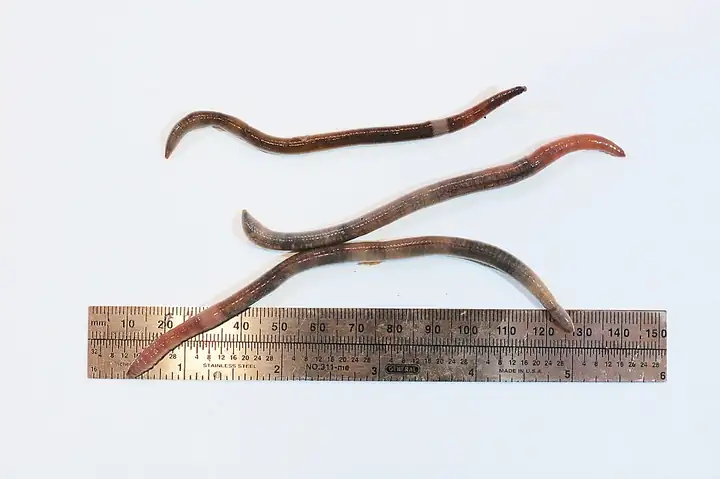
Jumping worms
Amynthas species (including Amynthas agrestis and A. tokioensis), invasive earthworms from East Asia; also called crazy worms, snake worms, Alabama jumpers or Jersey wrigglers
| Type | Worm or other invertebrate |
|---|---|
| When | Young worms from late spring; adults most noticeable from midsummer into fall. |
| Pressure by region | High pressure: Northeast, Midwest |
About
Invasive earthworms from East Asia that thrash wildly, may jump, and can shed their tails when handled. Unlike helpful earthworms, they strip away leaf litter and mulch and leave loose, grainy soil like coffee grounds, where plants grow poorly (Virginia Tech, UMN, Wisconsin).
Spotting it
Damage
The top few inches of soil turn into dry, granular castings that look like coffee grounds, the mulch and leaf layer disappears, and plants grow poorly or die (Virginia Tech, UMN). Tree roots can be left bare, seedlings struggle, garden beds lose productivity, and in woodlands native wildflowers decline while invasive plants gain (Virginia Tech).
How to find it early
Look for coffee-ground soil and bare ground where mulch used to be. Jumping worms are gray, brown or purplish, often with a sheen, firm and not slimy, and they snake and thrash when touched. Their collar (clitellum) is smooth, milky white, flush with the body and goes all the way around, about a third of the way back from the head (Virginia Tech, UMN).
When
Young worms from late spring; adults most noticeable from midsummer into fall.
Life cycle
Each worm lives one season: young hatch from tiny cocoons in late spring, mature by summer, lay cocoons without needing a mate, and die by winter. The cocoons, about 2 to 4 mm across, survive winter in the soil (Virginia Tech, UMN, Wisconsin).
What to do, gentlest first
Start at the top. Sprays are a last step; always read and follow the product label.
Don't bring them home Prevent
Buy heat-treated mulch, compost and soil, check potted and shared plants, and don't move soil out of an infested yard. Before sharing plants, wash the soil off the roots and repot them in clean mix (UMN, Virginia Tech).
Never buy jumping worms for bait or composting, and never release bait worms (Virginia Tech, UMN).
Hot compost Prevent
Compost that reaches 131°F or more and is turned on a schedule is likely to kill worms and cocoons (UMN).
Pick and bag By hand
Hand-pick the worms, seal them in a plastic bag and leave it in the sun for at least 10 minutes, or drown them in soapy water, then put them in the trash (Virginia Tech, UMN).
No pesticide is labeled for earthworms in the US, and products sold as fertilizers to kill worms are neither effective nor legal to use that way (UMN).
Solarize a bed By hand
In early spring, cover moist soil with clear plastic for 2 to 3 weeks, until the soil tops 104°F for at least three days; in a study, cocoons died after three days at that temperature (Virginia Tech, UMN).
Solarizing also kills any plants under the plastic.
Pressure by region
Jumping worms are found throughout the eastern US, though not everywhere within each state (Virginia Tech); they were found in Wisconsin in 2013 and in Minnesota home gardens (Wisconsin, UMN). No source covered the West, Alaska or Hawaii, so those ratings, like the others, are estimates. Minnesota lists them as a prohibited invasive species; report finds through EDDMapS or your state natural resources agency.
| Northeast | High pressure |
|---|---|
| Southeast | Moderate |
| South Central | Low |
| Midwest | High pressure |
| Great Plains | Low |
| Mountain West | Low |
| Southwest | Low |
| Pacific Northwest | Low |
| California | Low |
| Alaska | Low |
| Hawaii | Low |
Ratings come from extension sources where available; some are estimates, as noted above.
Sources
Photo: Photo: Njh5880 / Wikimedia Commons, CC BY-SA 4.0 (CC BY-SA 4.0). Photo resized for the web.

Planting dates and advice are general guidance; check with your local Cooperative Extension office for your area.