
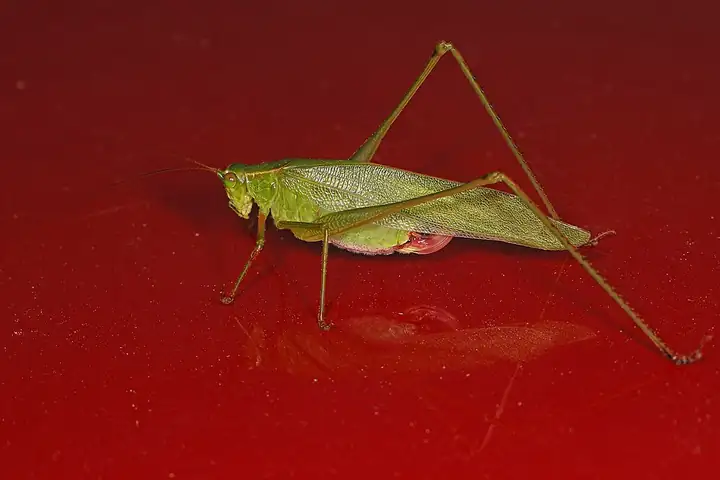
Katydids
Family Tettigoniidae; in fruit, mainly the forktailed bush katydid (Scudderia furcata), plus the angularwinged katydid (Microcentrum retinerve) and broadwinged katydid (Microcentrum rhombifolium)
| Type | Insect |
|---|---|
| When | Nymphs in spring; adults in summer. |
| Pressure by region | Moderate: California |
About
Large, leaf-green relatives of grasshoppers with antennae as long as or longer than their bodies. Most are harmless, but a few take single bites out of young fruit, leaving corky scars (UC IPM).
Spotting it
Damage
They chew holes in a few leaves, which hardly matters, and take one small bite out of many young fruits. The wounds heal into brown, gray or tan, slightly sunken, corky patches that grow with the fruit, and badly bitten young fruit may be misshapen or drop. The inside of the fruit is usually fine (UC IPM).
How to find it early
Katydids feed at night and hide by day, and by the time scars show they are often gone. In spring, look for wingless nymphs with black-and-white banded antennae; adults come to porch lights and are slow and easy to catch on cool mornings. Cutworms and earwigs can leave similar scars (UC IPM).
When
Nymphs in spring; adults in summer.
Life cycle
Katydids spend winter as eggs; forktailed bush katydids tuck theirs into leaf edges. In California those eggs hatch from late March through May and adults appear by midsummer, and most species have one generation a year (UC IPM).
What to do, gentlest first
Start at the top. Sprays are a last step; always read and follow the product label.
Usually just tolerate them Prevent
UC IPM generally recommends no control on home fruit trees and bushes, because the scars rarely hurt eating quality and katydids are seldom plentiful.
Catch and crush By hand
Pick off the few you find; they're easiest to catch on cool mornings (UC IPM).
Egg parasites Natural enemies
Where natural enemies are plentiful, tiny parasites often attack katydid eggs (UC IPM).
Spinosad after petal fall Organic spray
If fruit damage has been unacceptable, spray spinosad after the petals fall, while fruit is small; adding horticultural oil may help it last longer (UC IPM).
Spinosad is toxic to bees and some helpful predators for at least several hours, so never spray plants in bloom (UC IPM). Follow the label and its pre-harvest interval.
Plants it goes after
Apricot, Blueberry, Lemon, Mandarin (satsuma, clementine, tangerine), Orange and blood orange, Peach, Pear, Plum
Pressure by region
The source found, UC IPM, covers California, where at least 74 katydid species live but few are pests. Katydids live across the country, but no source rated fruit damage elsewhere, so the other ratings are estimates.
| Northeast | Low |
|---|---|
| Southeast | Low |
| South Central | Low |
| Midwest | Low |
| Great Plains | Low |
| Mountain West | Low |
| Southwest | Low |
| Pacific Northwest | Low |
| California | Moderate |
| Alaska | Low |
| Hawaii | Low |
Ratings come from extension sources where available; some are estimates, as noted above.
Sources
Photo: Photo: Judy Gallagher / Wikimedia Commons, CC BY 2.0 (CC BY 2.0). Photo resized for the web.

Planting dates and advice are general guidance; check with your local Cooperative Extension office for your area.