
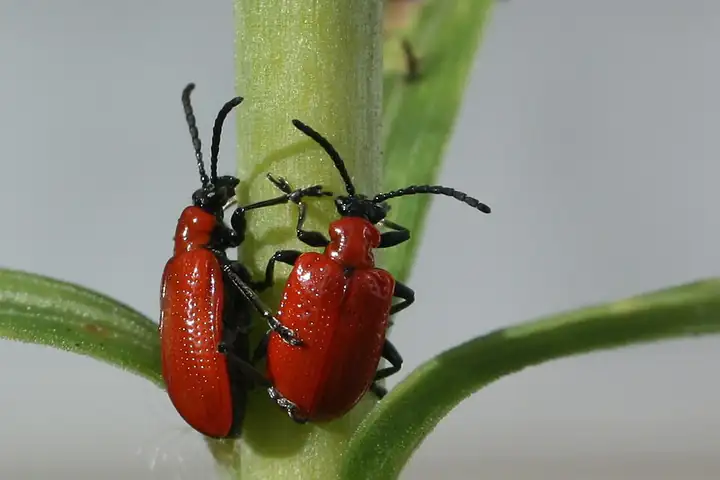
Lily leaf beetle
Lilioceris lilii
| Type | Insect |
|---|---|
| When | Spring through summer; eggs are usually laid in May (UMass). |
| Pressure by region | High pressure: Northeast |
About
A shiny scarlet beetle, about 1/4 to 3/8 inch long, with a black head, legs and antennae. It and its soft, sluglike larvae feed on true lilies and fritillaries; daylilies, cannas and calla lilies are not true lilies and are not at risk (USU).
Spotting it
Damage
Adults and larvae chew holes and notches in leaves, stems and buds and can strip a lily to bare stems. Plants attacked early make undersized bulbs that may not bloom the next year (USU).
How to find it early
Check lilies every few days from spring on for the bright red adults, which drop to the ground and play dead when disturbed. Turn leaves over to find rows of reddish-orange eggs and plump larvae covered in their own dark droppings (UMass, USU).
When
Spring through summer; eggs are usually laid in May (UMass).
Life cycle
There is one generation a year, and adults spend winter in soil or plant debris. In spring each female lays 250 to 450 eggs in rows under the leaves, usually in May, and the eggs hatch in about 4 to 8 days (UMass, USU).
What to do, gentlest first
Start at the top. Sprays are a last step; always read and follow the product label.
Try more tolerant lilies Prevent
USU reports that some Oriental lilies, such as 'Madame Butterfly' and 'Black Beauty', show resistance.
Hand-pick adults, eggs and larvae By hand
Squash eggs and larvae under the leaves and pick off adults. Adults drop and play dead when disturbed, so be ready to catch them. UMass says hand-picking works well when you have only a few plants.
Parasitic wasps Natural enemies
Three tiny wasps that lay their eggs inside lily leaf beetle larvae have been released in New England and New York. They are established and spreading, and URI reports less damage in parts of New England. They are not sold to gardeners (UMass).
Neem or insecticidal soap on young larvae Organic spray
Neem (azadirachtin) and insecticidal soap give some control of young larvae when sprayed every 5 to 7 days after the eggs hatch (USU, UMass).
Neem is toxic to bees mainly if they eat it, and its residue lasts under 2 hours (PNW 591). UMass advises spraying in the evening, when fewer bees are out, and not spraying plants in bloom. Read and follow the label.
Spinosad Organic spray
UMass says spinosad may also work on young larvae.
Spinosad is toxic to bees for 3 hours to a day after spraying (PNW 591), so never spray open flowers or plants where bees are working. Read and follow the label.
Pyrethroid sprays, as a last resort Conventional spray
USU lists contact sprays of permethrin, cyhalothrin or deltamethrin as effective.
These are highly toxic to bees. Residues of permethrin and cyhalothrin can stay toxic for half a day to more than a day; deltamethrin for up to about 4 hours (PNW 591). Spray in the evening and never on open flowers. Some guides also list imidacloprid; it is a neonicotinoid that harms pollinators, so skip it. Read and follow the label.
Plants it goes after
Pressure by region
An invasive beetle first found in the US in Cambridge, Massachusetts, in 1992. It is established across New England and New York and has been detected in 14 states, including Pennsylvania, Wisconsin, Minnesota and Washington, and it is still spreading (URI, USU). USU says it is not known in Utah. Ratings outside the Northeast are estimates. If you find it somewhere new, report it to your state department of agriculture.
| Northeast | High pressure |
|---|---|
| Southeast | Low |
| South Central | Low |
| Midwest | Moderate |
| Great Plains | Low |
| Mountain West | Low |
| Southwest | Low |
| Pacific Northwest | Moderate |
| California | Low |
| Alaska | Low |
| Hawaii | Low |
Ratings come from extension sources where available; some are estimates, as noted above.
Sources
Photo: Photo: Charles J. Sharp, CC BY-SA 3.0, via Wikimedia Commons (CC BY-SA 3.0). Photo resized for the web.

Planting dates and advice are general guidance; check with your local Cooperative Extension office for your area.