
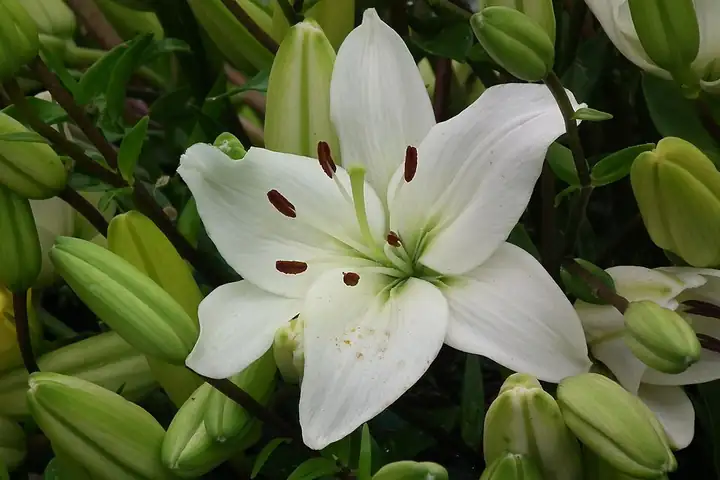
Lily (Lilium)
Lilium species and hybrids (Asiatic, Oriental, trumpet, Orienpet, Easter and others) · Lily family (Liliaceae)
| Hardiness zones | 3 to 8 |
|---|---|
| Sun | full sun to part shade |
| Water | moderate |
| Life cycle | perennial |
| Frost | Hardy: takes frost |
| Spacing | 6 to 10 inches |
About Lily (Lilium)
True lilies are hardy summer bulbs with big trumpet, bowl or Turk's-cap flowers, from Asiatic lilies in June to fragrant Oriental lilies in August. Butterflies, bees and hummingbirds visit them (NC State). WARNING FOR CAT OWNERS: every part of a true lily, even a few grains of pollen licked off fur or water from a vase, can cause deadly kidney failure in cats; daylilies (Hemerocallis, a separate plant) are just as dangerous to cats (FDA, ASPCA).
NC State lists zones 3-8 for lilies (Oriental hybrids 3-9); Asiatic and trumpet types like cool summers, while Easter lilies do well on the hot coast (Clemson). Tiger lily (L. lancifolium) spreads by little bulbils, has naturalized across eastern North America and is hard to contain (NC State).
When to plant
Timing is counted from your average last spring frost (and first fall frost). Sow & Tell works out the actual dates for your ZIP code.
Plant bulbs in early to mid fall or in spring, handling them gently since the scales snap off (Chicago Botanic Garden, Clemson). Cover them with soil about twice as deep as the bulb is wide (a 2-inch bulb under 4 inches of soil), except Madonna lilies, which go in shallow; stake tall kinds.
Soil
Deep, well-drained soil rich in organic matter; wet soil rots the bulbs. Mulch to keep the roots cool while the tops get sun (NC State, Clemson, Chicago Botanic Garden).
Deep, well-drained soil rich in organic matter; mulch to keep roots cool (NC State, Clemson).
Feeding
- Monthly during the growing season: low-nitrogen fertilizer such as 5-10-10. Clemson suggests feeding lilies monthly; follow a soil test and water it in.
Don't cut stems while they are green; wait until they brown, then cut at ground level (Clemson). Overly wet soil rots the bulbs (NC State).
Harvest
Lilies bloom from late May into early September, depending on type (Chicago Botanic Garden). Remove faded flowers so seedpods don't form, but let stems turn brown before cutting them at the ground (Clemson). Because even the vase water can poison cats (FDA), keep cut lilies out of homes with cats.
Varieties (19)
| Variety | Type | Days | Notes |
|---|---|---|---|
| Black Spider | Asiatic hybrid lily | Cream flowers with burgundy spots and black centers; unscented. | |
| King Pete | Asiatic hybrid lily | Yellow with orange spots and darker freckles. | |
| Latvia | Asiatic hybrid lily | Upright yellow flowers with dense violet speckles toward the center. | |
| Monte Negro | Asiatic hybrid lily | Red flowers. | |
| Tinos | Asiatic hybrid lily | Alabaster flowers with red and yellow centers. | |
| Tiny Nugget | Asiatic hybrid lily (dwarf) | Short plant with yellow flowers. | |
| Tiny Rocket | Asiatic hybrid lily (dwarf) | Short plant with red flowers. | |
| Uchida | Lilium speciosum | Sweetly fragrant, spotted flowers; often the last lily to bloom. | |
| Easter lily | Longiflorum lily (Lilium longiflorum) | Fragrant white trumpets on 1-3 foot plants; blooms late summer in the garden after its forced spring bloom. | |
| Claude Shride | Martagon hybrid lily | Small Turk's-cap flowers on 3-4 foot stems; adapted to shade. | |
| Conca d'Or | Orienpet (Oriental x trumpet) hybrid lily | Cream flowers with lemon-yellow centers and an elegant fragrance. | |
| Black Beauty | Orienpet hybrid lily | Recurved raspberry-red flowers. | |
| Casa Blanca | Oriental hybrid lily | Large white, fragrant flowers with dark orange anthers; 3-4 feet. | |
| Stargazer | Oriental hybrid lily | Fragrant pinkish-red, upward-facing flowers. | |
| Sumatra | Oriental hybrid lily | Burgundy flowers edged white, slightly recurved. | |
| Tom Pounce | Oriental hybrid lily | Soft lavender flowers with yellow ribs. | |
| Starlight Express | Oriental hybrid lily (compact) | Fuchsia flowers edged white on 1-2 foot plants. | |
| Tiger lily | Species (Lilium lancifolium) | Bright orange, dark-spotted flowers on 2-6 foot stems; spreads by bulbils in the leaf axils. | |
| Regal lily | Trumpet lily (Lilium regale) | Fragrant white trumpets with golden centers on stems up to 6 feet. |
Pests to watch for
Aphids, Slugs, Brown garden snail, Deer, Lily leaf beetle, Narcissus bulb fly
Diseases and problems
Gray mold (Botrytis), Mosaic viruses, Bulb rot
In the kitchen
Keeping it: Change the water every couple of days and keep the vase cool and away from fruit; pull off each flower as it fades.
Safety: The pollen stains skin and clothes (NC State). The big danger is to cats (see pets).
Pets: Deadly to cats: the ASPCA lists true lilies as toxic to cats (kidney failure). Every part, even pollen or vase water, can poison a cat, and kidney damage is usually permanent if treatment is delayed 18 hours or more (FDA). Get a cat to a vet right away after any contact. The ASPCA lists lilies as non-toxic to dogs and horses; dogs may get a mild stomach upset (FDA).
Sources
- plants.ces.ncsu.edu
- plants.ces.ncsu.edu
- plants.ces.ncsu.edu
- plants.ces.ncsu.edu
- plants.ces.ncsu.edu
- hgic.clemson.edu
- chicagobotanic.org
- umass.edu
- aspca.org
- fda.gov
Photo: Photo: Rameshng, CC BY-SA 3.0, via Wikimedia Commons (CC BY-SA 3.0). Photo resized for the web.

Planting dates and advice are general guidance; check with your local Cooperative Extension office for your area.