
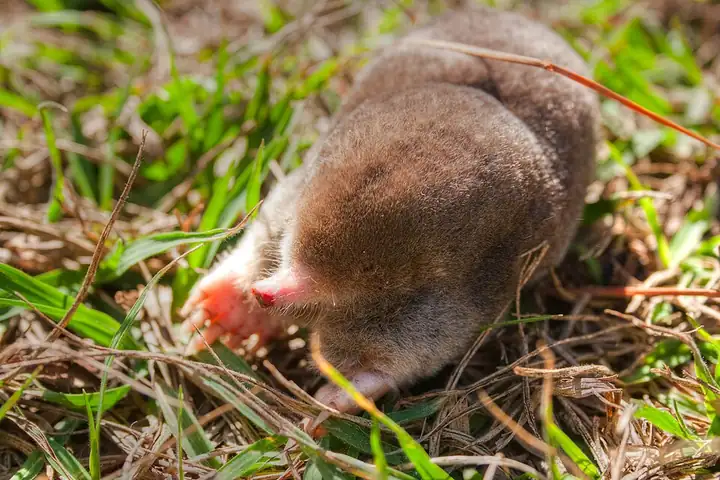
Moles
Eastern mole (Scalopus aquaticus), plus hairy-tailed and star-nosed moles in the East; western moles (Scapanus species) in California and the Pacific Northwest, such as the Townsend mole and coast mole
| Type | Animal |
|---|---|
| Pressure by region | Moderate: Northeast, Southeast, South Central, Midwest, Pacific Northwest, California |
About
Moles are not rodents. They are insect-eaters about 6 to 8 inches long, with velvety gray fur, tiny hidden eyes and big paddle-like front feet. They eat earthworms, grubs and other soil animals, not plants, but their tunneling heaves up lawns and beds and can dislodge plants and dry out their roots.
Spotting it
Damage
Moles push up raised ridges just under the surface and round, volcano-shaped mounds with no open hole; pocket gopher mounds are crescent-shaped. Chewed roots and bulbs are almost always the work of voles or other rodents, not moles: voles have mouse-like feet, visible eyes and gnawing teeth, eat plants, and leave open surface runways about 2 inches wide.
How to find it early
Press down a few ridges with your foot and check the next day; ridges pushed back up are active tunnels. Main tunnels run about 8 to 12 inches deep, and new mounds show up most after rain or watering.
When
Year-round; busiest after rain or watering, and slow in extreme cold, heat or drought.
Life cycle
Moles mate in late winter or early spring and have one litter a year of 3 to 5 young, which leave home in the month after they are weaned. They live alone, are active all year, and dig most after rain or watering.
What to do, gentlest first
Start at the top. Sprays are a last step; always read and follow the product label.
Live with them if you can Prevent
Mole tunnels mix the soil and improve air flow and drainage, and moles eat many soil insects. Where damage is light, simply rake out mounds and press ridges back down.
Do not count on grub control Prevent
Killing lawn grubs will not get rid of moles, because they also eat earthworms and other soil animals; earthworms make up 70 to 90 percent of the Townsend mole's diet, and moles are often found in grub-free lawns.
Buried mesh barrier Barrier
To keep moles out of a small bed, bury 1/4-inch hardware cloth in a trench at least 2 feet deep with a 6-inch lip bent outward at the bottom, and leave about 6 inches above ground (UC IPM). North Carolina State suggests at least 12 inches deep with a 10-inch outward bend.
Mole traps, where legal Trap
Trapping is the most reliable way to remove a mole. Set traps in active main tunnels, at least 18 inches from a mound. Rules vary: North Carolina requires a depredation permit before trapping eastern and hairy-tailed moles, Washington's Initiative 713 made the usual body-gripping mole traps illegal there, Pennsylvania protects moles but lets landowners control them when they cause damage, and California classes them as nongame mammals.
Keep children and pets away from set traps. This guide does not recommend poison baits, which put pets, children and other wildlife at risk. Trapping and relocating wildlife is regulated by state law, and the rules differ from state to state. Check with your state wildlife agency or your county Extension office before you set a trap.
Castor oil and gadgets are unreliable Repellent
UC IPM says home remedies such as mothballs, vibrating devices and the gopher-mole plant have not worked, and repellents such as castor oil at best push moles next door. UConn found castor oil only slightly effective, and Penn State calls marigold borders doubtful.
Use only products labeled for the site, follow the label, and keep children and pets off treated areas until dry.
Predators will not solve it Natural enemies
Cats and dogs sometimes catch moles, but UC IPM says this does little to control them.
Pressure by region
The eastern mole is the widespread species in the East and Midwest; Washington has three mole species, and California's moles live in the Sierra Nevada, the coast ranges and the whole coastal zone (UC IPM). Colorado State says moles are rare in Colorado and found only on the eastern plains. No regional severity source was found, so all ratings are estimates, including Alaska and Hawaii, where no source reports moles.
| Northeast | Moderate |
|---|---|
| Southeast | Moderate |
| South Central | Moderate |
| Midwest | Moderate |
| Great Plains | Low |
| Mountain West | Low |
| Southwest | Low |
| Pacific Northwest | Moderate |
| California | Moderate |
| Alaska | Low |
| Hawaii | Low |
Ratings come from extension sources where available; some are estimates, as noted above.
Sources
- extension.psu.edu
- extension.psu.edu
- extension.purdue.edu
- extension.entm.purdue.edu
- ipm.ucanr.edu
- naturalresources.extension.iastate.edu
- extension.umd.edu
- wdfw.wa.gov
- content.ces.ncsu.edu
- homegarden.cahnr.uconn.edu
- boulder.extension.colostate.edu
Photo: Photo: Bert Cash, CC BY 2.0, via Wikimedia Commons (CC BY 2.0). Photo resized for the web.

Planting dates and advice are general guidance; check with your local Cooperative Extension office for your area.