
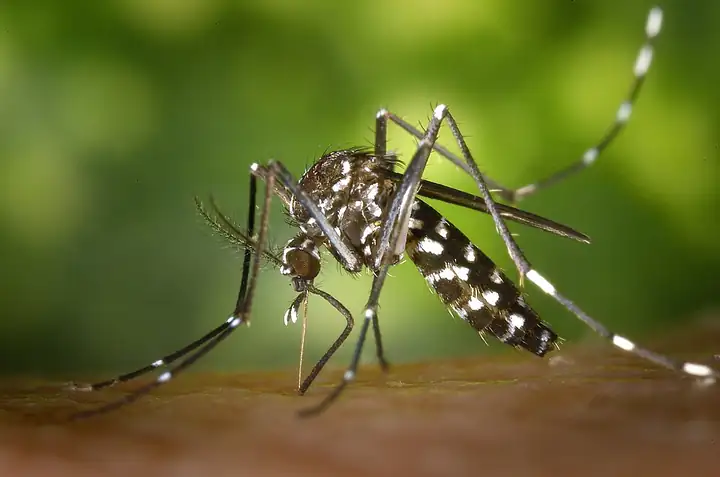
Mosquitoes (yard and container mosquitoes)
Many species; around homes mostly house mosquitoes (Culex species) and Aedes species, including the invasive yellow fever mosquito (Aedes aegypti) and Asian tiger mosquito (Aedes albopictus)
| Type | Insect |
|---|---|
| Pressure by region | High pressure: Southeast, South Central |
About
Small, long-legged flies whose females bite people and animals for the blood they need to make eggs. They don't hurt plants, but they breed in any still water a yard collects, from plant saucers and buckets to rain barrels and clogged gutters, and some spread West Nile virus and other diseases (UC IPM).
Spotting it
Damage
No harm to plants. The trouble is itchy bites and the diseases some species carry: West Nile virus (mostly Culex), and Zika, dengue and chikungunya (Aedes). Mosquitoes also spread heartworm to dogs (UC IPM).
How to find it early
Once a week, look into anything that holds water: saucers, buckets, toys, tires, birdbaths, pet dishes, rain barrels, gutters, tree holes and the cups of bromeliads. Small black or brown "wigglers" hanging at the surface are larvae, and even a bottle cap of water can raise Aedes (UC IPM, UF/IFAS).
When
Warm months, peaking in warm, wet weather; the season runs longer where winters are mild.
Life cycle
Eggs laid on water hatch within a couple of days into wriggling larvae that breathe at the surface, then turn into comma-shaped pupae; in summer the whole cycle can take a week or less. Aedes eggs stuck to a container above the waterline can wait months or longer and hatch when water rises (UC IPM).
What to do, gentlest first
Start at the top. Sprays are a last step; always read and follow the product label.
Dump standing water every week Prevent
Once a week, empty, scrub, turn over or throw out anything that holds water, such as buckets, plant saucers, toys, tires and trash cans. Change birdbath water at least weekly (UF suggests every 2 or 3 days) and pet water daily, clean gutters, fill tree holes, and don't overwater (CDC, UC IPM, UF/IFAS).
Cover rain barrels and fix screens Barrier
Put tight lids on rain barrels, cisterns and buckets, or cover openings with wire mesh fine enough to keep mosquitoes out. Keep window and door screens in good repair (CDC, UC IPM).
Protect yourself while you garden Repellent
Many mosquitoes bite most at dawn and dusk. Wear long sleeves, long pants and socks, and use an EPA-registered repellent such as DEET, picaridin, IR3535 or oil of lemon eucalyptus. Permethrin is for treating clothing only, never skin (UC IPM).
Follow the label. Oil of lemon eucalyptus (and its synthetic form, PMD) is not for children under 3. UC IPM says wristbands, ultrasonic devices and vitamin B1 don't work, and bug zappers kill insects that prey on mosquitoes.
Bti for water you can't dump Natural enemies
For ponds, water gardens, rain barrels and bromeliad cups, use dunks or granules made with Bacillus thuringiensis israelensis (Bti). It kills the larvae of mosquitoes, black flies and fungus gnats, and dunks last about 30 days (UC IPM, EPA). EPA found no risk to people and minimal toxicity to honey bees.
Buy a product labeled for the israelensis strain; the Bt sold for caterpillars won't work (UF/IFAS). Bti kills larvae, not pupae. Only some products are allowed in drinking-water cisterns, so follow the label (EPA).
Mosquitofish and moving water Natural enemies
In a small pond without other fish, mosquitofish (Gambusia) eat larvae; UF says one female can eat up to 200 a day. A pump, fountain or bubbler that keeps water moving also helps (UF/IFAS, Penn State).
Get mosquitofish from your local mosquito control district. Never put them in streams, lakes or natural ponds: they aren't native, and in California releasing them is illegal (UC IPM).
Larvicides first; adult sprays last Conventional spray
Methoprene, an insect growth regulator, keeps larvae in standing water from becoming adults (UC IPM). Sprays and foggers for adult mosquitoes give only short relief, so steady larval control works better (UC IPM).
Broad-spectrum sprays for adult mosquitoes also kill bees, butterflies and other helpful insects (Penn State). If you must use one, spray in the evening or at night when pollinators are less active, keep it off flowers, and follow the label.
Pressure by region
Mosquitoes live in every region, but no source rated them region by region, so all ratings are estimates. Invasive Aedes aegypti and Aedes albopictus, which bite by day and breed in tiny containers, turned up in California in the early 2010s and have spread through Southern California, the Central Valley and the Bay Area (UC IPM). Your county or regional mosquito and vector control agency can help.
| Northeast | Moderate |
|---|---|
| Southeast | High pressure |
| South Central | High pressure |
| Midwest | Moderate |
| Great Plains | Moderate |
| Mountain West | Moderate |
| Southwest | Moderate |
| Pacific Northwest | Moderate |
| California | Moderate |
| Alaska | Moderate |
| Hawaii | Moderate |
Ratings come from extension sources where available; some are estimates, as noted above.
Sources
Photo: Photo: James Gathany, CDC / Wikimedia Commons, Public domain. Photo resized for the web.

Planting dates and advice are general guidance; check with your local Cooperative Extension office for your area.