
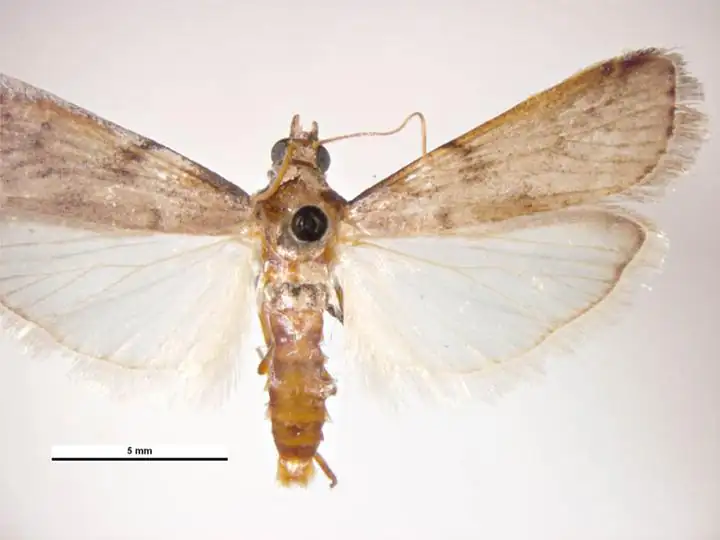
About
A caterpillar that feeds inside almonds and other nuts. It spends the winter in old nuts left on the tree or the ground, so cleanup and an early harvest are the main home controls (UC).
Spotting it
Damage
Worms feed on the kernels inside the nut, and infested nuts can carry live worms into storage (UC).
How to find it early
In winter, look for old nuts still hanging in the tree or lying under it; these shelter the overwintering worms (UC Home Orchard).
When
Damage builds as the nuts ripen and the hulls split, so the longer nuts stay out, the more worm damage (UC IPM).
Life cycle
It overwinters in old nuts (mummies) that stay on the tree or lie on the ground (UC Home Orchard).
What to do, gentlest first
Start at the top. Sprays are a last step; always read and follow the product label.
Winter cleanup Prevent
Knock down, rake up and destroy old nuts left on the tree and the ground before spring (UC Home Orchard).
Harvest early Prevent
Start knocking nuts down as soon as the hulls begin to split, and pick them up from the ground promptly (UC IPM).
Freeze the harvest By hand
Freeze hulled nuts for at least 48 hours (UC IPM), or in-shell nuts for 1 to 2 weeks (UC Home Orchard), to kill worms and eggs, then store them sealed in plastic bags or jars so they aren't reinfested.
Plants it goes after
Pressure by region
Our sources cover only California almonds; the California rating and all other regional ratings are estimates.
| Northeast | Low |
|---|---|
| Southeast | Low |
| South Central | Low |
| Midwest | Low |
| Great Plains | Low |
| Mountain West | Low |
| Southwest | Low |
| Pacific Northwest | Low |
| California | High pressure |
| Alaska | Low |
| Hawaii | Low |
Ratings come from extension sources where available; some are estimates, as noted above.
Sources
Photo: Photo: Simon Hinkley & Ken Walker, Museums Victoria / Wikimedia Commons, CC BY 3.0 AU (CC BY 3.0 AU). Photo resized for the web.

Planting dates and advice are general guidance; check with your local Cooperative Extension office for your area.