
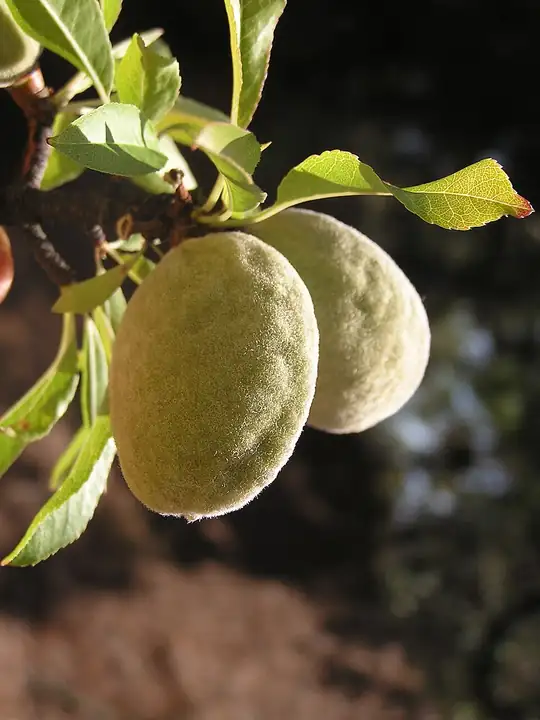
Almond
Prunus dulcis · Rose family (Rosaceae)
| Hardiness zones | 6 to 7 |
|---|---|
| Sun | full sun |
| Water | moderate |
| Life cycle | perennial |
| Frost | Hardy: takes frost |
| Spacing | 240 inches |
About Almond
Almond is a peach relative grown for its sweet nut; nearly all U.S. almonds come from California's Central Valley and drier southern coast. It blooms in February, earlier than any other stone fruit, so frost and poor bee weather at bloom are the main reasons home trees fail outside the warmest dry-summer areas.
No Extension source we opened gives a nationwide zone range: Utah State's Utah-only TreeBrowser rates it zones 6(?)-7, and a few peach-almond hybrids are rated to zone 5 but have poor nuts (Utah State). Most U.S. almonds grow in warmer California, in the Central Valley and drier southern coast (UC). Frost at bloom is the real limit: buds die below -10 F, and frost below 28 F at or after bloom kills the flowers, which is why Rutgers calls almond borderline in New Jersey and Arizona advises growing it only where bloom is frost-free.
When to plant
Timing is counted from your average last spring frost (and first fall frost). Sow & Tell works out the actual dates for your ZIP code.
Plant bare-root trees in early spring (Utah State) or in January to early February in coastal California (UC Master Gardeners); keep the graft 2 to 3 inches above the soil. Give each mature tree about 20 by 20 feet. Expect nuts 4 to 6 years after planting (Utah State).
Soil
Must drain well; almonds don't tolerate wet or salty soil (UC; Utah State; University of Arizona).
Control perennial weeds and work compost or other organic matter into the top 8 inches of well-drained soil.
Feeding
- Young trees: small, frequent feedings through the growing season: nitrogen fertilizer such as 21-0-0 (ammonium sulfate). Give about 1 ounce of actual nitrogen per year of tree age each year (a 3-year-old tree gets about 14 ounces of 21-0-0), spread evenly under the drip line and watered in; never more than 1/2 lb of actual nitrogen a year.
- Mature trees: spring, just before the first irrigation: nitrogen fertilizer such as urea (46-0-0) or manure. UC suggests about 2 lb of urea or 30 lb of manure per mature tree, watered in.
- Mature trees: before the last irrigation before harvest: nitrogen fertilizer such as urea (46-0-0) or manure. Repeat the spring amount and water it in.
Too much nitrogen, heavy pruning and soggy soil all cut the crop; aim for 6 to 12 inches of new growth a year on bearing trees.
Harvest
Nuts take about 180 to 240 days to mature; harvest when the hulls split and the shells inside are dry and brown, by shaking or knocking them down, then remove the hulls (UC; University of Arizona).
One crop a year, from late August (Nonpareil) to October (Mission) in California; harvest as soon as the hulls split to beat worms and rain.
Varieties (10)
UC and other Extension sources document 10 varieties for home planting.
| Variety | Type | Days | Notes |
|---|---|---|---|
| Hall's Hardy | Peach-almond hybrid | Kernel is bitter; not grown for eating quality. Very winter hardy, with a hard shell and showy spring flowers; bears heavily. | |
| All-in-One | Sweet kernel. Paper-shelled; somewhat dwarfing. | ||
| Butte | Late-blooming variety recommended for warm home-orchard sites in California. | ||
| Carmel | Recommended for home orchards in several California counties. | ||
| Garden Prince | Listed for Contra Costa County home orchards. | ||
| Mission | Strong flavor; not suited to blanching. Also sold as 'Texas'. Hard, well-sealed shell; small, round nut on a large, upright, vigorous tree. | ||
| Ne Plus Ultra | Older California variety; plump, long kernels, often two per nut. Blooms between Nonpareil and Mission. | ||
| Nonpareil | Excellent flavor; flat, medium-large kernel. The leading California variety; paper-thin shell that often isn't fully sealed; large tree. Blooms about the third week of February in the Central Valley. | ||
| Price | Recommended for Santa Clara County home orchards. | ||
| Thompson | Medium-size tree; small nut with a soft, paper-thin shell. |
Pests to watch for
Navel orangeworm, Twospotted spider mite, European red mite, Peachtree borer, Scale insects, Deer
Diseases and problems
Bacterial canker, Shot hole (Coryneum blight), Cytospora canker (stone fruit), Root and crown rot
In the kitchen
Eaten raw or roasted as a snack; blanched (skinned) almonds are used in baking, and ground almonds go into cookies (University of Illinois Extension).
Keeping it: Keep dry almonds in airtight containers in a dry place; in the shell they keep about 6 months somewhere cool and airy, and shelled almonds keep for a very long time in the freezer (Utah State; University of Arizona).
Safety: Grow only sweet almonds: bitter almonds contain amygdalin, which releases small amounts of hydrogen cyanide when chewed or crushed (Utah State). Almonds are tree nuts, one of the major food allergens named by the FDA; anyone with a tree-nut allergy should avoid them.
Pets: No ASPCA plant entry for almond was found. The ASPCA warns that nuts, almonds included, are high in fats that can cause vomiting, diarrhea and possibly pancreatitis in pets.
Sources
- homeorchard.ucanr.edu
- extension.usu.edu
- extension.usu.edu
- ccfruitandnuts.ucanr.edu
- class.ucanr.edu
- ucanr.edu
- extension.arizona.edu
- ipm.ucanr.edu
- extension.illinois.edu
- fda.gov
- aspca.org
- njaes.rutgers.edu
Photo: Photo: Andrey Butko / Wikimedia Commons, CC BY-SA 3.0 (CC BY-SA 3.0). Photo resized for the web.

Planting dates and advice are general guidance; check with your local Cooperative Extension office for your area.