
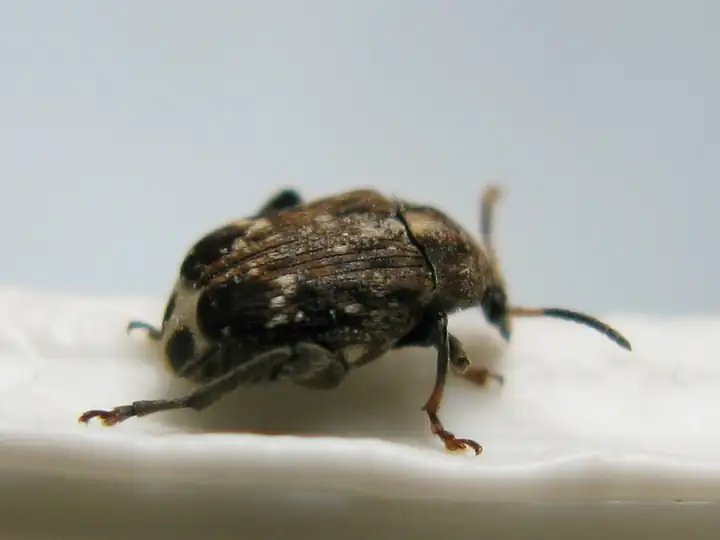
Pea weevil
Bruchus pisorum
| Type | Insect |
|---|---|
| When | Pea bloom through pod fill. |
| Pressure by region | High pressure: Pacific Northwest |
About
A squat, fifth-of-an-inch beetle, brown flecked with white, black and gray. Despite the name it is a seed beetle, not a true weevil, and it attacks only peas.
Spotting it
Damage
Each larva bores into a single developing pea and hollows it out, so damage stays hidden until you shell the pods or find a round exit hole in dried seed.
How to find it early
From flowering on, look for small yellow eggs stuck on the outside of green pods, and sweep the vines with a net at bloom to find adults.
When
Pea bloom through pod fill.
Life cycle
Adults overwinter in stored peas, buildings, bark or debris and fly to peas at bloom to lay eggs on the pods. There is one generation a year, and infested saved seed carries the next one into spring.
What to do, gentlest first
Start at the top. Sprays are a last step; always read and follow the product label.
Clean up after harvest Prevent
Remove or till under pea debris and volunteer plants right after harvest, and plant and harvest early varieties.
Use clean seed Prevent
Do not plant weevil-infested seed. Freeze peas you save for seed for a few days before storing them.
Sweep net at bloom By hand
Run a sweep net through the vines at first bloom to check for adults.
Pyrethrins Organic spray
Organic pyrethrin products are labeled for home use against pea weevil; apply soon after first bloom, before pods form.
Highly toxic to bees while wet; spray in the evening when they are not foraging, and follow the label and pre-harvest interval.
Pyrethroids or carbaryl at first bloom Conventional spray
Bifenthrin, esfenvalerate or carbaryl, applied soon after first bloom and before pods form.
Highly toxic to bees (PNW 591); spray in the evening when bees are not foraging. Carbaryl has been a restricted-use material in California since August 1, 2020 (UC IPM), so home gardeners there cannot buy it. Follow the label and pre-harvest interval.
Plants it goes after
Pressure by region
Found nearly worldwide wherever peas grow, but its greatest importance has been in the Pacific Northwest, including the Palouse of Idaho and Washington. Other regions are rated low for lack of a source, so those ratings are estimates.
| Northeast | Low |
|---|---|
| Southeast | Low |
| South Central | Low |
| Midwest | Low |
| Great Plains | Low |
| Mountain West | Moderate |
| Southwest | Low |
| Pacific Northwest | High pressure |
| California | Low |
| Alaska | Low |
| Hawaii | Low |
Ratings come from extension sources where available; some are estimates, as noted above.
Sources
Photo: Photo: Malte, CC BY-SA 3.0, via Wikimedia Commons (CC BY-SA 3.0). Photo resized for the web.

Planting dates and advice are general guidance; check with your local Cooperative Extension office for your area.