
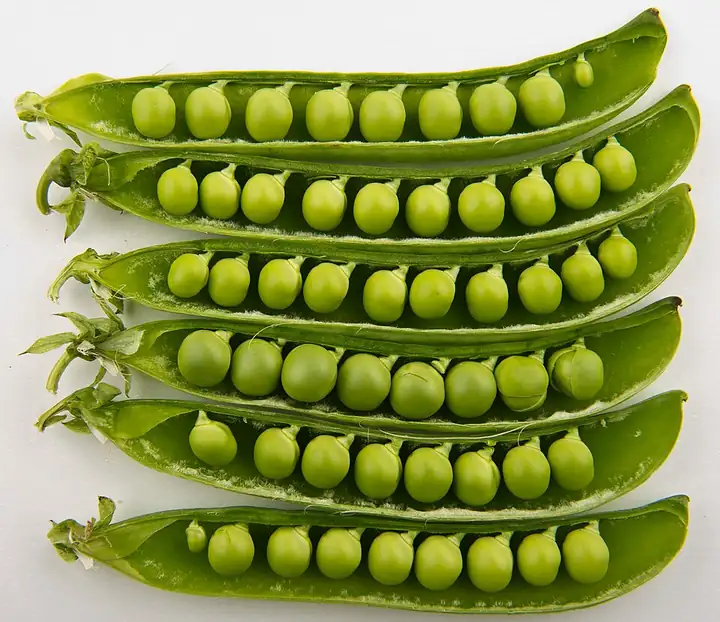
Peas
Pisum sativum · Pea family (Fabaceae)
| Hardiness zones | 2 to 11 |
|---|---|
| Sun | full sun |
| Water | moderate |
| Life cycle | annual |
| Frost | Hardy: takes frost |
| Soil pH | 6.0–7.5 |
| Spacing | 1 to 2 inches |
| Days to harvest | 60 to 70 days |
| Soil temperature to plant | at least 40°F |
About Peas
Garden peas include shelling peas, flat snow peas and crunchy sugar snaps. They are one of the first seeds sown in spring and stop producing once temperatures climb above about 85F.
Grown as a cool-season annual in every zone; time it for the cool weather of spring or fall.
When to plant
Timing is counted from your average last spring frost (and first fall frost). Sow & Tell works out the actual dates for your ZIP code.
- Sow seeds outdoors: 2 to 4 weeks before the last frost
- Fall planting: 9 to 10 weeks before the first fall frost
Days count from seeding. Sow as soon as the soil has thawed and can be worked; tall vining types need a trellis about 5 feet high, bush types grow 2 to 3 feet.
Soil
Any well-drained soil, sandy to clay, with some organic matter; go light on added compost and nitrogen.
Follow a soil test and keep pH about 6.0 to 7.0; work in compost, and without a test add about 3 lb of 5-10-10 per 100 sq ft into the top 6 inches.
Feeding
Peas need no more fertilizer if fertilizer or compost went in at planting; extra nitrogen gives leaves, delays flowering and cuts pod set.
Harvest
Snow peas: pods full length with only tiny peas inside. Snap peas: pods nearly filled but still crisp, about 5 to 8 days after flowering. Shelling peas: peas plump and sweet, about 18 to 21 days after flowering. Pick every 1 to 3 days.
Pick regularly and plants keep flowering and filling pods for about 3 to 4 weeks, until temperatures above about 85F stop flowering. Check daily, since peas lose quality within 1 to 3 days of maturity; sow a week or two apart for a longer season.
Varieties (39)
| Variety | Type | Days | Notes |
|---|---|---|---|
| Bolero | Shelling (English) | 69 days | High-yielding open-pollinated pea with pods often borne in twos and threes. Resists fusarium wilt. |
| Burpeeana Early | Shelling (English) | Tender, sweet peas. Dwarf vines bear small pods well filled with 8 to 10 dark green peas. | |
| Early Frosty | Shelling (English) | 64 days | Medium vines with blunt, dark green pods about 3.5 inches long, often in pairs. Good for freezing and resists fusarium wilt. |
| Eclipse | Shelling (English) | Late pea on short, upright plants. Described as starchless. | |
| Green Arrow | Shelling (English) | 65 to 68 days | A popular shelling pea. Resists powdery mildew and fusarium wilt. |
| Knight | Shelling (English) | 60 days | A shelling pea recommended in Texas, Oklahoma and Kansas. |
| Lincoln | Shelling (English) | 67 days | A shelling pea recommended by Utah State and UGA. |
| Little Marvel | Shelling (English) | 63 days | A shelling pea recommended in Texas, Oklahoma, Kansas, Wisconsin and Georgia. |
| Maestro | Shelling (English) | 60 days | A shelling pea that resists powdery mildew. |
| Maxigolt | Shelling (English) | Shelling pea recommended for Wisconsin home gardens. | |
| Mr. Big (Mister Big) | Shelling (English) | 58 days | About 28-inch vines with long, pointed pods holding 8 to 10 peas. Resists powdery mildew and fusarium wilt. |
| Oregon Trail | Shelling (English) | 69 days | Released by Oregon State University in 1991. Resists pea enation mosaic virus, powdery mildew and fusarium wilt. |
| Patriot | Shelling (English) | 58 days | An early shelling pea on Utah State's recommended list. |
| Spring | Shelling (English) | Early pea with dark green peas that freeze well. Resists fusarium wilt. | |
| Wando | Shelling (English) | 68 days | Released in 1943; handles both cold and heat better than most peas and is good for freezing. |
| Novella | Shelling (English), semi-leafless | 64 days | Semi-leafless plants that have tendrils but no leaflets. |
| Alaska | Shelling (English), smooth seed | 52 days | Early, smooth-seeded pea with good yields, long used for canning. |
| Royal Snap | Snap (edible pod) | Edible-pod pea recommended for Georgia gardens. | |
| Sugar Mel | Snap (edible pod) | 65 days | Short vines with medium-size pods that have strings. Resists powdery mildew. |
| Super Snappy | Snap (edible pod) | Medium-height vines with very large pods that have strings. Resists powdery mildew. | |
| Cascadia | Snap (edible pod), dwarf | 58 days | Tender and sweet pods. Released by Oregon State University in 1992. Short plants with very thick-walled, succulent pods. Resists pea enation mosaic virus, powdery mildew and fusarium wilt. |
| Sugar Ann | Snap (edible pod), dwarf | 55 to 60 days | Short vines with small pods that ripen early; pods have strings. Resists fusarium wilt and powdery mildew. |
| Sugar Bon | Snap (edible pod), dwarf | 55 days | Short vines with small, early pods that have strings. Resists powdery mildew and fusarium wilt. |
| Sugar Daddy | Snap (edible pod), stringless | 72 to 75 days | Medium vines with stringless, medium pods. Resists powdery mildew. |
| Sugar Pop | Snap (edible pod), stringless | Short vines with small, stringless pods. Resists powdery mildew and bean leafroll virus but does not tolerate heat. | |
| Sugar Sprint | Snap (edible pod), stringless | Short vines with medium, stringless pods in early to midseason. Resists powdery mildew. | |
| Snappy | Snap (edible pod), tall vine | 63 days | Tall vines with large pods holding 8 to 9 peas. Pods have strings. Resists powdery mildew. |
| Sugar Magnolia | Snap (edible pod), tall vine | 70 days | Vining snap pea recommended for Central Texas and trialed in North Dakota. |
| Sugar Snap | Snap (edible pod), tall vine | 70 to 72 days | Tall vines that need a trellis. Pods are eaten whole or shelled; pods have strings. Resists fusarium wilt; an All-America Selections winner. |
| Super Sugar Snap | Snap (edible pod), tall vine | 64 days | Round, straight pods on vines about 5 feet tall that need a trellis. Like Sugar Snap but resists powdery mildew. |
| Avalanche | Snow (flat edible pod) | Snow pea recommended after North Dakota home garden trials. | |
| Dwarf Grey Sugar | Snow (flat edible pod) | 60 days | A snow pea recommended in Texas, Kansas and Wisconsin. |
| Mammoth Melting Sugar | Snow (flat edible pod) | 70 days | A snow pea recommended in Texas, Kansas and Wisconsin. |
| Norli | Snow (flat edible pod) | Snow pea recommended for Oklahoma home gardens. | |
| Oregon Giant | Snow (flat edible pod) | 69 days | Released by Oregon State University in 1991. Large edible pods; resists pea enation mosaic virus, powdery mildew and fusarium wilt. |
| Oregon Sugar Pod II | Snow (flat edible pod) | 68 days | Released by Oregon State University in 1985. Resists pea enation mosaic virus, powdery mildew and fusarium wilt. |
| Snow Green | Snow (flat edible pod) | Snow pea recommended for Kansas and Wisconsin gardens. | |
| Sweet Horizon | Snow (flat edible pod) | Snow pea recommended after North Dakota home garden trials. | |
| Snow Bird | Snow (flat edible pod), dwarf | Very early dwarf snow pea that often sets pods in pairs; pods about 3 inches long. |
Good neighbors
UMD Extension mentions peas as a windbreak for young tomatoes; this is a practical pairing, not proven pest control.
Pests to watch for
Aphids, Pea weevil, Cutworms, Leafminers, Stink bugs, Mice (house mice and deer mice), Beet armyworm, Seedcorn maggot, Deer, Groundhog (woodchuck)
Diseases and problems
Powdery mildew, Fusarium wilt, Root rot, Pea enation mosaic, White mold, Herbicide injury, Sooty mold, Watermelon mosaic, Lettuce mosaic
In the kitchen
Snow and snap peas are eaten pod and all, raw or stir-fried; shelling peas are cooked or frozen.
Keeping it: Garden peas lose sweetness within hours, so refrigerate them in the pod and eat them within 1 to 2 days. Snap and snow peas keep about a week or more in a plastic bag in the fridge.
Pets: Not listed as toxic by the ASPCA; its garden-safety tips name peas as fine snacks for pets in moderation.
Sources
- extension.umn.edu
- extension.usu.edu
- extension.unh.edu
- monroe.cce.cornell.edu
- extension.colostate.edu
- warren.cce.cornell.edu
- extension.umd.edu
- aspca.org
- hgic.clemson.edu
Photo: Photo: Bill Ebbesen, CC BY-SA 3.0, via Wikimedia Commons (CC BY-SA 3.0). Photo resized for the web.

Planting dates and advice are general guidance; check with your local Cooperative Extension office for your area.