
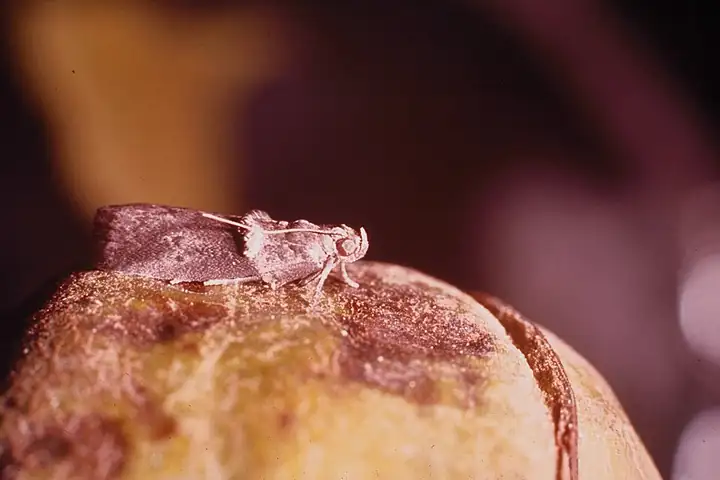
Pecan nut casebearer
Acrobasis nuxvorella
| Type | Insect |
|---|---|
| Pressure by region | High pressure: Southeast, South Central |
About
A small gray moth whose caterpillars bore into tiny pecan nutlets in spring. Texas A&M calls it the most damaging pecan pest; it occurs in pecan areas from Florida to southern New Mexico (Oklahoma State).
Spotting it
Damage
Caterpillars tunnel into young nutlets, and one caterpillar often destroys every nut in a cluster; look for silk and black droppings on the nuts (Texas A&M).
How to find it early
Right after pollination, check about 10 nut clusters per tree for tiny white eggs that turn pink or red, entry holes, silk and dark droppings (Texas A&M; Oklahoma State).
When
Spring, just after pecan bloom: April in South Texas to early June farther north; later generations in summer.
Life cycle
Young caterpillars spend the winter in tiny silk cases near buds, then moths lay eggs on the nutlets just after pollination. There are 2 to 3 generations a year, and the first (spring) one does the most harm (Oklahoma State; Texas A&M).
What to do, gentlest first
Start at the top. Sprays are a last step; always read and follow the product label.
Protect natural enemies Prevent
Tiny parasitic wasps and flies attack the caterpillars, so avoid broad-spectrum sprays that kill them (Oklahoma State).
Bacillus thuringiensis (Bt) Natural enemies
Spray Bt right as eggs hatch, before caterpillars bore into the nuts; rain and sun break it down fast, so timing is everything (Oklahoma State).
Follow the label.
Spinosad Organic spray
Spray at first egg hatch; once caterpillars are inside the nuts, sprays can't reach them (Texas A&M).
Big trees are hard to cover from the ground. Follow the label.
Plants it goes after
Pressure by region
Oklahoma State gives its range as pecan country from Florida to southern New Mexico; the regional ratings are estimates based on that range and on where pecans grow.
| Northeast | Not found here |
|---|---|
| Southeast | High pressure |
| South Central | High pressure |
| Midwest | Low |
| Great Plains | Moderate |
| Mountain West | Not found here |
| Southwest | Moderate |
| Pacific Northwest | Not found here |
| California | Not found here |
| Alaska | Not found here |
| Hawaii | Not found here |
Ratings come from extension sources where available; some are estimates, as noted above.
Sources
Photo: Photo: Louis Tedders, USDA ARS / Wikimedia Commons, Public domain. Photo resized for the web.

Planting dates and advice are general guidance; check with your local Cooperative Extension office for your area.