
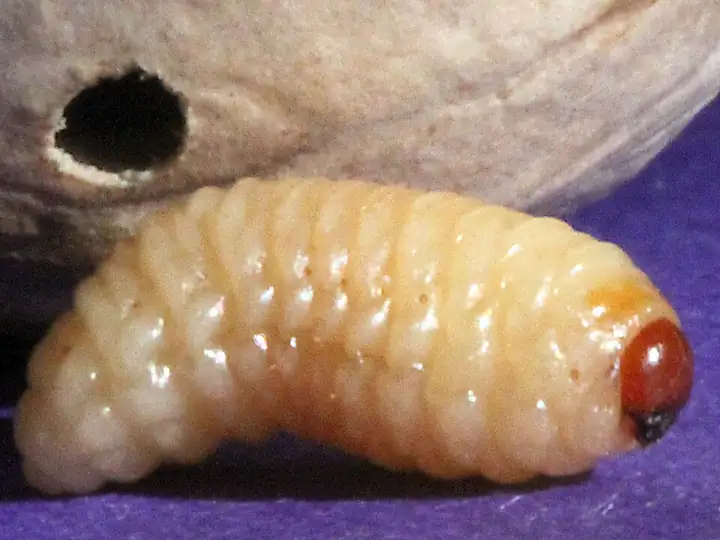
Pecan weevil
Curculio caryae
| Type | Insect |
|---|---|
| When | Late summer into fall, as the nuts fill. |
| Pressure by region | Moderate: Southeast, South Central, Midwest, Great Plains |
About
A weevil whose grubs ruin pecans; Kansas State lists it among the three most serious insect pests of pecans, and Clemson names it as a cause of early nut drop.
Spotting it
Damage
Infested nuts are ruined, and many drop from the tree early (Clemson).
How to find it early
Watch for nuts dropping early in late summer and early fall, and for round, BB-sized exit holes in nuts on the ground (Clemson; Texas A&M).
When
Late summer into fall, as the nuts fill.
Life cycle
One generation takes 2 years (some take 3): adults come out of the soil from mid-August to early September and lay eggs in nuts once the kernels reach the gel stage, and grubs leave through BB-sized holes from late September on and spend about 2 years underground (Texas A&M).
What to do, gentlest first
Start at the top. Sprays are a last step; always read and follow the product label.
Pick up dropped nuts By hand
Gather infested and early-fallen nuts at least twice a week and destroy them (Clemson).
Sticky trunk band Barrier
Wrap a band of sticky trap material around the trunk in late July (Clemson).
Sprays are rarely practical Conventional spray
Clemson notes that chemical control on large pecan trees usually isn't practical for homeowners, so cleanup is the main tool.
If you do spray, follow the label.
Plants it goes after
Pressure by region
No source we opened rated it region by region; these ratings are estimates based on where pecans grow (Kansas State and Clemson both name it as a key pest).
| Northeast | Low |
|---|---|
| Southeast | Moderate |
| South Central | Moderate |
| Midwest | Moderate |
| Great Plains | Moderate |
| Mountain West | Low |
| Southwest | Low |
| Pacific Northwest | Low |
| California | Low |
| Alaska | Low |
| Hawaii | Low |
Ratings come from extension sources where available; some are estimates, as noted above.
Sources
Photo: Photo: Peterwchen / Wikimedia Commons, CC BY-SA 4.0 (CC BY-SA 4.0). Photo resized for the web.

Planting dates and advice are general guidance; check with your local Cooperative Extension office for your area.