
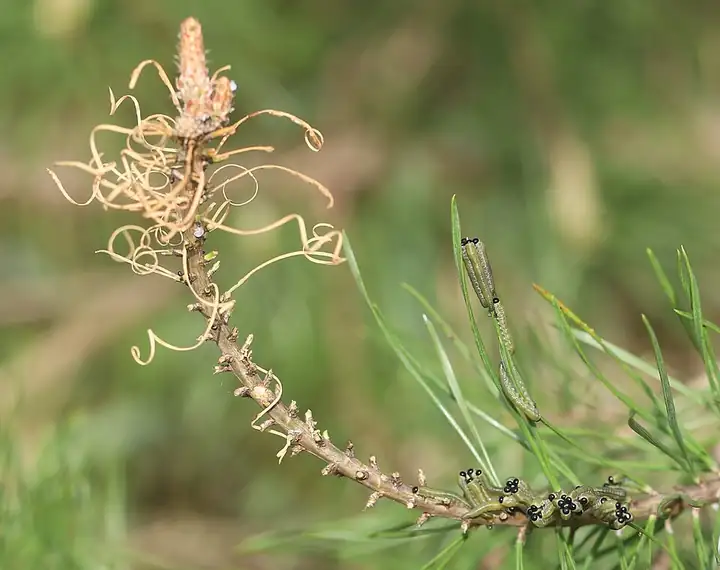
Pine sawflies (European, introduced and redheaded pine sawflies)
European pine sawfly (Neodiprion sertifer), introduced pine sawfly (Diprion similis) and related kinds such as the redheaded pine sawfly
| Type | Insect |
|---|---|
| Pressure by region | High pressure: Northeast, Midwest |
About
Sawfly larvae look like caterpillars but are the young of stingless, wasplike insects, and they feed in groups on pine needles (UMass). The European pine sawfly came from Europe in 1925 and is the most common pine sawfly in Pennsylvania, while the introduced pine sawfly feeds on eastern white pine and several other pines (Penn State, UMass).
Spotting it
Damage
Young European pine sawfly larvae chew the needle surface so needles look dry and straw-like; older ones eat needles down to the base. They rarely eat the new needles, so trees look thin but usually survive; mugo, Scots and red pines are favorites, and white pine is hit mainly when it grows near them (Penn State). Introduced pine sawflies can strip whole trees, worst in the upper half (UMass).
How to find it early
In late April and May, look for tufts of dry, straw-colored needles on last year's growth and clusters of gray-green larvae with shiny black heads (Penn State). From May on, check white pines for black larvae with yellow and white markings (UMass).
When
Spring for European pine sawfly; May through early fall for introduced pine sawfly.
Life cycle
European pine sawfly has one generation a year: eggs spend winter in rows inside needles, hatch in late April to early May, larvae drop to the ground by early June to spin cocoons, and adults lay eggs in fall (Penn State). Introduced pine sawfly has two generations in the North and three in North Carolina, with larvae from May into early October, and spends winter in cocoons on twigs or bark (UMass).
What to do, gentlest first
Start at the top. Sprays are a last step; always read and follow the product label.
Choose and place pines with care Prevent
Remove unwanted host pines nearby, since adults fly in from unmanaged trees, and choose less susceptible pines; northern Scots pine strains resist better than southern ones (Penn State).
Pick off or prune out colonies By hand
Wearing gloves, knock or pick the larvae into a bucket of soapy water; this works best while young larvae still feed in groups. Or prune off an infested branch if it won't spoil the tree's shape (UMass, Penn State).
Natural virus and parasitic wasps Natural enemies
A virus that infects only European pine sawfly often makes outbreaks crash, and dozens of parasites attack introduced pine sawfly (UMass).
Bt does not work: it kills only moth and butterfly caterpillars, and sawfly larvae are not caterpillars (UMass).
Insecticidal soap, horticultural oil or spinosad Organic spray
Spray young larvae directly; for European pine sawfly that is early to mid-May (Penn State, UMass).
Spinosad is toxic to bees and oil can harm bees it hits (PNW 591); keep spray off nearby flowers. Follow the label.
Plants it goes after
Pressure by region
European pine sawfly ranges from New England west to Iowa and south to Missouri (Penn State); other ratings are estimates.
| Northeast | High pressure |
|---|---|
| Southeast | Moderate |
| South Central | Low |
| Midwest | High pressure |
| Great Plains | Moderate |
| Mountain West | Low |
| Southwest | Low |
| Pacific Northwest | Low |
| California | Low |
| Alaska | Low |
| Hawaii | Not found here |
Ratings come from extension sources where available; some are estimates, as noted above.
Sources
Photo: Photo: Slimguy / Wikimedia Commons, CC BY-SA 4.0 (CC BY-SA 4.0). Photo resized for the web.

Planting dates and advice are general guidance; check with your local Cooperative Extension office for your area.