
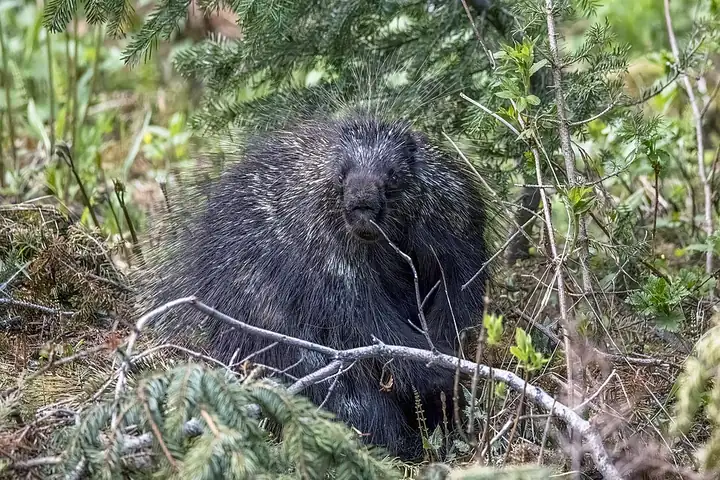
Porcupine
North American porcupine (Erethizon dorsatum)
| Type | Animal |
|---|---|
| When | Year-round; bark damage is worst in winter. |
| Pressure by region | Moderate: Northeast, Midwest, Mountain West, Pacific Northwest, Alaska |
About
A large rodent weighing about 12 to 35 pounds and covered with up to 30,000 quills. In winter it strips bark from trees, and apple trees are a favorite food; Utah State says porcupines also damage fruit trees and vegetable gardens.
Spotting it
Damage
Patches of bark chewed off trunks and branches, often high in the crown on young bark and twigs, with grooved tooth marks about 5 mm (1/5 inch) wide. Bark stripped all the way around a trunk or branch girdles it and kills everything above. Porcupines also gnaw tool handles, plywood and other wood for salt.
How to find it early
In winter, check trees for fresh bark wounds, especially near the top, and look for chewed wood on sheds and tools.
When
Year-round; bark damage is worst in winter.
Life cycle
Porcupines mate in fall, and the female has a single young in April or May that stays with her through summer. They are mostly active at night and live about 5 to 7 years in the wild.
What to do, gentlest first
Start at the top. Sprays are a last step; always read and follow the product label.
Metal trunk bands Barrier
Wrap a band of aluminum flashing about 30 inches wide around the trunk so porcupines cannot climb, and circle the trunks of small trees with wire mesh or hardware cloth.
Fence with a hot wire Barrier
Woven-wire fencing 18 to 24 inches high, with an electric wire about 1 1/2 inches above the top, keeps porcupines out of gardens and orchards.
Check the rules before trapping Trap
Rules vary by state: Massachusetts makes it illegal to relocate wildlife or to poison it, and Utah lists the porcupine as a controlled species for collection and possession. Call your state wildlife agency before you trap.
If a pet gets quills, keep it from pawing at them, don't cut the quills, and call a veterinarian right away. Never handle a wild animal, live or dead, with bare hands. Trapping and relocating wildlife is regulated by state law, and the rules differ from state to state. Check with your state wildlife agency or your county Extension office before you set a trap.
Plants it goes after
Pressure by region
Porcupines range from Alaska through the West to Mexico and across the northern states from California to Maine (Utah State); they live in all of Alaska except the Alaska Peninsula and Kodiak, Nunivak and St. Lawrence islands, and are common in western and central Massachusetts. No regional severity source was found, so all ratings are estimates, including the low ratings for the South and Hawaii.
| Northeast | Moderate |
|---|---|
| Southeast | Low |
| South Central | Low |
| Midwest | Moderate |
| Great Plains | Low |
| Mountain West | Moderate |
| Southwest | Low |
| Pacific Northwest | Moderate |
| California | Low |
| Alaska | Moderate |
| Hawaii | Low |
Ratings come from extension sources where available; some are estimates, as noted above.
Sources
Photo: Photo: Charles J. Sharp, CC BY-SA 4.0, via Wikimedia Commons (CC BY-SA 4.0). Photo resized for the web.

Planting dates and advice are general guidance; check with your local Cooperative Extension office for your area.