
Rose sawflies (roseslugs)
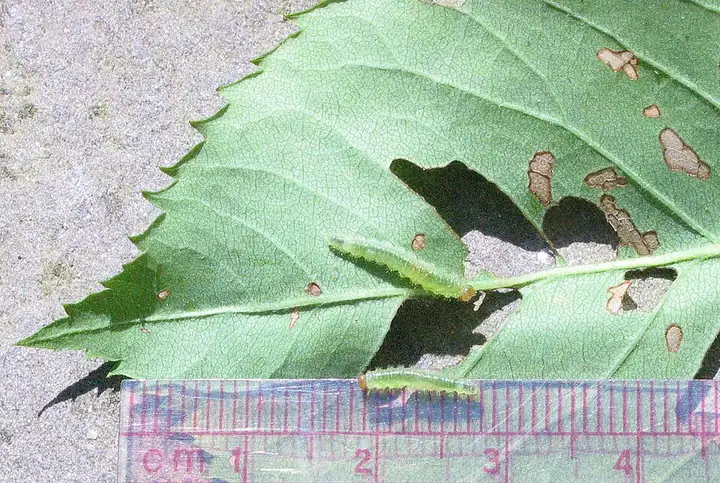
Roseslug (Endelomyia aethiops), bristly roseslug (Cladius difformis) and curled rose sawfly (Allantus cinctus)
| Type | Insect |
|---|---|
| Pressure by region | Moderate: Northeast, Southeast, South Central, Midwest, Great Plains, Mountain West, Southwest, Pacific Northwest, California |
About
Roseslugs are not slugs or caterpillars. They are the larvae of sawflies, stout, mostly black relatives of bees and wasps. The pale green larvae are 1/2 to 3/4 inch long; the bristly roseslug is covered in hairlike bristles, and the curled rose sawfly coils up as it feeds (UC IPM).
Spotting it
Damage
Young larvae scrape the leaf surface and leave clear 'windowpane' patches. Older larvae chew holes or skeletonize leaves down to the veins (UC IPM, UGA). It looks bad, but Iowa State says the damage is largely cosmetic and rarely harms the plant's long-term health.
How to find it early
From spring on, turn rose leaves over to look for small green larvae and the first see-through spots. In Delaware, larvae are usually found from mid-May to early June.
When
Mid-spring to early summer for the roseslug; in Georgia the bristly roseslug can feed from April to October (UGA).
Life cycle
They spend winter in the soil as full-grown larvae or pupae, and adults come out in spring to lay eggs (Iowa State, UGA). The roseslug has one generation a year, but the bristly roseslug can have as many as six (Iowa State).
What to do, gentlest first
Start at the top. Sprays are a last step; always read and follow the product label.
Tolerate light damage Prevent
The damage is mostly cosmetic. Iowa State says there is no need to treat once the larvae have finished feeding.
Pick or wash them off By hand
Pick off larvae or clip infested leaves (UC IPM). A strong stream of water aimed at the leaf undersides knocks larvae off (Delaware); UGA suggests doing this three times a week.
Let natural enemies work Natural enemies
Parasitic wasps, predatory beetles and insect-eating birds all feed on roseslugs (UC IPM).
Bt (Bacillus thuringiensis) does not work, because these larvae are not caterpillars (UC IPM).
Insecticidal soap, horticultural oil or neem Organic spray
Spray the larvae directly, covering the leaf undersides. These work only on contact, so repeat as needed (UC IPM, UGA).
Soap and oil work only on contact. Oil can harm bees it hits for up to about 3 hours (PNW 591), so spray when bees are not on the plants. Neem residue is toxic to bees for under 2 hours (PNW 591). Read and follow the label, including its pre-harvest interval if you eat any part of the plant.
Spinosad Organic spray
UC IPM lists spinosad as effective on roseslugs.
UC IPM says spinosad can harm bees, so do not use it on roses in flower. UC IPM also advises against broad-spectrum sprays such as pyrethroids, which harm bees and natural enemies. Some guides list neonicotinoids; they harm pollinators, so skip them. Read and follow the label, including its pre-harvest interval if you eat any part of the plant.
Plants it goes after
Pressure by region
Rose sawflies are widespread. Sources cover California, Oregon, Iowa, Delaware and Georgia, so all ratings are estimates, including the low ratings for Alaska and Hawaii.
| Northeast | Moderate |
|---|---|
| Southeast | Moderate |
| South Central | Moderate |
| Midwest | Moderate |
| Great Plains | Moderate |
| Mountain West | Moderate |
| Southwest | Moderate |
| Pacific Northwest | Moderate |
| California | Moderate |
| Alaska | Low |
| Hawaii | Low |
Ratings come from extension sources where available; some are estimates, as noted above.
Sources
- ipm.ucanr.edu
- yardandgarden.extension.iastate.edu
- fieldreport.caes.uga.edu
- udel.edu
- agsci.oregonstate.edu
- s3.wp.wsu.edu
Photo: Photo: Boringbob4wk at English Wikipedia, CC BY 3.0, via Wikimedia Commons (CC BY 3.0). Photo resized for the web.

Planting dates and advice are general guidance; check with your local Cooperative Extension office for your area.