
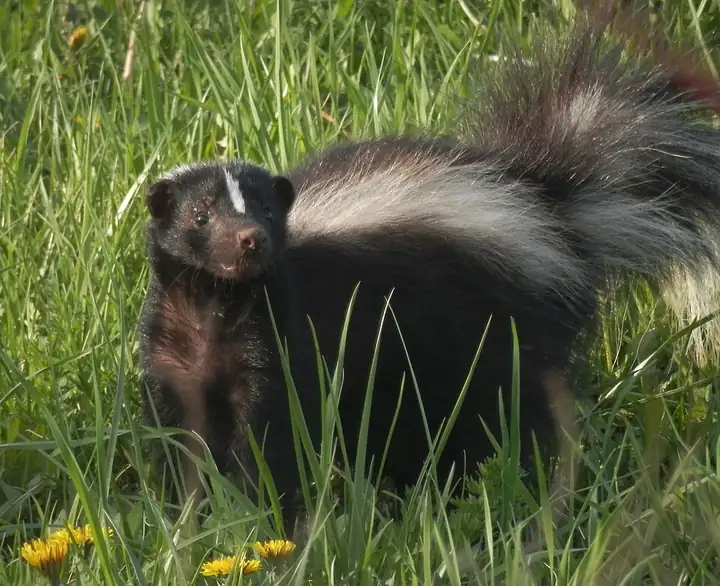
Striped skunk
Mephitis mephitis (spotted skunks, Spilogale species, are smaller relatives)
| Type | Animal |
|---|---|
| When | Year-round, mostly from dusk to dawn; young appear in late spring. |
| Pressure by region | Moderate: Northeast, Southeast, South Central, Midwest, Great Plains, Mountain West, Southwest, Pacific Northwest, California |
About
A black-and-white animal about the size of a house cat, weighing 4 to 10 pounds. In gardens it mostly digs in lawns and beds for grubs and insects, but it also eats ripe berries and fallen fruit, and it is a major carrier of rabies.
Spotting it
Damage
Small cone-shaped holes about 3 to 5 inches across, dug overnight in lawns and beds, or patches of upturned soil. Armadillo holes look similar but can be up to 6 inches deep; skunk holes are usually under 4 inches across and under 3 inches deep. In berry patches, skunks eat ripe berries right off the plants and rip fruit from the canes.
How to find it early
Look at dawn for fresh cone-shaped holes. A skunk warns before it sprays by stamping its front feet, hissing and raising its tail, so back away.
When
Year-round, mostly from dusk to dawn; young appear in late spring.
Life cycle
Skunks breed once a year in February or March, and a litter of 2 to 10 young (often 4 to 6) is born in May. They are most active from dusk to dawn.
What to do, gentlest first
Start at the top. Sprays are a last step; always read and follow the product label.
Rabies safety first Prevent
Skunks are one of the main wild carriers of rabies. A skunk that wanders aimlessly or acts aggressive, uncoordinated or oddly tame may be sick: keep people and pets away and call animal control.
See a doctor for any skunk bite, however small, and report it to your local health department. Keep pets' rabies shots up to date. Never handle a wild animal, live or dead, with bare hands.
Seal dens and fence berries Barrier
Close openings under decks, porches and sheds with 1/4-inch hardware cloth buried at least 6 inches. If a skunk is already living there, first fit a one-way door of hardware cloth so it can leave but not return. A metal fence around a small berry patch, or an electric wire at nose height about 4 to 6 inches off the ground, cuts damage.
Trapping and moving skunks is restricted Trap
California forbids relocating skunks without written permission from the Department of Fish and Wildlife. In Colorado a trapped skunk must be released where it was caught or destroyed, and Maryland, which lists skunks as a rabies-vector species, does not allow them to be relocated. Hire a licensed wildlife control operator or call your state wildlife agency.
Never handle a wild animal, live or dead, with bare hands. Trapping and relocating wildlife is regulated by state law, and the rules differ from state to state. Check with your state wildlife agency or your county Extension office before you set a trap.
Ammonia rags to move them along Repellent
Rags soaked in household ammonia placed under a deck or porch can encourage a skunk to leave before you seal the space.
Keep ammonia away from children and pets.
Plants it goes after
Pressure by region
Striped skunks live across the lower 48 states; no regional severity source was found, so those moderate ratings are estimates. Alaska is rated low as an estimate because no source found reports skunks there. Skunks are prohibited in Hawaii and not established there; stowaways are caught at harbors now and then, so report any sighting to the Pest Hotline at 808-643-PEST (7378).
| Northeast | Moderate |
|---|---|
| Southeast | Moderate |
| South Central | Moderate |
| Midwest | Moderate |
| Great Plains | Moderate |
| Mountain West | Moderate |
| Southwest | Moderate |
| Pacific Northwest | Moderate |
| California | Moderate |
| Alaska | Low |
| Hawaii | Not found here |
Ratings come from extension sources where available; some are estimates, as noted above.
Sources
- extension.colostate.edu
- ipm.ucanr.edu
- extension.umd.edu
- ipm.ucanr.edu
- fruitscout.mgcafe.uky.edu
- extension.okstate.edu
- dab.hawaii.gov
Photo: Photo: Ryan Hodnett, CC BY-SA 4.0, via Wikimedia Commons (CC BY-SA 4.0). Photo resized for the web.

Planting dates and advice are general guidance; check with your local Cooperative Extension office for your area.