
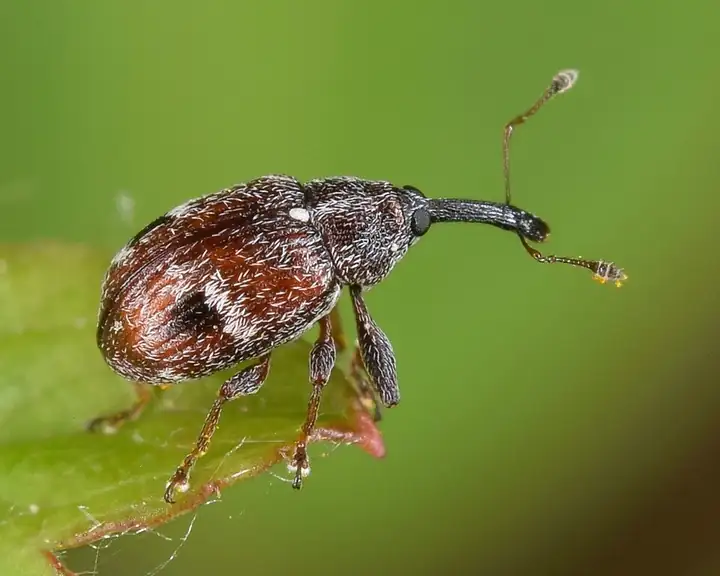
Strawberry clipper (strawberry bud weevil)
Anthonomus signatus
| Type | Insect |
|---|---|
| When | Spring, from early bud through bloom. |
| Pressure by region | Moderate: Northeast |
About
A reddish-brown to nearly black snout beetle only about a tenth of an inch long, with dark spots on its back. Females lay an egg in an unopened flower bud and then cut the bud stem.
Spotting it
Damage
Unopened buds hang by a thread or drop off as if snipped with scissors. UNH reports losses of 50 to 75% in some areas.
How to find it early
Before bloom, check plants along field edges near woods for dangling or cut buds.
When
Spring, from early bud through bloom.
Life cycle
Adults spend winter in mulch and leaf litter and become active around bloom. Each female lays 20 to 30 eggs; larvae grow inside the clipped buds and new adults appear in midsummer. There is one generation a year.
What to do, gentlest first
Start at the top. Sprays are a last step; always read and follow the product label.
Choose forgiving varieties and remove nearby hosts Prevent
Varieties that set many flowers can make up for clipped buds by growing the rest larger (UNH). Remove weedy or unmanaged brambles nearby, where the weevils also breed.
Insecticide only if clipping is heavy Conventional spray
UNH advises using a product labeled for strawberries, following your state's small-fruit guide, when scouting before bloom finds many clipped buds.
Most insecticides that kill weevils are toxic to bees (PNW 591), and this pest is active at bloom: spray before flowers open or when bees are not working, and follow the label and pre-harvest interval.
Plants it goes after
Pressure by region
Sourced for New Hampshire (UNH) and Minnesota (UMN, which says it shows up only occasionally). Other regions are rated low for lack of a source; those ratings are estimates.
| Northeast | Moderate |
|---|---|
| Southeast | Low |
| South Central | Low |
| Midwest | Low |
| Great Plains | Low |
| Mountain West | Low |
| Southwest | Low |
| Pacific Northwest | Low |
| California | Low |
| Alaska | Low |
| Hawaii | Low |
Ratings come from extension sources where available; some are estimates, as noted above.
Sources
Photo: Photo: Christina Butler, CC BY 2.0, via Wikimedia Commons (CC BY 2.0). Photo resized for the web.

Planting dates and advice are general guidance; check with your local Cooperative Extension office for your area.