
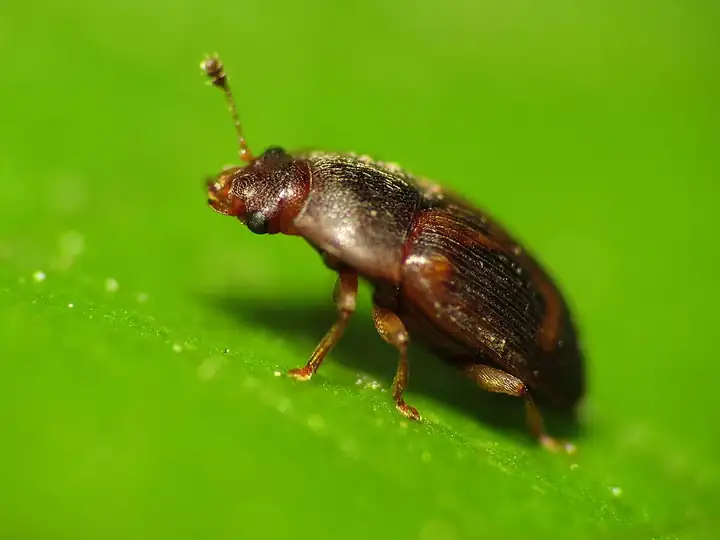
Strawberry sap beetle
Stelidota geminata
| Type | Insect |
|---|---|
| When | Late spring through summer. |
| Pressure by region | Moderate: Northeast, Midwest |
About
A tiny, oval brown beetle, an eighth of an inch or less, with knobbed antennae and a faint lighter X-shaped mark across its back. It is drawn to ripe and overripe fruit.
Spotting it
Damage
Adults and larvae chew small, deep holes in ripe berries, usually on the side touching the ground. They can bring in fruit rot, and larvae turn up inside picked fruit.
How to find it early
Look for small beetles in holes on ripe berries, especially under leaves at soil level. Bait traps with fermenting fruit or bread dough along wooded edges show when they move in (UMD).
When
Late spring through summer.
Life cycle
Adults spend winter in wooded areas and in blueberry and raspberry patches and move into strawberries as fruit ripens in May and June. A generation takes about 20 days at 69°F, and numbers build through summer.
What to do, gentlest first
Start at the top. Sprays are a last step; always read and follow the product label.
Pick often and remove damaged fruit Prevent
Harvest frequently and completely, and remove overripe, damaged and rotting fruit right away. Destroy it by freezing or by sealing it in a clear plastic bag in the sun. Beds next to woods have more beetles.
Bait buckets outside the bed Trap
Set containers a few feet outside the garden baited with bread dough, overripe fruit, stale beer, molasses-yeast mix or vinegar, and empty and rebait every 3 to 4 days (UMN).
Insecticides work poorly Conventional spray
UMN does not recommend sprays: beetles hide inside and under fruit, and products cannot be used on ripe fruit close to harvest. Sanitation does more.
If you do spray, use only a product labeled for strawberries, follow its pre-harvest interval, and avoid blooming plants; bifenthrin and carbaryl are highly toxic to bees (PNW 591).
Plants it goes after
Blueberry, Cantaloupe (muskmelon), Cherry (sweet and tart), Peach, Raspberry, Strawberry
Pressure by region
Sourced for Maryland (UMD) and Minnesota (UMN). Other regions are rated low for lack of a source; those ratings are estimates.
| Northeast | Moderate |
|---|---|
| Southeast | Low |
| South Central | Low |
| Midwest | Moderate |
| Great Plains | Low |
| Mountain West | Low |
| Southwest | Low |
| Pacific Northwest | Low |
| California | Low |
| Alaska | Low |
| Hawaii | Low |
Ratings come from extension sources where available; some are estimates, as noted above.
Sources
Photo: Photo: Katja Schulz, CC BY 2.0, via Wikimedia Commons (CC BY 2.0). Photo resized for the web.

Planting dates and advice are general guidance; check with your local Cooperative Extension office for your area.