
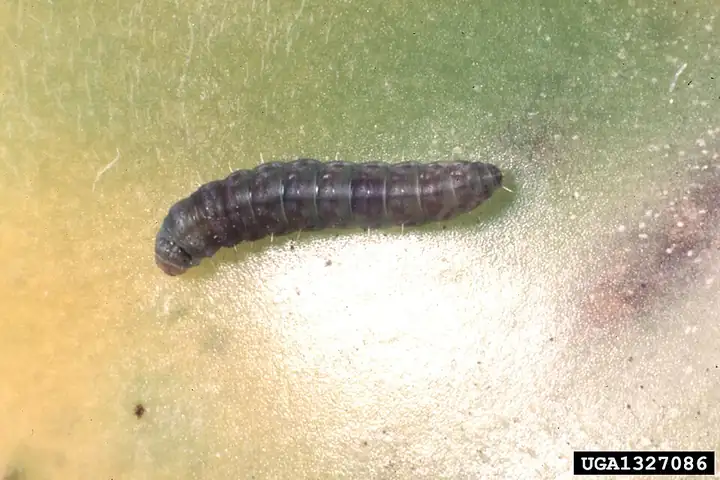
Tomato pinworm
Keiferia lycopersicella
| Type | Insect |
|---|---|
| Pressure by region | High pressure: California |
About
The caterpillar of a tiny gray moth, about a quarter inch long. It feeds only on tomato and its relatives and is mostly a warm-climate pest, though it can hitch a ride north on transplants.
Spotting it
Damage
Young caterpillars make winding or blotchy mines in leaves; older ones fold and web leaves together or bore into fruit, usually under the stem cap. The fruit gets pinholes, dark tunnels and frass, and may rot. UF/IFAS says it can infest 60 to 80% of tomato fruits in a season.
How to find it early
Check transplants and leaves for small winding or blotch mines, folded or webbed leaves, and frass at the stem end of fruit. Pheromone traps catch the moths.
When
Spring through fall, getting worse as the season goes on; year-round in warm areas and greenhouses.
Life cycle
A generation can take as little as about 4 weeks in warm weather, and overlapping generations add up to seven or eight a year in Florida (UF/IFAS). It survives winter outdoors only in warm areas, as pupae at or near the soil surface (Lincoln University).
What to do, gentlest first
Start at the top. Sprays are a last step; always read and follow the product label.
Clean transplants and a break between crops Prevent
Buy locally grown transplants and check them for mines and folded leaves. Keep new plantings away from old tomato, eggplant and potato plantings, and leave a gap with no host plants between crops (UC IPM, UF/IFAS).
Remove infested leaves and clean up By hand
Pick off mined or folded leaves and seal them in plastic bags. After harvest, remove and destroy all plant debris (University of Kentucky, UMD).
Protect parasitic wasps Natural enemies
Several tiny parasitic wasps attack pinworms. Broad-spectrum sprays kill them and can also trigger leafminer outbreaks (UC IPM).
Garden friends that go after it
Trichogramma wasps
Protect these helpers: skip broad sprays when they're around.
Plants it goes after
Pressure by region
It lives year-round in warm parts of California, Texas, Florida and Hawaii (UF/IFAS) and is common throughout southern California (UC IPM). Farther north it cannot survive winter outdoors; it turns up in greenhouses and high tunnels (Delaware, Kentucky, Mississippi, Missouri, Pennsylvania, Virginia) and on infested transplants. Ratings other than California are estimates.
| Northeast | Low |
|---|---|
| Southeast | Moderate |
| South Central | Moderate |
| Midwest | Low |
| Great Plains | Low |
| Mountain West | Low |
| Southwest | Low |
| Pacific Northwest | Low |
| California | High pressure |
| Alaska | Low |
| Hawaii | Moderate |
Ratings come from extension sources where available; some are estimates, as noted above.
Sources
- ipm.ucanr.edu
- journals.flvc.org
- journals.flvc.org
- lincolnu.edu
- extension.uga.edu
- kentuckypestnews.wordpress.com
- s3.wp.wsu.edu
- extension.umd.edu
Photo: Photo: Alton N. Sparks, Jr., University of Georgia, Bugwood.org, CC BY 3.0 US, via Wikimedia Commons (CC BY 3.0 US). Photo resized for the web.

Planting dates and advice are general guidance; check with your local Cooperative Extension office for your area.