
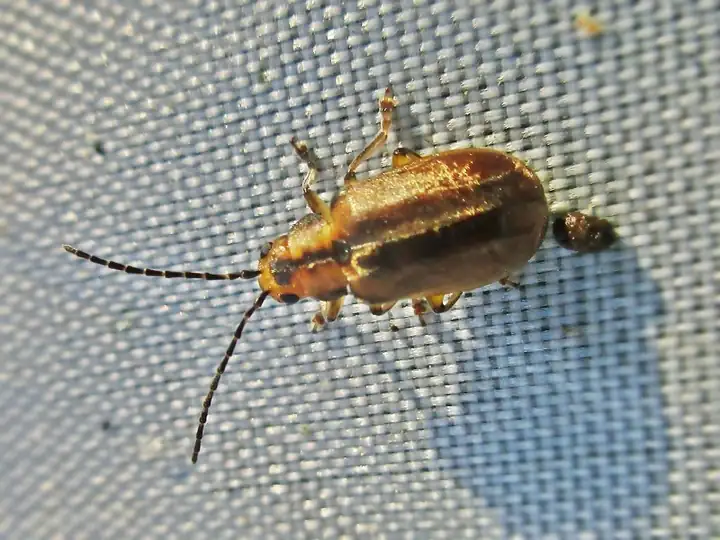
Viburnum leaf beetle
Pyrrhalta viburni
| Type | Insect |
|---|---|
| When | Larvae feed in May and June; adults are active from July into September (UMD). |
| Pressure by region | High pressure: Northeast |
About
A small golden-brown beetle, 4.5 to 6.5 mm long, from Europe and Asia that feeds only on viburnums (UMass). Highly susceptible kinds, including American cranberrybush (highbush cranberry), are often destroyed within 2 to 3 years of infestation (Cornell).
Spotting it
Damage
Larvae skeletonize leaves in spring, leaving only the veins, and adults keep feeding through summer. Bad infestations strip shrubs completely, and 2 to 3 years of complete defoliation can kill them (UMass).
How to find it early
After leaves drop and before spring, look for rows of egg sites along the tips of twigs and branches. In early May, check leaf undersides for small larvae (UMass).
When
Larvae feed in May and June; adults are active from July into September (UMD).
Life cycle
There is one generation a year. Eggs spend winter in small pits chewed into twig tips and hatch in late April or May; larvae pupate in the soil, and adults appear in July and lay up to 500 eggs each in late summer and fall (UMass, Illinois, UMD).
What to do, gentlest first
Start at the top. Sprays are a last step; always read and follow the product label.
Choose resistant viburnums Prevent
Doublefile, Judd, Koreanspice, tea, dawn and David viburnums resist the beetle; American and European cranberrybush and arrowwood are among the most susceptible (UMass, UMD, Cornell).
Prune out egg-laden twigs By hand
Between leaf drop and spring hatch, cut off and destroy twig tips with egg sites (UMass, UMD).
Native predators Natural enemies
Lady beetles, lacewings and spined soldier bugs eat the larvae (UMass, UMD).
Dormant oil on eggs Organic spray
UMass says a 4% horticultural oil sprayed on leafless, dormant shrubs killed 75 to 80% of eggs.
Oil can harm bees it hits for up to about 3 hours (PNW 591). Read and follow the label, including its pre-harvest interval if you eat any part of the plant.
Soap, oil or spinosad on larvae Organic spray
In spring, spray young larvae with a 2 to 3% insecticidal soap or horticultural oil, or with spinosad (UMass).
Soap and oil work only on contact. Oil can harm bees it hits for up to about 3 hours (PNW 591), so spray when bees are not on the plants. Spinosad is toxic to bees for 3 hours to a day after spraying (PNW 591), so never spray open flowers or plants where bees are working. Some guides list imidacloprid; it is a neonicotinoid that harms pollinators, so skip it. Read and follow the label, including its pre-harvest interval if you eat any part of the plant.
Plants it goes after
Pressure by region
First identified in North America in Ontario in 1947 and in Massachusetts in 2004, it is established in New England, New York, Pennsylvania and Maryland and has reached Ohio, Michigan, Minnesota, Illinois and Washington (UMass, UMD, Illinois). It is still spreading; report finds in new areas to your state department of agriculture. Ratings outside the Northeast are estimates.
| Northeast | High pressure |
|---|---|
| Southeast | Low |
| South Central | Low |
| Midwest | Moderate |
| Great Plains | Low |
| Mountain West | Low |
| Southwest | Low |
| Pacific Northwest | Low |
| California | Low |
| Alaska | Low |
| Hawaii | Low |
Ratings come from extension sources where available; some are estimates, as noted above.
Sources
Photo: Photo: Bj.schoenmakers, CC0, via Wikimedia Commons (CC0). Photo resized for the web.

Planting dates and advice are general guidance; check with your local Cooperative Extension office for your area.