
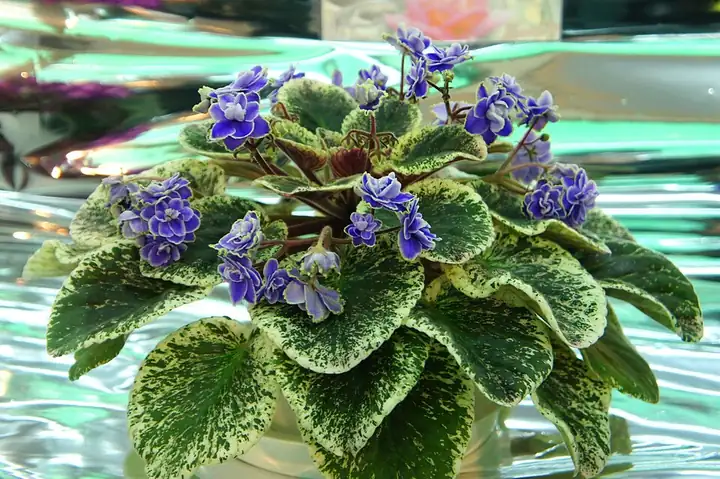
African violet
Streptocarpus ionanthus (formerly Saintpaulia ionantha) · Gesneriad family (Gesneriaceae)
| Hardiness zones | 11 to 12 |
|---|---|
| Sun | shade |
| Water | moderate |
| Life cycle | perennial |
| Frost | Tender: killed by frost |
| Soil pH | 6.0–6.5 |
About African violet
African violets are small, fuzzy-leaved rosettes from the coastal woods of Tanzania that can flower in every month of the year on a windowsill or under a shop light (NC State, UGA). Hundreds of varieties come in blue, purple, pink, red-violet and white, single or double, from micro-miniatures to plants over 16 inches across. They are fussy about only a few things: steady warmth, room-temperature water kept off the leaves, and enough light.
Hardy outdoors only in zones 11-12 (NC State); it is grown indoors everywhere and is usually kept inside year-round, since nights below 60 F stunt it (NC State, UGA).
When to plant
Timing is counted from your average last spring frost (and first fall frost). Sow & Tell works out the actual dates for your ZIP code.
Usually bought as a blooming nursery plant or started from a leaf cutting, which gives a flowering plant in about 10 months (UGA, Iowa State).
Growing it indoors
- Light: Bright light with no direct afternoon sun, within 3 ft of a window (Clemson); MU Extension prefers a north window, and under two shop-light tubes 6-12 in above the leaves for 14-16 hours a day it blooms year-round (Clemson, UMN).
- Water: Keep the mix moist but let the surface dry before watering again, using room-temperature water either from the bottom (set the pot in 1 in of water until the surface is damp, then drain) or from the top with the leaves kept dry (NC State, Clemson, UMN). Cold water on the leaves leaves white rings, and a constantly wet pot brings crown and root rot, the main killer.
- Humidity: It tolerates ordinary room humidity but does best at 40-60 percent, so group plants or use a pebble tray; don't mist the leaves (UMN, UGA).
- Temperature: Nights of 65-70 F and days up to 80-85 F suit it; below 60 F growth stunts and leaves deform, and a cold windowsill or a draft on wet leaves chills them (Clemson, NC State, UGA, MU Extension).
- Feeding: UGA feeds a water-soluble fertilizer such as 20-20-20 at a third to half the label rate every 4-6 weeks; UMN feeds an African violet fertilizer at quarter strength with every watering and flushes with plain water monthly; either way, feed after watering, never a dry plant.
- Repotting: Once a year into fresh mix, usually the same size pot or one size up, with the crown set a quarter to half inch below the rim; divide plants that have grown extra crowns (UMN, UGA).
Soil
A light, well-drained mix such as equal parts potting soil, peat and perlite, or a soilless African violet mix at pH 6.2-6.5, in a pot with a drainage hole (Clemson, UMN).
Pot in a light, well-drained mix of equal parts potting soil, peat and perlite, or a soilless African violet mix at pH 6.2-6.5 (Clemson, UMN).
Feeding
- Year-round while it is growing and blooming: water-soluble African violet or balanced fertilizer such as 20-20-20, diluted. UGA: a third to half the label rate every 4-6 weeks after watering; UMN: a quarter of the label rate with every watering, with a plain-water flush once a month. Don't feed newly rooted cuttings (UGA).
Too much fertilizer shows as rusty, brittle leaves and a tight center; flush the pot with plain water and feed every other watering instead (UMN).
Harvest
Can bloom year-round under good light, in flushes that last 3-6 weeks (Clemson); snap off spent flower stems at the base and keep the crown to a single rosette.
Varieties (12)
NC State names 12 cultivars by size class; hundreds exist.
| Variety | Type | Days | Notes |
|---|---|---|---|
| Little Ruby | Micro-miniature | A micro-miniature, the smallest class, named by NC State. | |
| Little Intermezzo | Miniature (under 6 in) | A miniature named by NC State. | |
| Little Maya | Miniature (under 6 in) | A miniature named by NC State. | |
| Persian Prince | Miniature (under 6 in) | A miniature named by NC State. | |
| Champagne Pink | Semi-miniature (6-8 in) | A semi-miniature with pale pink flowers. | |
| Amethyst | Standard (8-16 in) | A standard-size plant named by NC State; purple tones. | |
| Diamond Tiffany | Standard (8-16 in) | A standard-size cultivar named by NC State. | |
| Everlove | Standard (8-16 in) | A standard-size cultivar named by NC State. | |
| First Kiss Blush | Standard (8-16 in) | A standard-size cultivar named by NC State; blush-pink tones. | |
| Harlequin | Standard (8-16 in) | A standard-size cultivar named by NC State; two-tone flowers. | |
| Lyon's Lavender Magic | Standard (8-16 in) | A lavender-flowered cultivar named by NC State; size class not stated. | |
| Nightfall | Standard (8-16 in) | A standard-size cultivar named by NC State; dark flowers. |
Pests to watch for
Mealybugs, Cyclamen mite, Thrips, Aphids
Diseases and problems
Root and crown rot, Crown rot, Gray mold (Botrytis), Ring spot (cold water)
In the kitchen
Safety: Not listed as poisonous to people or pets (NC State, ASPCA).
Pets: Non-toxic to dogs, cats and horses (ASPCA, listed as Saintpaulia spp.).
Sources
- plants.ces.ncsu.edu
- hgic.clemson.edu
- extension.umn.edu
- fieldreport.caes.uga.edu
- yardandgarden.extension.iastate.edu
- extension.missouri.edu
- aspca.org
Photo: Photo: Mk2010, CC BY-SA 3.0, via Wikimedia Commons (CC BY-SA 3.0). Photo resized for the web.

Planting dates and advice are general guidance; check with your local Cooperative Extension office for your area.