
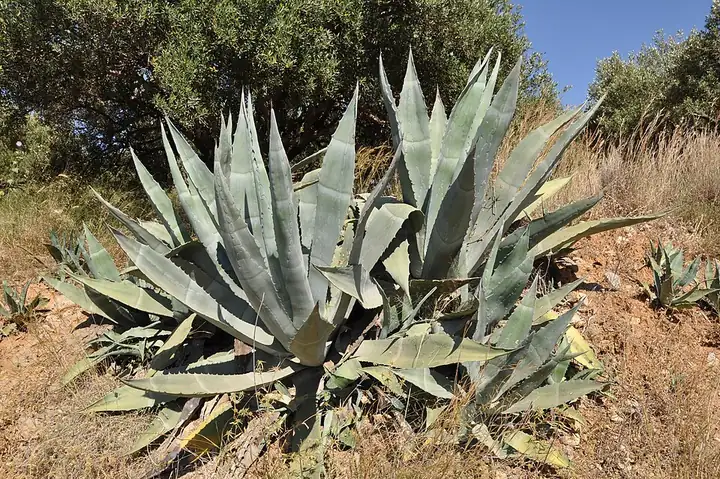
Agave (century plant)
Agave americana (century plant) and native agaves such as Parry's agave (A. parryi), Havard's agave (A. havardiana), lechuguilla (A. lechuguilla) and American agave (A. virginica, formerly Manfreda virginica) · Asparagus family (Asparagaceae)
| Hardiness zones | 6 to 11 |
|---|---|
| Sun | full sun |
| Water | low |
| Life cycle | perennial |
| Frost | Hardy: takes frost |
| Spacing | 36 to 144 inches |
About Agave (century plant)
Agaves are slow-growing succulents that make bold rosettes of thick, spine-tipped leaves, grown as living sculpture in dry, sunny yards, rock gardens and big pots (NC State, UF/IFAS). Century plant is native to Mexico and to Arizona, California, Texas, Louisiana and Florida; Parry's agave grows wild in Arizona, New Mexico and Texas, Havard's agave in Texas, lechuguilla in West Texas and southern New Mexico, and American agave from Illinois southwest to Texas (wildflower.org, NC State). Most rosettes bloom only once, after 10-25 years or more rather than 100, sending up a towering stalk and then dying, while pups at the base carry on (NC State, UF/IFAS). The sap burns and blisters skin and the leaf tips are needle-sharp, so plant it away from paths and wear gloves and long sleeves to work on it (Cutis, wildflower.org).
Century plant is hardy in zones 8-11 (NC State; UF/IFAS lists 9-11) and its leaves are scarred by winter lows in the teens (wildflower.org); Parry's agave takes zone 6 if it stays dry in winter, and American agave grows in zones 6-9 (NC State). UF/IFAS rates century plant 'not a problem species' in Florida.
When to plant
Timing is counted from your average last spring frost (and first fall frost). Sow & Tell works out the actual dates for your ZIP code.
Set out nursery plants or rooted pups in full sun and well-drained soil; UF/IFAS spaces agaves 3-5 ft apart, but century plant needs 6-12 ft (NC State). To make more, cut off well-rooted suckers at the base or grow from seed (UF/IFAS, NC State). Keep it well back from walks, patios and play areas because of the spines (wildflower.org).
Soil
Sharply drained sandy, gravelly or rocky soil of almost any pH; wet soil or overwatering causes root rot (NC State, UF/IFAS).
No rich soil needed: give it sharply drained sandy, gravelly or rocky ground, and fix drainage before planting rather than adding fertilizer (NC State, UF/IFAS).
Feeding
Overwatering and wet winter soil cause root rot; Parry's agave should get no winter water at all (NC State). Established plants need little irrigation (UF/IFAS). Watch for agave snout weevil, which tunnels into the base (NC State, UF/IFAS).
Harvest
Blooms in summer, usually only once per rosette: one stalk 15-30 ft tall with branched clusters of greenish-yellow flowers (NC State). The mother rosette dies afterward; cut it out carefully once it fades and let the pups fill in. Remove dead lower leaves as needed, wearing gloves (NC State, wildflower.org).
Varieties (12)
Extension and wildflower.org sources document these 12 agaves and named forms; we found no sourced list of 15.
| Variety | Type | Days | Notes |
|---|---|---|---|
| Quadricolor | A. lophantha | Small rosette 1-2 ft tall and 1-3 ft wide with striped leaf edges and toothed margins. | |
| Marginata | Century plant (A. americana) | Big rosette 6-10 ft tall and wide with yellow leaf edges. | |
| Medio-picta 'Alba' | Century plant (A. americana) | Leaves striped white and green. | |
| Yellow Ribbons | Century plant (A. americana) | Leaves striped yellow. | |
| Sharkskin Shoes | Hybrid | Broad, slightly twisted, slate-colored leaves. | |
| Havard's agave | Native species (A. havardiana) | Broad gray-green rosette about 3 ft across; yellow-green flowers June-September on a stalk up to about 15 ft after 20-40 years. Native to Texas; hardy to about 15 F. | |
| Lechuguilla | Native species (A. lechuguilla) | Narrow-leaved rosettes about 2 ft tall that spread by offshoots; native to West Texas and southern New Mexico. | |
| Parry's agave | Native species (A. parryi) | Compact blue-gray rosette 1-3 ft tall and wide; red buds open to bright yellow flowers on a 10-20 ft stalk after 8-15 years. Native to Arizona, New Mexico and Texas. | |
| American agave | Native species (A. virginica, formerly Manfreda virginica) | Rosette of leaves 6-20 in long with 4-5 ft stalks of fragrant, pale yellow-green tubular flowers that night-flying moths pollinate; unlike true agaves it can bloom more than once. Native from Illinois southwest to Texas and the Southeast. | |
| Couesii | Parry's agave variety (A. parryi var. couesii) | Smaller, about 18 in tall and 2 ft wide, with many offsets. | |
| Desmettiana | Species (A. desmettiana) | Dwarf, spineless agave 2-3 ft tall and 3-4 ft wide. | |
| Geminiflora | Species (A. geminiflora) | Spineless rosette 2-3 ft tall and wide of thin leaves with loose fibers. |
Pests to watch for
Mealybugs, Scale insects, Slugs, Brown garden snail
Diseases and problems
Root rot
In the kitchen
Agave syrup, pulque and tequila come from particular agaves grown and processed commercially (NC State). We don't suggest eating garden agaves: wildflower.org warns that lechuguilla hearts are poisonous.
Safety: The sap is the main danger. It is packed with needle-like calcium oxalate crystals that cause fast burning, then redness, swelling and an itchy, blistering rash, often in streaks where it touched (Cutis 2003; NC State). Wear gloves and long sleeves when trimming leaves or removing pups, and wash off any sap. The leaf tips and edge teeth can stab people and pets; UF/IFAS notes you can clip the tips where children play.
Pets: Not listed by the ASPCA (no agave or century plant entry on its plant lists). NC State lists the leaves and sap as mildly poisonous (calcium oxalate) and skin-irritating, and wildflower.org warns the spines can hurt pets; lechuguilla has killed livestock that ate it in droughts.
Sources
- plants.ces.ncsu.edu
- plants.ces.ncsu.edu
- plants.ces.ncsu.edu
- plants.ces.ncsu.edu
- ask.ifas.ufl.edu
- wildflower.org
- wildflower.org
- wildflower.org
- cdn.mdedge.com
- assessment.ifas.ufl.edu
- aspca.org
- aspca.org
Photo: Photo: Marc Ryckaert (MJJR), CC BY-SA 3.0, via Wikimedia Commons (CC BY-SA 3.0). Photo resized for the web.

Planting dates and advice are general guidance; check with your local Cooperative Extension office for your area.