
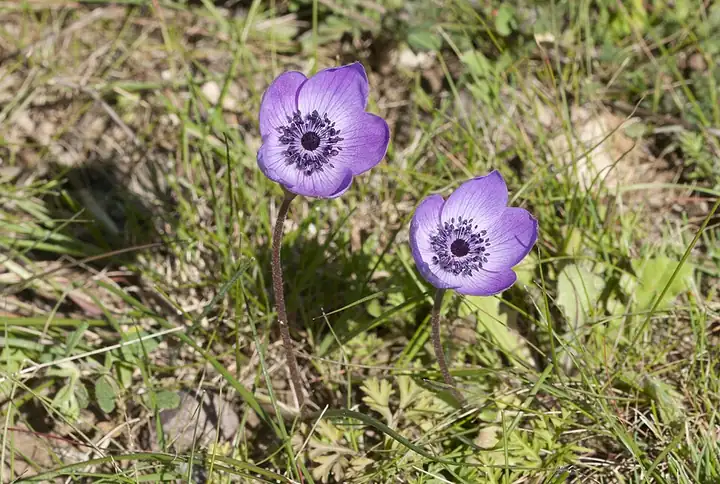
Anemone (windflower)
Anemone coronaria (poppy anemone), A. blanda (Grecian windflower) and Japanese anemones (A. x hybrida, A. hupehensis; now often placed in Eriocapitella) · Buttercup family (Ranunculaceae)
| Hardiness zones | 4 to 10 |
|---|---|
| Sun | full sun to part shade |
| Water | moderate |
| Life cycle | perennial |
| Frost | Hardy: takes frost |
About Anemone (windflower)
Anemones, or windflowers, come in three garden groups. Poppy anemone grows from small tubers and opens big, poppy-like spring flowers in red, blue, purple and white around a dark center, a favorite cut flower; Grecian windflower makes a 4-6 inch carpet of blue, pink or white daisies under trees in early spring (NC State, Clemson). Japanese anemones are tall perennials with pink or white cups from late summer to frost that spread by roots into colonies. All parts contain protoanemonin, which irritates skin and mouth.
Japanese anemones are hardy in zones 4-8 and Grecian windflower in 5-9 (NC State; UMN lists it as a hardy bulb even in zones 3-4). Poppy anemone is hardy only in zones 7-10; elsewhere grow it as an annual or lift and store the tubers (NC State).
When to plant
Timing is counted from your average last spring frost (and first fall frost). Sow & Tell works out the actual dates for your ZIP code.
Plant Grecian windflower tubers in fall, and poppy anemone in fall in zones 7-10, about 2-3 inches deep and 4-6 inches apart; soak the small, hard tubers overnight first (NC State, Clemson). In colder areas plant poppy anemone in spring and treat it as an annual, or dig and store the tubers in fall (NC State, Kansas State). Set out Japanese anemones in spring or fall; they're slow to settle in, then spread. We found no sourced day count to first bloom.
Soil
Well-drained soil rich in organic matter; tubers and roots rot in waterlogged ground. Japanese anemones want steady moisture but not wet soil, and Grecian windflower likes moisture in fall and spring and dryness in summer (NC State).
Make sure drainage is good. For permanent plantings without a soil test, mix a slow-release complete fertilizer, or bone meal plus 1-2 lb of 10-10-10 per 100 sq ft, into the root zone at fall planting (Clemson).
Feeding
- Spring, when shoots come up: balanced fertilizer such as 10-10-10. About 1-2 lb per 100 sq ft, watered in (Clemson's bulb advice); for Japanese anemones, a complete slow-release fertilizer such as 12-6-6 at the same rate just before growth starts. Follow a soil test.
One-season plantings of poppy anemone don't need fertilizer (Clemson). Avoid wet, poorly drained soil, which rots tubers and roots (NC State).
Harvest
Grecian windflower blooms in early spring for about four weeks (April-May), poppy anemone in mid-spring, and Japanese anemones from late summer until frost (NC State). Cut poppy anemones for the vase when the buds are just starting to open, and keep them away from ripening fruit, since they're sensitive to ethylene (Oklahoma State). Cut back old Japanese anemone stems after flowering.
Varieties (6)
NC State documents these 6 (two only by name); we found no sourced named cultivars of Grecian windflower.
| Variety | Type | Days | Notes |
|---|---|---|---|
| Honorine Jobert | Japanese anemone (A. x hybrida) | White flowers 2-3 inches across with a hint of pink on the back, on plants 3-4 ft tall; blooms 4-8 weeks. | |
| September Charm | Japanese anemone (A. x hybrida) | Silvery pink flowers with darker shading, 2-3 inches across; plants 3-4 ft tall that spread into colonies. | |
| Robustissima | Japanese anemone type | ||
| Serenade | Japanese anemone type | ||
| De Caen series | Poppy anemone (A. coronaria) | Single flowers in a range of colors; bred in France. | |
| St. Brigid series | Poppy anemone (A. coronaria) | Semi-double flowers; good for cutting and for partly shady gardens. Bred in Holland. |
Pests to watch for
Cutworms, Slugs, Flea beetles, Foliar nematodes
Diseases and problems
Root rot, Downy mildew, Powdery mildew, Leaf spot, Rust
In the kitchen
Safety: All parts are poisonous (NC State). The protoanemonin in fresh sap can redden and blister skin, so wear gloves when handling; eating it causes mouth pain, vomiting and diarrhea. Keep it away from children.
Pets: Not listed by the ASPCA (no anemone or windflower entry on its dog, cat or horse lists that we could check). NC State says all parts contain protoanemonin, which irritates the mouth and stomach, so keep pets from chewing it.
Sources
- plants.ces.ncsu.edu
- plants.ces.ncsu.edu
- plants.ces.ncsu.edu
- plants.ces.ncsu.edu
- hgic.clemson.edu
- extension.umn.edu
- bookstore.ksre.ksu.edu
- extension.okstate.edu
- aspca.org
- aspca.org
- aspca.org
- extension.rutgers.edu
- hgic.clemson.edu
Photo: Photo: Zeynel Cebeci / Wikimedia Commons, CC BY-SA 4.0 (CC BY-SA 4.0). Photo resized for the web.

Planting dates and advice are general guidance; check with your local Cooperative Extension office for your area.