
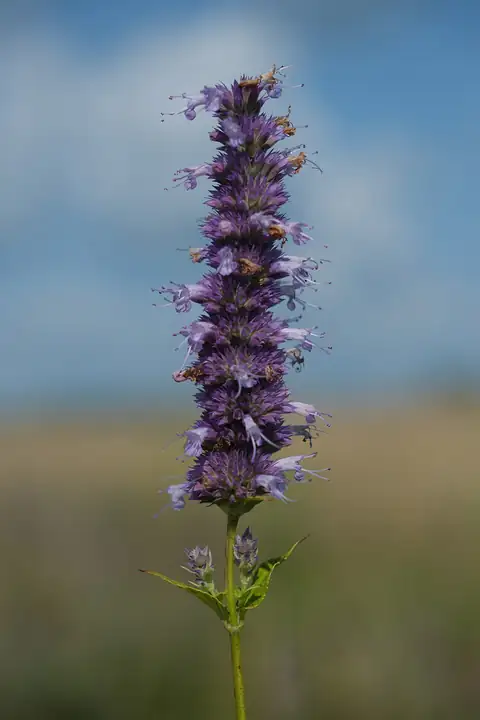
Anise hyssop
Agastache foeniculum · Mint family (Lamiaceae)
| Hardiness zones | 3 to 8 |
|---|---|
| Sun | full sun to part shade |
| Water | low |
| Life cycle | perennial |
| Frost | Hardy: takes frost |
| Spacing | 12 to 36 inches |
About Anise hyssop
Anise hyssop is a native perennial with licorice-scented leaves and lavender flower spikes from midsummer to fall. It is a magnet for bumblebees, butterflies and hummingbirds, and deer tend to leave it alone.
Hardy in zones 3-8 (University of Wisconsin; NC State lists 4-8).
When to plant
Timing is counted from your average last spring frost (and first fall frost). Sow & Tell works out the actual dates for your ZIP code.
Seed needs light to sprout, so barely cover it; it germinates in 1-4 weeks, and cold, moist stratification helps. Divide clumps in spring or fall (University of Wisconsin).
Soil
Tolerates a wide range of soils, including sandy and rocky ones, as long as drainage is good.
Plant in full sun to part shade in any well-drained soil; it tolerates a wide range of soils. Follow a soil test; without one, work about 1 lb of a complete fertilizer such as 10-10-10 per 100 sq ft into the bed, plus 2-3 inches of compost or other organic matter. A pH of 6.0 to 6.5 suits most perennials.
Feeding
- early spring, just before new shoots come up (only if growth is weak or a soil test calls for it): complete fertilizer such as 10-10-10 or 5-10-5. Most perennials need little fertilizer; about 1 lb of 10-10-10 per 100 sq ft is plenty. Scatter it around the plants, keep it off the leaves, and water it in.
Overfed perennials make soft, floppy growth and very few flowers.
Harvest
Flower spikes form by midsummer and keep blooming into fall. Pick leaves for tea any time; plants self-sow, but extra seedlings pull easily (University of Wisconsin).
Varieties (14)
Covers Agastache broadly. Only NC State's plant pages were found with cultivar descriptions, and most are just flower color. Not all Agastache cultivars are true anise hyssop (A. foeniculum); NC State does not give parent species for the hybrids. Zones: 4-8 for A. foeniculum and 5-10 for the genus, per NC State.
| Variety | Type | Days | Notes |
|---|---|---|---|
| Anise hyssop (species) | A. foeniculum | Lavender-blue flower spikes on 3-5 ft plants with anise-scented leaves. | |
| Blue Blazes | A. foeniculum | Purple-lavender flowers. | |
| Golden Jubilee | A. foeniculum | Gold to chartreuse leaves with fragrant lavender-blue flowers. | |
| Acapulco Orange | Agastache cultivar | Orange tubular flowers. | |
| Astello Indigo | Agastache cultivar | Fragrant deep indigo-blue flowers with a minty scent. | |
| Black Adder | Agastache cultivar | Violet-red flowers. | |
| Blue Boa | Agastache cultivar | Blue flowers; shorter than Blue Fortune. | |
| Blue Fortune | Agastache cultivar | Blue flowers. | |
| Firebird | Agastache cultivar | Fragrant coral-orange flowers. | |
| Kudos Ambrosia | Agastache cultivar | Peachy-pink tubular flowers; aromatic leaves help deter deer. | |
| Pink Pearl | Agastache cultivar | Pink flowers. | |
| Poquito Orange | Agastache cultivar | Flowers and leaves have a licorice scent. | |
| Purple Haze | Agastache cultivar | Blue-purple flowers. | |
| Red Happiness | Agastache cultivar | Red tubular flowers. |
Pests to watch for
Rabbits
Diseases and problems
Root and crown rot, Powdery mildew, Rust
In the kitchen
Leaves flavor herbal tea and jellies or are eaten fresh; the flowers are edible, and seeds can go into baked goods.
Keeping it: Pick edible flowers the day you use them; if you must hold them, keep them in a plastic bag in the fridge for a day or so.
Pets: Not listed as toxic by the ASPCA
Sources
- hort.extension.wisc.edu
- plants.ces.ncsu.edu
- aspca.org
- aspca.org
- extension.psu.edu
- extension.illinois.edu
- hgic.clemson.edu
Photo: Photo: Jasper Shide, CC0, via Wikimedia Commons (CC0). Photo resized for the web.

Planting dates and advice are general guidance; check with your local Cooperative Extension office for your area.