
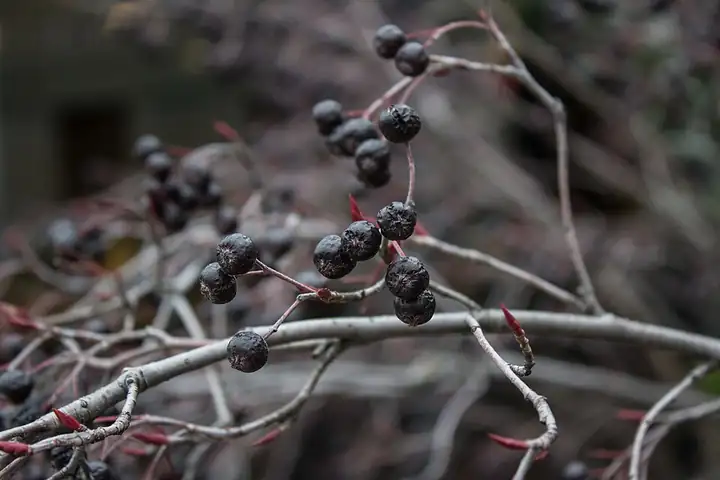
Aronia (black chokeberry)
Aronia melanocarpa · Rose family (Rosaceae)
| Hardiness zones | 3 to 8 |
|---|---|
| Sun | full sun |
| Water | moderate |
| Life cycle | perennial |
| Frost | Hardy: takes frost |
| Soil pH | 5.0–7.0 |
| Spacing | 48 to 84 inches |
About Aronia (black chokeberry)
Aronia is a tough native shrub with white spring flowers, glossy black-purple berries in late summer and red fall color. The berries are very astringent raw, so most people turn them into juice, jelly or wine. It sets fruit without a pollination partner, so one plant will bear.
NC State lists zones 3-8; it needs about 1,000 chill hours, which puts its southern limit near the Georgia-Tennessee line (University of Maryland), and it suckers freely and can spread into a thicket (NC State).
When to plant
Timing is counted from your average last spring frost (and first fall frost). Sow & Tell works out the actual dates for your ZIP code.
Space plants at least 4 feet apart (University of Maryland). Drip irrigation helps new plants through their first two seasons. Plants bear a first crop within two growing seasons, about 3 to 4 pounds per plant, and more than 15 pounds by age 7 or 8 (University of Maryland).
Soil
Adapts to clay, loam or sand and to spots that are wet or dry at times (NC State). Fruit growers keep fertility low so plants stay compact (University of Maine).
Test the soil and amend it as you would for fruit trees (University of Maryland); aim for a pH of about 5.0-7.0, and keep fertility modest so plants stay compact (University of Maine).
Feeding
- Once a year, in October or early March: nitrogen fertilizer such as 21-0-0. About 1/4 to 1/2 ounce of actual nitrogen per plant per year (University of Maryland); follow a soil test.
Too rich a soil makes big, leggy plants; University of Maine notes low fertility keeps them small.
Harvest
Berries ripen in mid- to late August in Maryland; pick them before they begin to wrinkle and dry (University of Maryland). Berries that turn brownish are overripe (University of Maine).
Aronia gives one harvest a year, in mid to late August in Maryland, with yields rising from 3-4 pounds per plant in the first crops to over 15 pounds at 7-8 years old.
Varieties (9)
Sources document 9 named aronia types; Viking, Nero and Galicjanka are the main fruiting varieties. Most sources rate only the species (hardy to Zone 3; UMN gives Zones 3-8), not individual cultivars, so zones are left blank unless a source rates the cultivar. All aronia are self-fruitful. The big-fruited fruiting types (Viking, Nero, McKenzie) are now thought to be chokeberry × mountain ash hybrids.
| Variety | Type | Days | Notes |
|---|---|---|---|
| Glossy black chokeberry (var. elata) | Botanical variety (Aronia melanocarpa var. elata) | Taller form, about 5-7 ft tall and 4-6 ft wide, with white May flowers and bright red and purple fall color. | |
| Galicjanka | Fruiting hybrid (Aronia × mitschurinii, chokeberry × mountain ash) | Large berries, bred for juice and processing. Productive fruiting variety. | |
| Nero | Fruiting hybrid (Aronia × mitschurinii, chokeberry × mountain ash) | Large, fairly sweet dark blue-black berries; astringent raw, better processed. Smaller shrub than Viking, about 3-4 ft tall. Bred for big berries and heavy crops. | |
| Viking | Fruiting hybrid (Aronia × mitschurinii, chokeberry × mountain ash) | Large berries that are sweeter than wild chokeberry, though still astringent when eaten fresh; much milder in juice and jam. Vigorous, productive shrub, about 3-8 ft tall with many stems; glossy leaves turn red in fall. Yielded roughly 9-16 lb per plant in Montana State trials. | |
| McKenzie | Hybrid (×Sorbaronia mitschurinii; conservation release) | Dull purplish-black berries about 1/2 inch across, in large clusters. Tall, many-stemmed shrub, usually 6-12 ft; glossy leaves turn red in fall. Montana State measured 8-21 lb of fruit per plant, similar to Viking. | |
| Autumn Magic | Ornamental (Aronia melanocarpa) | Small berries; Montana State measured high sugar but low yields. Compact shrub, about 3-5 ft tall, with bright red-purple fall color. Yielded only about 1-4 lb per plant in Montana trials. | |
| Iroquois Beauty | Ornamental (Aronia melanocarpa) | Dwarf, spreading shrub about 2-3 ft tall and 4-5 ft wide. | |
| Low Scape Hedger | Ornamental (Aronia melanocarpa) | Narrow, upright shrub about 5 ft tall and 3 ft wide, with white spring flowers and orange fall color. | |
| Low Scape Mound | Ornamental (Aronia melanocarpa) | Edible black berries in summer. Low, dense mound about 2 ft tall and 3 ft wide, with white spring flowers and yellow, orange and red fall color. |
Pests to watch for
Aphids, Japanese beetle, Blister beetles, Stink bugs, Spotted wing drosophila, Scale insects, Birds, Deer, Rabbits
Diseases and problems
Cedar-quince rust, Powdery mildew, Scab
In the kitchen
Used for juice, jelly and wine; some processing is needed to tame the astringent taste (University of Maryland). The raw berries are edible but very puckery (NC State).
Keeping it: Fresh berries keep best in the refrigerator for short spells; for longer, freeze them, which also tames a bit of their pucker (Iowa State).
Safety: The sources we checked list no toxic parts, and we found no research-based guidance on use in pregnancy, drug interactions or allergies.
Pets: Not listed as toxic by the ASPCA
Sources
- extension.umaine.edu
- extension.umd.edu
- plants.ces.ncsu.edu
- plantsservices.sc.egov.usda.gov
- aspca.org
- aspca.org
Photo: Photo: Jason Zhang / Wikimedia Commons, CC BY-SA 3.0 (CC BY-SA 3.0). Photo resized for the web.

Planting dates and advice are general guidance; check with your local Cooperative Extension office for your area.