
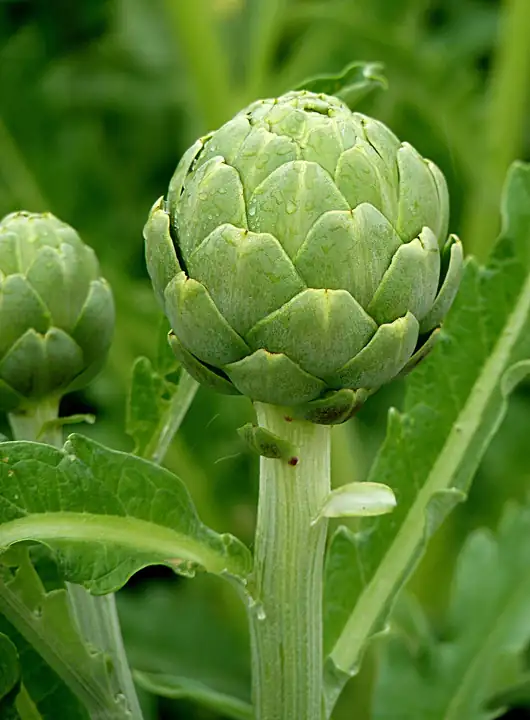
Artichoke
Cynara cardunculus var. scolymus (also listed as Cynara scolymus) · Daisy family (Asteraceae)
| Hardiness zones | 7 to 10 |
|---|---|
| Sun | full sun |
| Water | moderate |
| Life cycle | tender perennial (grown as an annual) |
| Frost | Half-hardy: takes a light frost |
| Spacing | 18 to 36 inches |
| Days to harvest | 90 to 100 days |
About Artichoke
Globe artichokes are big, silvery, thistle-like plants grown for their edible flower buds. They are perennial in mild-winter areas, and gardeners in colder places can grow them as annuals from early transplants.
Perennial only where winters are mild (NC State lists Cynara cardunculus for zones 7-10); crowns are hurt below about 25F and badly damaged below 15F. Elsewhere, grow annual-type varieties such as Imperial Star from transplants.
When to plant
Timing is counted from your average last spring frost (and first fall frost). Sow & Tell works out the actual dates for your ZIP code.
- Start seeds indoors: 11 to 16 weeks before the last frost
- Set out plants: 3 to 4 weeks before the last frost
Days count from transplanting to the first flower buds. Plants need a spell of cool weather (below 50F) to form buds, which is why annual crops are started indoors about 2 to 3 months ahead and set out 3 to 4 weeks before the frost-free date.
Soil
Deep, rich, fertile and well-drained soil; give 1 to 2 inches of water a week in several waterings.
Use rich, well-drained soil with plenty of compost or well-rotted manure worked in; follow a soil test for phosphorus and potassium and mix them in before planting.
Feeding
- 4 weeks after setting out transplants: nitrogen fertilizer such as 21-0-0. Sprinkle about 2 tsp per plant around the base and water it in.
- 8 weeks after transplanting (every 4 weeks): nitrogen fertilizer such as 21-0-0. Repeat about 2 tsp per plant and water it in.
- 12 weeks after transplanting (every 4 weeks): nitrogen fertilizer such as 21-0-0. Repeat about 2 tsp per plant and water it in.
- plants kept over winter: early each spring, before buds start to form: nitrogen fertilizer. Feed once in early spring, spread around the plants and watered in.
Harvest
Cut buds with 1 to 1.5 inches of stem when they reach full size but before the bracts (bud scales) start to open.
Each flower stalk gives 3 to 5 buds and a plant makes several stalks, so harvest runs from late July or August until frost in cold areas. Cut buds as they size up and remove spent stems so new ones can grow; in mild-winter areas plants can be kept for several years.
Varieties (12)
Extension sources document about a dozen globe artichoke varieties. Utah State and Oregon State note that Imperial Star, which needs little chilling to flower, works well as an annual. Texas lists Green Globe at more than 150 days and Imperial Star at more than 100 days.
| Variety | Type | Days | Notes |
|---|---|---|---|
| Imperial Star | Annual (seed-grown), green | A medium plant about 3 feet tall with many thornless buds. It flowers after little chilling, so it works well as an annual, and has good disease resistance. | |
| Green Globe Improved | Green, open-pollinated | Large (over 0.9 lb), round, green, thornless buds. More uniform and higher yielding than Green Globe. | |
| Emerald | Green, seed-grown | Glossy, green, meaty buds that are longer than Imperial Star's. It needs little if any chilling and is about two weeks earlier than Imperial Star. | |
| Grande Beurre | Green, seed-grown | Spineless heads on a very tall plant, up to 9 feet. Grown from seed. | |
| Madrigal | Hybrid, green | Large, slightly elongated, green, thornless buds. Seed germinates well and seedlings are uniform. | |
| Opal | Hybrid, purple | Medium, purple, thornless buds that are cylinder- to cone-shaped. Seed germinates well. | |
| Green Globe | Perennial, green | Large plants with many dark green buds and large hearts. It needs a long cold period to flower, so it does best kept for several years in mild climates. | |
| Purple Sicilian | Purple | A purple globe artichoke grown from seed. Fairly tolerant of heat and cold. | |
| Violetto | Purple | Purplish buds. Cornell lists it among shorter-season types suited to New York. | |
| Talpiot | Seed-grown | An artichoke grown from seed. | |
| Amethyst | Tested in Connecticut, where buds averaged about 6 ounces but a quarter were misshapen. | ||
| Harmony | On Texas A&M's list of artichokes for Texas gardens. |
Pests to watch for
Aphids, Voles
Diseases and problems
Root and crown rot, Powdery mildew
In the kitchen
Buds are steamed or boiled and eaten scale by scale with a dip, or the hearts are grilled, roasted or marinated.
Keeping it: Keep artichokes in a plastic bag in the refrigerator; good ones hold for about two weeks.
Safety: Artichoke leaf products can cause mild diarrhea, nausea and heartburn, may trigger allergies in people sensitive to the daisy family (Asteraceae), and should be avoided by people with certain liver or bile duct problems (European Medicines Agency). EMA limits artichoke leaf medicines to adults and adolescents over 12.
Pets: Not listed as toxic by the ASPCA
Sources
Photo: Photo: Jamain, CC BY-SA 3.0, via Wikimedia Commons (CC BY-SA 3.0). Photo resized for the web.

Planting dates and advice are general guidance; check with your local Cooperative Extension office for your area.