
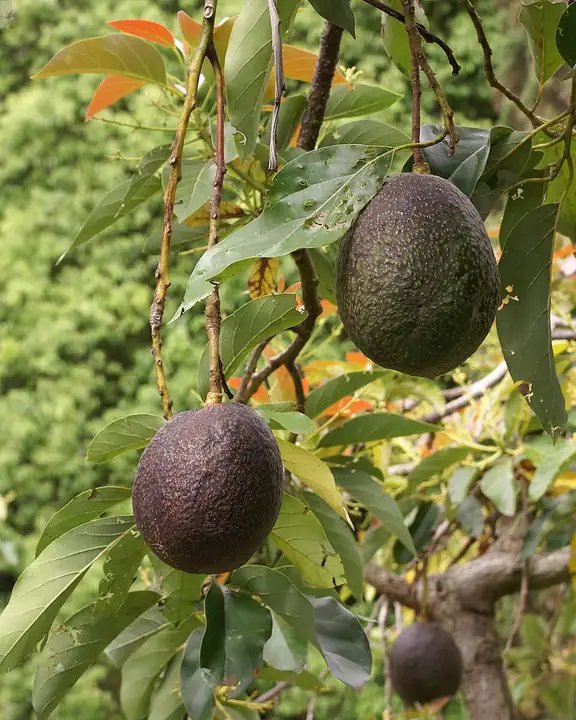
Avocado
Persea americana · Laurel family (Lauraceae)
| Hardiness zones | 9 to 12 |
|---|---|
| Sun | full sun |
| Water | moderate |
| Life cycle | perennial |
| Frost | Tender: killed by frost |
| Soil pH | 6.0–6.5 |
| Spacing | 276 to 360 inches |
About Avocado
The avocado is an evergreen tree that can reach 30-60 ft tall (NC State), so porch growers need a grafted dwarf such as 'Wurtz' (sold as 'Little Cado'), which stays about 10 ft. Mexican-type avocados handle the most cold, and grafted trees start bearing in about 3-4 years. A tree grown from a grocery-store pit makes a nice houseplant but rarely fruits in a pot.
NC State lists zones 9-12. Cold tolerance depends on type: Mexican-type trees can take the low 20s F, Guatemalan types about 24-28 F and West Indian types only about 25-30 F (UF/IFAS); UC Ventura puts damage at 25 F for 'Bacon' and 'Zutano', 28 F for 'Fuerte' and 29 F for 'Hass'.
When to plant
Timing is counted from your average last spring frost (and first fall frost). Sow & Tell works out the actual dates for your ZIP code.
No source ties the move outdoors to a frost date; set a potted tree out after frost danger is past. In the ground, UC Master Gardeners suggest planting March through June, 23-30 ft or more from buildings and other trees (UF/IFAS). Grafted trees bear in about 3-4 years (UF/IFAS; UC Ventura); seedlings take far longer.
Soil
Loose, very well-drained soil; avocados won't tolerate flooding or poor drainage and suffer when soil pH is above 7 (UF/IFAS; UC Ventura).
Test pH first: avocados are very sensitive to pH above 7 and do best around 6-6.5; plant in loose, fast-draining soil or mix (UC Ventura; UC Master Gardeners, Contra Costa).
Feeding
- First year, every 1-2 months while the tree is growing: balanced fertilizer with magnesium, 6-10% nitrogen, phosphate and potash plus 4-6% magnesium. UF/IFAS starts in-ground trees at 1/4 lb and works up to 1 lb per application; UC Ventura instead gives about 1 oz of actual nitrogen per tree for the whole first year, split into 4-5 feedings. Use much less in a pot and follow the label.
- Each later year, spring through summer: the same fertilizer; add potassium once the tree starts bearing (about year 3). UC Ventura doubles the nitrogen each year for the first 5 years; UF/IFAS moves mature trees to 3-4 feedings a year and adds 3-4 sprays of copper, zinc, manganese and boron a year for the first 4-5 years.
- Potted tree indoors for winter: no fertilizer. Hold fertilizer until new growth appears in late winter or early spring (University of Maryland).
Don't overwater or let a pot sit in water: root rot is the main avocado killer (UC Ventura; NC State). Keep mulch at least 6 inches from the trunk (UC Ventura).
Harvest
Avocados don't ripen on the tree. When fruit reaches full size for its variety, pick one large fruit and leave it on the counter: a mature fruit softens in 3-8 days (UF/IFAS). Harvest season depends on the variety.
Avocados give one crop a year, maturing anywhere from June to March in Florida depending on the variety, and the fruit need not all be picked at once. Some varieties bear heavily only every other year; good care reduces that swing.
Varieties (20)
| Variety | Type | Days | Notes |
|---|---|---|---|
| Wurtz (Little Cado) | Flower type A | Good, consistent flavor; about 16% oil. The only true dwarf avocado, about 10 ft tall; medium dark-green fruit of 6-12 oz with thin, shiny skin and a small seed. Takes about 25 F. | |
| Nabal | Guatemalan | Many consider it the best-tasting avocado. Very tender, damaged around 30 F. | |
| Reed | Guatemalan | Columnar tree that needs less room; damaged around 29 F. | |
| Lula | Guatemalan x West Indian hybrid | Pear-shaped 14-24 oz fruit; productive, with high cold tolerance, but very prone to scab. | |
| Choquette | Guatemalan x West Indian hybrid; flower type A | Large 18-40 oz fruit; resists scab, moderately high cold tolerance. | |
| Booth 8 | Guatemalan x West Indian hybrid; flower type B | Fruit of 9-28 oz; moderate cold tolerance; moderately prone to scab. | |
| Monroe | Guatemalan x West Indian hybrid; flower type B | Very large 24-40 oz fruit; moderate cold tolerance; moderately prone to scab. | |
| GEM | Guatemalan; flower type A | UC Riverside rates the flavor excellent. Thick-skinned fruit of 7-11 oz. | |
| Holiday | Guatemalan; flower type A | Dwarf tree with very large 18-24 oz fruit; very tender, damaged around 30 F. | |
| Hass | Hybrid, mostly Guatemalan; flower type A | UC Riverside rates the flavor excellent. Pebbly-skinned 6-14 oz fruit. Frost-sensitive, damaged around 29 F; umbrella-shaped tree. | |
| Gwen | Hybrid; flower type A | Hass-like flavor. Small tree; pebbly 6-15 oz fruit with the stem set off to one side. | |
| Lamb Hass | Hybrid; flower type A | Hass-like flavor. Pebbly fruit of 10-18 oz, usually a shouldered pear shape. | |
| Fuerte | Hybrid; flower type B | Obovate 9-16 oz fruit that hangs well on the tree; damaged around 28 F. | |
| Stewart | Mexican | Lower oil content than Hass. Much more cold-tolerant than Hass, to about 25 F. | |
| Zutano | Mexican | Lower oil content than Hass. Much more cold-tolerant than Hass, to about 25 F. | |
| Mexicola | Mexican; flower type A | Small 4-6.5 oz fruit with smooth, thin skin and a large seed; leaves smell of anise. Takes about 25 F. | |
| Mexicola Grande | Mexican; flower type A | Smooth, thin-skinned 6-7 oz fruit; one of the more cold-tolerant avocados for cool areas. | |
| Bacon | Mexican; flower type B | High oil; unusually pale yellow-green flesh. Smooth, thin-skinned 10-18 oz fruit with a large seed. Heavy, steady bearer and one of the more frost-tolerant avocados, taking about 25 F. | |
| Donnie | West Indian; flower type A | Fruit of 12-20 oz; resists scab but has low cold tolerance, so it needs a frost-free spot. | |
| Pinkerton | Higher oil content. |
Pests to watch for
Scale insects, Twospotted spider mite, Thrips, Roof rats and Norway rats
Diseases and problems
Phytophthora root rot, Scab, Cercospora spot, Anthracnose, Laurel wilt, Potassium deficiency
In the kitchen
The fruit is eaten fresh once it softens after picking (UF/IFAS); Mexican types are the richest in oil and West Indian types the lowest (NC State).
Keeping it: Ripen picked avocados in a paper bag at room temperature (2-5 days), then refrigerate ripe ones for 3-4 days. Sprinkle cut halves with lemon or lime juice and use within a day or two.
Safety: People with a latex allergy may react to avocado; MedlinePlus lists it among the foods most strongly linked to latex allergy. The ASPCA names persin as the toxic compound (listed for horses).
Pets: Toxic to horses (ASPCA): persin can cause breathing trouble, heart failure and swelling
Sources
- ask.ifas.ufl.edu
- ucanr.edu
- ucanr.edu
- ucanr.edu
- ucanr.edu
- ask.extension.org
- plants.ces.ncsu.edu
- extension.umd.edu
- medlineplus.gov
- aspca.org
- invasiveplantatlas.org
Photo: Photo: B.navez, CC BY-SA 3.0, via Wikimedia Commons (CC BY-SA 3.0). Photo resized for the web.

Planting dates and advice are general guidance; check with your local Cooperative Extension office for your area.