
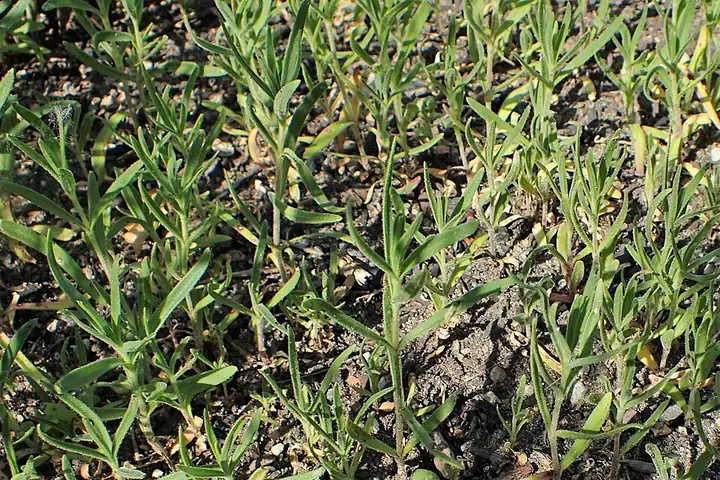
Baby's breath
Gypsophila paniculata (perennial baby's breath) and Gypsophila elegans (annual baby's breath) · Carnation family (Caryophyllaceae)
| Hardiness zones | 3 to 9 |
|---|---|
| Sun | full sun |
| Water | low |
| Life cycle | perennial |
| Frost | Hardy: takes frost |
| Soil pH | 7.0–7.5 |
About Baby's breath
Baby's breath makes airy clouds of tiny white or pink flowers on wiry, much-branched stems, and florists have long used it as the classic filler with roses (NC State, Missouri Botanical Garden). The perennial kind (G. paniculata) comes back for years from a deep, fleshy root, while annual baby's breath (G. elegans) blooms quickly from seed and is grown for fresh bouquets (Kansas State). Neither is native to the U.S.; both come from Europe and Asia. Perennial baby's breath is invasive in places: Washington lists it as a Class C noxious weed, California rates it a B-list noxious weed, and on Great Lakes dunes its deep roots crowd out the threatened Pitcher's thistle (National Park Service), so don't plant it near natural areas.
Perennial baby's breath is hardy in zones 3-9 (NC State, Missouri Botanical Garden); the annual kind is a summer annual in every zone. Invasive: Washington lists G. paniculata as a Class C noxious weed, California rates it a B-list noxious weed, and Michigan's Natural Features Inventory names it a threat to open dunes; NC State notes even the annual can escape gardens.
When to plant
Timing is counted from your average last spring frost (and first fall frost). Sow & Tell works out the actual dates for your ZIP code.
- Sow seeds outdoors: up to 2 weeks after the last frost
Annual baby's breath: sow seed outdoors, lightly covered, once frost danger has passed, and sow again every 2-4 weeks until July for flowers all summer (Kansas State, NC State). Perennial baby's breath grows from seed or cuttings; its big fleshy roots resent moving, and many double kinds are grafted (NC State, UVM). A University of Alaska seed chart starts perennial seed indoors about 7 weeks before setting out, with sprouts in about 10-15 days. No sourced count from sowing to first bloom.
Soil
Average to somewhat dry, well-drained loam or sandy soil that is neutral to alkaline; add lime to acid soil, and avoid wet spots, since poor drainage can kill plants over winter (Missouri Botanical Garden, NC State).
Loosen the soil for sharp drainage and add lime if it's acid; baby's breath does best at about pH 7.0-7.5 (Missouri Botanical Garden, UVM, Virginia Tech).
Feeding
Wet, poorly drained soil can kill plants over winter, and digging up established clumps damages the roots (Missouri Botanical Garden, NC State).
Harvest
Perennial baby's breath blooms from early summer into early fall; shear or cut it back after the first flush for more flowers, but don't cut grafted doubles below the graft (NC State, Missouri Botanical Garden). For bouquets, cut when 60-70% of the tiny flowers are open; for drying, wait until 80-90% are open, then hang bunches upside down in a warm, dry place (Virginia Tech, UC Davis).
Varieties (11)
UVM, NC State and Missouri Botanical Garden document these 11 perennial baby's breath cultivars; we found no sourced cultivar names for annual baby's breath (G. elegans).
| Variety | Type | Days | Notes |
|---|---|---|---|
| Rosenschleier (Rosy Veil) | Hybrid (G. paniculata x G. repens) | Low, about 15 in, with semi-double pink flowers. | |
| Bristol Fairy | Perennial (G. paniculata) | Mounding plant about 2-3 ft with many long-lasting double white flowers; reblooms after shearing. | |
| Compacta Plena | Perennial (G. paniculata) | Shorter, about 18 in, with semi-double white flowers. | |
| Festival | Perennial (G. paniculata) | About 15 in tall, in a pink and white mix of single and double flowers; grown from seed. | |
| Flamingo | Perennial (G. paniculata) | Double pink flowers on plants about 24 in tall. | |
| Perfecta | Perennial (G. paniculata) | Large double white flowers on plants about 30 in tall; the standard cut-flower variety. | |
| Pink Fairy | Perennial (G. paniculata) | Double pink flowers on 18-in plants; blooms until frost. | |
| Pink Star | Perennial (G. paniculata) | Pink flowers on plants about 18 in tall. | |
| Red Sea | Perennial (G. paniculata) | Double rose flowers on tall plants, 3-4 ft. | |
| Schneeflocke (Double Snowflake) | Perennial (G. paniculata) | Tall, about 36 in, with double white flowers. | |
| Viette's Dwarf | Perennial (G. paniculata) | Compact, about 18 in, with double pinkish flowers. |
Pests to watch for
Leafhoppers, Aphids, Slugs, Brown garden snail
Diseases and problems
Gray mold (botrytis), Aster yellows, Crown gall, Stem and root rot
In the kitchen
Keeping it: Keep cut stems cool and away from ripening fruit: ethylene gas from fruit makes the tiny flowers wilt and the buds stop opening (UC Davis, Oklahoma State).
Safety: NC State rates it medium for poisoning: it may contain saponins, and handling it often can irritate the eyes, nose and sinuses, set off asthma or cause a skin rash. Wear gloves when you cut a lot of it, and don't eat it.
Pets: The ASPCA lists baby's breath (Gypsophila elegans) as non-toxic to dogs, cats and horses, though eating it may cause mild stomach upset such as vomiting and diarrhea.
Sources
- plants.ces.ncsu.edu
- plants.ces.ncsu.edu
- missouribotanicalgarden.org
- pss.uvm.edu
- bookstore.ksre.ksu.edu
- vtechworks.lib.vt.edu
- postharvest.ucdavis.edu
- uaf.edu
- nwcb.wa.gov
- blogs.cdfa.ca.gov
- nps.gov
- mnfi.anr.msu.edu
- aspca.org
Photo: Photo: Krzysztof Ziarnek, Kenraiz, CC BY-SA 4.0, via Wikimedia Commons (CC BY-SA 4.0). Photo resized for the web.

Planting dates and advice are general guidance; check with your local Cooperative Extension office for your area.