
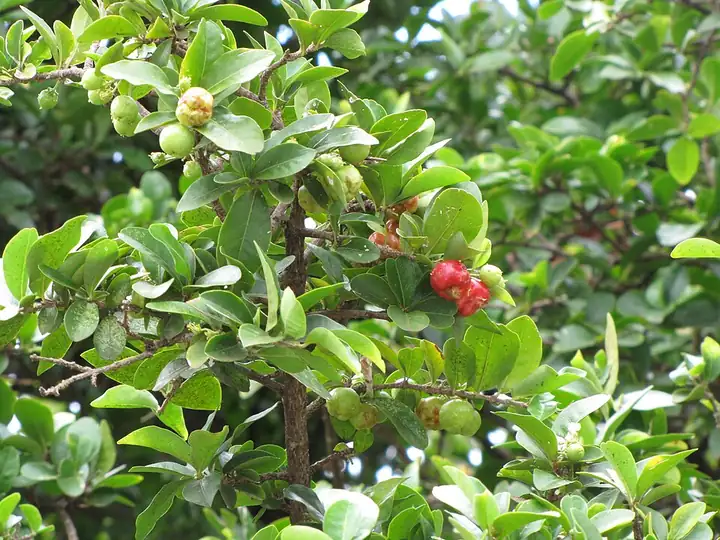
Barbados cherry (acerola)
Malpighia emarginata (often sold as M. glabra or M. punicifolia) · Malpighia family (Malpighiaceae)
| Hardiness zones | 9 to 11 |
|---|---|
| Sun | full sun |
| Water | moderate |
| Life cycle | perennial |
| Frost | Tender: killed by frost |
| Soil pH | 6.0–7.0 |
| Spacing | 120 to 180 inches |
About Barbados cherry (acerola)
Barbados cherry, or acerola, is a bushy evergreen shrub or small tree with pink flowers and bright red, cherry-like fruit that is among the richest known sources of vitamin C. It blooms off and on from spring to fall, and each flush ripens in just 3-4 weeks, so a plant can give several crops a year. It makes a good hedge or a big potted plant; UF/IFAS says it is not known to be invasive in Florida.
UF/IFAS lists zones 9b-11. Young plants die below about 30 F, and mature trees survive only brief dips to about 28 F (Morton, Purdue NewCROP; UF/IFAS), so in the ground it suits south Florida and other nearly frost-free spots, and elsewhere it is grown in a pot. UF/IFAS Extension (Sarasota) notes its native range reaches Texas; it is not considered invasive in Florida.
When to plant
Timing is counted from your average last spring frost (and first fall frost). Sow & Tell works out the actual dates for your ZIP code.
Plant in spring at the start of the rainy season, 10-15 ft apart, or 5-6 ft apart for a hedge (UF/IFAS). Water new plants 2-3 times a week for the first 2-3 months. Plants can fruit the year after planting and give a good crop by year 3 or 4 (Morton, Purdue NewCROP).
Soil
Well-drained sandy, limestone, marl or clay soil; aim for pH 6.0-7.0, liming soils more acid than about 5.5 (UF/IFAS; Morton, Purdue NewCROP). It needs soil free of root-knot nematodes and can't stand soggy roots.
Test the soil first; work compost or pine bark into well-drained sandy soil and aim for pH 6.0-7.0 (UF/IFAS St. Lucie County).
Feeding
- Young trees, every two months: balanced fertilizer. UF/IFAS St. Lucie County uses about 1/4 lb per young tree every two months.
- Mature trees, three times a year, including after the late crop and light pruning: balanced fertilizer. UF/IFAS uses 2-4 lb per application on mature in-ground trees; scale way down for a pot and follow a soil test.
- Alkaline soil or when deficiency shows: foliar iron, zinc and boron (micronutrient spray). Spray as the label directs (UF/IFAS); on limestone soils copper and zinc sprays also help (Morton).
Avoid poorly drained soil and soil with root-knot nematodes, which stunt the plant (UF/IFAS; Morton).
Harvest
Fruit ripens 3-4 weeks after bloom and is ready when bright red and slightly soft; pick every day or every few days, in the cool of the morning, because it bruises and spoils fast (UF/IFAS; Morton). In Florida the main crop comes in May, with more flushes into fall.
It blooms in flushes from spring to fall, and each flush ripens in 3-4 weeks, so Florida plants give 3-5 or more crops a year. Water during dry spells to keep it blooming, and pick every day or few days.
Varieties (3)
Sources describe 3 Florida and Puerto Rico cultivars; the USDA-ARS Hilo collection also holds 'Manoa Sweet', 'Hawaiian Queen', 'Tropical Ruby', 'Maunawili', 'F. Haley', 'C. F. Rehnborg' and 'Red Jumbo', but we found no description of them.
| Variety | Type | Days | Notes |
|---|---|---|---|
| B-15 | A Puerto Rico selection that out-yielded nine other clones in 1955-56 trials and had the highest vitamin C of those tested. | ||
| B-17 | An early Puerto Rico selection. | ||
| Florida Sweet | Semi-sweet, apple-like flavor. Upright plant with large, thick-skinned fruit and high yields; selected at Homestead, Florida, in 1956. |
Pests to watch for
Aphids, Whiteflies, Scale insects, Root-knot nematodes, Stink bugs, Birds
Diseases and problems
Leaf spot, Anthracnose, Algal leaf spot (green scurf)
In the kitchen
Eat ripe fruit fresh, or turn it into juice, syrup, jelly, jam, sherbet and dessert sauces; the juice is very high in vitamin C (UF/IFAS; Morton, Purdue NewCROP).
Keeping it: The fruit bruises easily and spoils fast at room temperature, so refrigerate or freeze it soon after picking (UF/IFAS); juice loses vitamin C in the fridge, so use it within a week (Morton).
Safety: Fine hairs on the leaves and leaf stems can irritate skin, so wear gloves and long sleeves when picking or pruning (UF/IFAS; Morton). Spit out the seeds: children in Curacao who ate whole fruit, seeds and all, have needed treatment for intestinal blockage (Morton, Purdue NewCROP).
Pets: Not listed by the ASPCA
Sources
- ask.ifas.ufl.edu
- blogs.ifas.ufl.edu
- blogs.ifas.ufl.edu
- hort.purdue.edu
- ars.usda.gov
- aspca.org
- aspca.org
- aspca.org
- extension.umd.edu
- yardandgarden.extension.iastate.edu
Photo: Photo: Forest and Kim Starr / Wikimedia Commons, CC BY 3.0 US (CC BY 3.0 US). Photo resized for the web.

Planting dates and advice are general guidance; check with your local Cooperative Extension office for your area.