
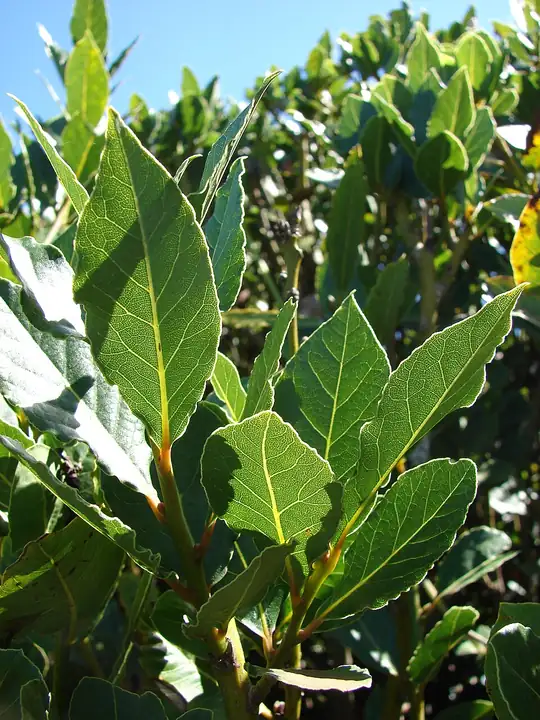
Bay laurel
Laurus nobilis · Laurel family (Lauraceae)
| Hardiness zones | 8 to 10 |
|---|---|
| Sun | full sun to part shade |
| Water | moderate |
| Life cycle | perennial |
| Frost | Half-hardy: takes a light frost |
About Bay laurel
Bay laurel, or sweet bay, is a slow-growing evergreen tree from the Mediterranean whose leathery leaves are the bay leaves used in soups and stews. It takes clipping well, so it is a classic formal pot or topiary that lives outdoors in summer and in a cool, bright room in winter. Male and female flowers grow on separate plants.
NC State lists zones 8b-10b and Oregon State calls it hardy to zone 8; older plants may take cold near 0 F but young ones are not reliably hardy (Clemson), so most gardeners north of zone 8 keep it in a pot.
When to plant
Timing is counted from your average last spring frost (and first fall frost). Sow & Tell works out the actual dates for your ZIP code.
No source ties the move outdoors to a frost date; set potted bay out after hard frosts are over. Bay grows slowly (Clemson). New plants come from semi-ripe cuttings in late summer, softwood cuttings in early summer, or fresh seed sown in fall (RHS).
Soil
Fertile, well-drained soil; it handles clay, loam or sand and short dry spells, but waterlogged roots cause leaf spots and yellowing (NC State; Clemson; RHS).
Use a well-drained, soil-based or soilless potting mix with extra grit (RHS); in the ground, fertile, well-drained soil, with lime and fertilizer based on a soil test (Clemson).
Feeding
- Potted plants, mid-spring through late summer: controlled-release fertilizer granules, or a liquid fertilizer. Mix slow-release granules into the potting mix once, or give a liquid feed every two weeks from mid-spring to late summer (RHS).
- Fall and winter: no fertilizer. Stop feeding at the end of summer and water sparingly while it rests indoors (RHS; University of Maryland).
Most herbs don't need very fertile soil (Clemson); overwatering and waterlogged mix, not hunger, cause most yellow or spotted bay leaves (RHS).
Harvest
Pick leaves any time of year and use them fresh or dried (Clemson).
This evergreen shrub can be picked any time of year, fresh or for drying, and it tolerates regular pruning.
Varieties (3)
Sources document only 3 named bay forms besides the common species, which the RHS notes is the one most grown for cooking. Hardiness ratings are the RHS UK scale converted to Fahrenheit.
| Variety | Type | Days | Notes |
|---|---|---|---|
| Aurea | Golden-leaved bay | Golden-yellow leaves, brightest in winter and spring; large conical shrub, 13-26 ft in time. Hardy to about 14-23 F (RHS H4). | |
| Saratoga | Hybrid bay (thought to be L. nobilis x L. azorica) | Leaves can be used in cooking; the flavor differs slightly from common bay. Open habit with larger, rounder, lighter olive-green leaves; new growth tinged red. Grows 20-30 ft in the ground. Resists laurel psyllid and soft scale. | |
| Willow-leaved bay (f. angustifolia) | Narrow-leaved bay | Leaves are thinner than common bay but still good for cooking. Long, narrow, wavy-edged leaves on a bushy shrub or small tree. Hardy to about 14-23 F (RHS H4). |
Pests to watch for
Scale insects
Diseases and problems
Laurel wilt, Phytophthora root rot, Leaf spot
In the kitchen
Leaves flavor soups, stews and pasta dishes while they cook, fresh or dried (NC State; RHS). Take the leaves out before serving.
Keeping it: Pick leaves as you need them all year. Dried leaves keep their aroma for about a year in an airtight jar in a cool, dark cupboard.
Safety: Don't eat the leaves: whole leaves are a choking hazard and can damage the digestive tract (NC State). Don't confuse bay with cherry laurel or other 'laurels', which are poisonous (Grieve).
Pets: Toxic to dogs, cats and horses (ASPCA): eugenol and other essential oils cause vomiting and diarrhea, and large amounts of whole leaves can cause a blockage
Sources
- plants.ces.ncsu.edu
- hgic.clemson.edu
- hgic.clemson.edu
- rhs.org.uk
- landscapeplants.oregonstate.edu
- aspca.org
- botanical.com
- extension.umd.edu
Photo: Photo: Forest and Kim Starr, CC BY 3.0 us, via Wikimedia Commons (CC BY 3.0 us). Photo resized for the web.

Planting dates and advice are general guidance; check with your local Cooperative Extension office for your area.