
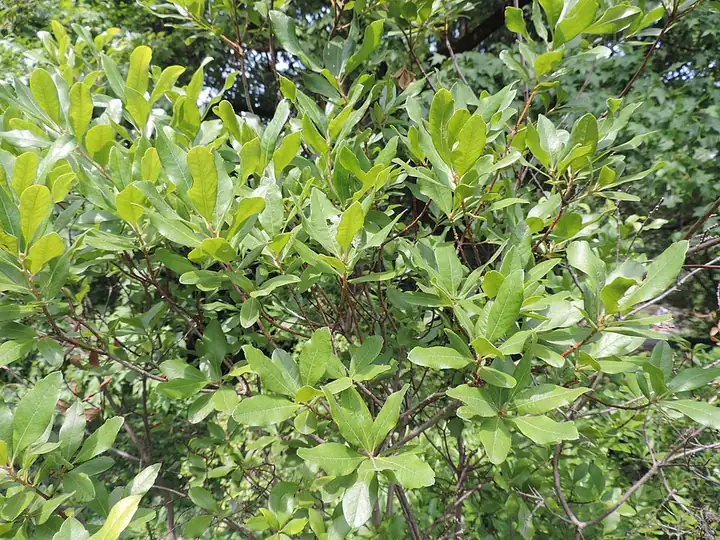
Bayberry and wax myrtle
Morella pensylvanica (northern bayberry; syn. Myrica pensylvanica) and M. cerifera (southern wax myrtle; syn. Myrica cerifera) as groups · Bayberry family (Myricaceae)
| Hardiness zones | 3 to 10 |
|---|---|
| Sun | full sun to part shade |
| Water | moderate |
| Life cycle | perennial |
| Frost | Hardy: takes frost |
| Soil pH | 6.0–6.5 |
| Spacing | 36 to 48 inches |
About Bayberry and wax myrtle
Bayberries are tough, aromatic native shrubs whose female plants carry clusters of small gray, wax-coated berries through winter; colonists boiled the berries for the wax to make fragrant bayberry candles (NRCS, Clemson). Northern bayberry is a deciduous to semi-evergreen shrub of the coast from Newfoundland to North Carolina and inland to Ohio; wax myrtle is a fast-growing evergreen shrub or small tree native from New Jersey to Florida and Texas (NRCS, wildflower.org, Clemson). Both shrug off salt spray, poor sandy soil and drought, fix their own nitrogen, and feed yellow-rumped warblers, tree swallows and many other birds in winter (NC State, NRCS). Wax myrtle has gone wild on Maui and the Big Island, and Hawaii's invasive species groups ask people not to plant it there (KISC).
Northern bayberry is hardy in zones 3-8 (NRCS) and wax myrtle in zones 7-10 (Clemson), where its leaves may brown or drop in hard cold. Wax myrtle is a do-not-plant species in Hawaii (advisory).
When to plant
Timing is counted from your average last spring frost (and first fall frost). Sow & Tell works out the actual dates for your ZIP code.
Plant container shrubs in spring or fall into weed-free ground and mulch; skip fertilizer, which mostly feeds weeds (NRCS). Space hedge plants 3-4 ft apart (NRCS). Plants are male or female: for berries, plant females with at least one male nearby, NRCS suggests about one male for every four females (NRCS, NC State). Wax myrtle needs steady water until established (NC State).
Soil
Sandy or peaty, slightly acid, well-drained soil is best, but both handle poor soil, salt spray, wind, drought and occasional wet spells; wax myrtle takes swampy ground once established (NRCS, NC State, wildflower.org).
Clear weeds and grass first, since young bayberry competes poorly; aim for slightly acid soil (pH 6.0-6.5) and base any amendments on a soil test (NRCS).
Feeding
Water is what new shrubs need most: daily for the first 2 weeks, every 2-3 days through week 12, then weekly until the roots spread, at least two growing seasons, using about a quarter to a third of the nursery pot's volume each time (UMN). Wax myrtle needs steady moisture its first season; in high-pH soil its leaves can yellow between the veins (iron chlorosis) (NC State, Clemson).
Harvest
Small, non-showy catkins open in spring; gray, waxy berries ripen on female plants from late summer and last into the next spring (NC State, NRCS). Berries form on last year's growth, so heavy pruning cuts the crop (NC State); northern bayberry also dislikes heavy pruning (NRCS). Wax myrtle can be limbed up into a small multi-trunk tree (Clemson).
Varieties (11)
NRCS, NC State and Clemson document these. Plants are male or female, so pair a female with a male for berries.
| Variety | Type | Days | Notes |
|---|---|---|---|
| Bobbee ('Bobzam') | Northern bayberry | Female; more compact than wild plants, with larger, glossier, wavy leaves. | |
| Myda | Northern bayberry | Female selected for heavy fruiting; 'Myriman' is its male partner. | |
| Northern Girl | Northern bayberry | Female selected for heavy fruit set. | |
| Silver Sprite ('Morton') | Northern bayberry | Compact female; the parent plant was about 5 ft tall after 15 years. | |
| Silver Sprite male ('Morton Male') | Northern bayberry | Compact male pollinator that blooms with 'Morton'. | |
| Wildwood | Northern bayberry | Seed-grown conservation release (Cape May Plant Materials Center, 1993) chosen for vigor, survival and pest resistance; not sexed. | |
| Don's Dwarf | Wax myrtle | Compact female, 3-5 ft tall and wide; resists leaf spot. | |
| Fairfax | Wax myrtle | Compact and mounding, 6-8 ft, with smaller, lighter green leaves; spreads into colonies. | |
| Hiwassee | Wax myrtle | Larger and more cold hardy than the species; came through -4 F in Tennessee without leaf burn. | |
| Tom's Dwarf | Wax myrtle | Male, 3-4 ft (possibly 6) tall and 4-6 ft wide; resists leaf spot. | |
| Wolf Bay | Wax myrtle | More upright and denser than the species, to 20 ft. |
Diseases and problems
Leaf spot, Anthracnose, Iron chlorosis
In the kitchen
Safety: Not food: NRCS notes the berry wax is considered toxic and possibly cancer-causing, so don't eat the berries or the wax. Wax myrtle's aromatic leaves and stems burn easily; NC State says to keep it out of the defensible space around a house in fire-prone areas.
Pets: Not listed by the ASPCA.
Sources
- plants.ces.ncsu.edu
- plants.ces.ncsu.edu
- wildflower.org
- wildflower.org
- plants.sc.egov.usda.gov
- hgic.clemson.edu
- ask.ifas.ufl.edu
- kauaiisc.org
- extension.rutgers.edu
- aspca.org
- aspca.org
- extension.umn.edu
- hgic.clemson.edu
Photo: Photo: Krzysztof Ziarnek, Kenraiz / Wikimedia Commons, CC BY-SA 4.0 (CC BY-SA 4.0). Photo resized for the web.

Planting dates and advice are general guidance; check with your local Cooperative Extension office for your area.