
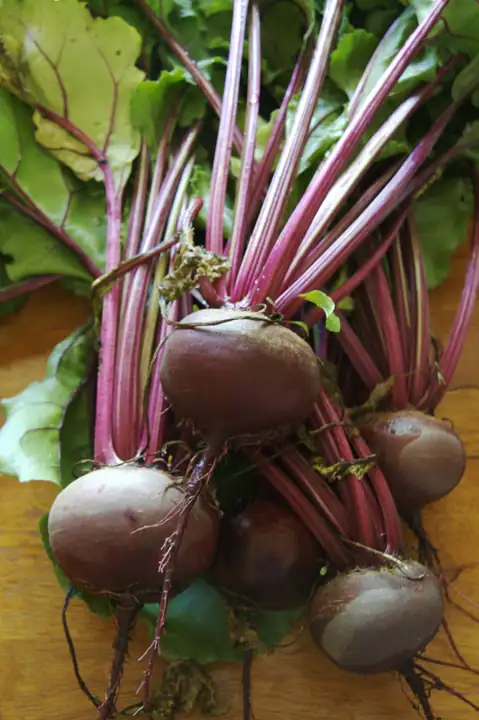
Beet
Beta vulgaris · Amaranth family (Amaranthaceae)
| Hardiness zones | 2 to 11 |
|---|---|
| Sun | full sun |
| Water | moderate |
| Life cycle | biennial |
| Frost | Half-hardy: takes a light frost |
| Soil pH | 6.2–6.5 |
| Spacing | 3 to 4 inches |
| Days to harvest | 50 to 80 days |
| Soil temperature to plant | at least 40°F |
About Beet
Beets give two crops in one: sweet roots and tender greens. They are fairly frost hardy and taste best after a spell of cool, frosty weather.
Grown as a cool-season annual in every zone; time it for the cool weather of spring or fall.
When to plant
Timing is counted from your average last spring frost (and first fall frost). Sow & Tell works out the actual dates for your ZIP code.
- Sow seeds outdoors: 2 to 4 weeks before the last frost
- Fall planting: 7 to 10 weeks before the first fall frost
Days count from seeding; it takes about 60 days for roots to reach 1 1/2 inches. Sow again every 3 to 4 weeks until midsummer; water stress in the first 6 weeks can make plants flower early.
Soil
Fertile, deep, well-drained sandy soil rich in organic matter, kept evenly moist to avoid cracked roots.
Follow a soil test; if you use compost, work in no more than about 1 inch over each 100 sq ft.
Feeding
- about 6 weeks after the seedlings come up: nitrogen fertilizer such as 21-0-0. Use about 1/4 cup per 10 ft of row, beside the plants, and water it in.
Beets need enough boron; black, sunken spots in the roots usually mean the soil is low in it, so follow a soil test.
Harvest
Pull roots any time they begin to size up; about 2 inches across is ideal, and roots over 3 inches can turn tough. Young leaves 4 to 6 inches tall can be picked for greens.
Pull each root once it sizes up (roots mature about 60 to 80 days from seed) and before heavy frosts; young leaves 4 to 6 inches tall can be picked for greens along the way. Sow every 2 to 3 weeks for a steady supply.
Varieties (27)
| Variety | Type | Days | Notes |
|---|---|---|---|
| Green Top Bunching | Bunching | 52 days | |
| Cylindra | Cylindrical | Long, cylinder-shaped dark red root about 6 inches long that gives many even slices; the leaves make good greens. | |
| Bull's Blood | Dark-leaf heirloom | Dark red beet grown mostly for its deep red tops. | |
| Boldor | Golden | 55 days | Dark golden beet whose yellow flesh keeps its color when cooked. |
| Burpee's Golden (Golden Beet) | Golden | Orange skin and yellow flesh; the color turns a golden yellow when cooked. | |
| Golden Boy | Golden | 60 days | High sugar content. Bright yellow, round roots. |
| Touchstone Gold | Golden | Bright gold flesh with green tops. | |
| Badger Flame | Golden (oblong) | 55 days | Mild and sweet, bred to reduce the earthy taste. Oblong golden roots. |
| Big Red | Round red | ||
| Bohan | Round red | 53 days | Grows vigorously even under stress. |
| Boro | Round red | 50 days | Very sweet. Smooth, dark red roots that grow quickly. Popular for baby beets. |
| Burpee's Red Ball | Round red | Smooth, uniform globe about 3 inches across, dark red, with medium-tall upright tops. | |
| Detroit Dark Red | Round red | 56 days | Smooth, uniform, globe-shaped root with deep red flesh. |
| Detroit Supreme | Round red | ||
| Eagle | Round red | 53 days | Very good flavor and texture. Round, uniform, smooth, dark red roots. |
| Early Wonder Tall Top | Round red | ||
| Merlin | Round red | 55 days | Very good eating quality. Round, smooth, dark red roots. |
| Pacemaker II | Round red | 50 days | |
| Red Ace | Round red | Red roots with red-veined leaves. | |
| Red Cloud | Round red | 55 days | Very sweet. Smooth, rich red roots with no light rings inside. |
| Ruby Queen | Round red | 55 days | Smooth, round, uniform root with a fine taproot and small crown. |
| Sangria | Round red | Beet recommended for Oklahoma home gardens. | |
| Sweet Dakota Bliss | Round red | 55 days | Sweet roots and tasty greens. Burgundy roots and lush leaves, good for both roots and greens. Bred in North Dakota. |
| Kestrel | Round red (baby beet) | Sweet. Deep red roots often picked small as baby beets. | |
| Lutz Green Leaf | Storage type | ||
| Chioggia | Striped (Italian heirloom) | Very sweet. Italian heirloom whose flesh shows rings of red (or pink) and white when sliced. 'Guardsmark Chioggia' is a selection of it. | |
| Avalanche | White | White-fleshed beet. |
Pests to watch for
Leafminers, Flea beetles, Wireworms, Mice (house mice and deer mice), Garden symphylan, Beet armyworm, Seedcorn maggot, Blister beetles, Voles
Diseases and problems
Leaf spots, Root rots, Yellows, Hail and wind damage, Boron deficiency, Herbicide injury, Mosaic viruses, Powdery mildew, Damping-off, Cercospora leaf spot, Common scab, Curly top
In the kitchen
Roots are roasted, boiled or pickled; young greens are cooked like spinach.
Keeping it: Twist off the tops, leaving an inch of stem, and refrigerate roots in a plastic bag for up to 3 weeks; in a cold, humid cellar they can keep for months. Cook the greens within a few days.
Pets: Listed as non-toxic to dogs, cats and horses (ASPCA); large mature leaves contain oxalic acid.
Sources
- extension.usu.edu
- extension.illinois.edu
- extension.colostate.edu
- yardandgarden.extension.iastate.edu
- warren.cce.cornell.edu
- extension.umd.edu
- aspca.org
Photo: Photo: BriannaWalther, CC BY-SA 3.0, via Wikimedia Commons (CC BY-SA 3.0). Photo resized for the web.

Planting dates and advice are general guidance; check with your local Cooperative Extension office for your area.