
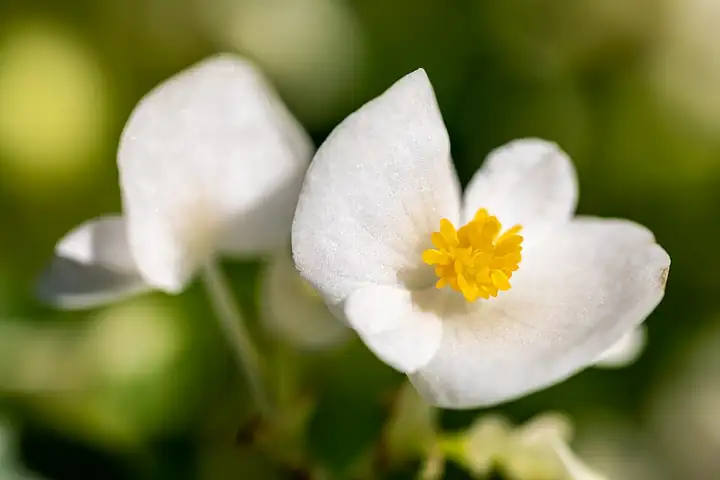
Begonia
Begonia × semperflorens-cultorum (wax begonia), B. × tuberhybrida (tuberous begonia), B. rex hybrids (Rex or painted-leaf begonia), B. × hybrida 'Dragon Wing' and kin · Begonia family (Begoniaceae)
| Hardiness zones | 9 to 12 |
|---|---|
| Sun | part shade |
| Water | moderate |
| Life cycle | tender perennial (grown as an annual) |
| Frost | Tender: killed by frost |
| Spacing | 6 to 12 inches |
About Begonia
Begonias are shade-garden favorites with waxy or showy leaves and flowers from spring to frost. Wax begonias are tough little bedding plants; tuberous begonias have big rose-like flowers for cool, shady spots; Rex begonias are grown for their painted leaves; and Dragon Wing types make arching 2-3 foot plants that bloom nonstop in sun or shade (Clemson). Bronze-leaved wax begonias handle more sun than green-leaved ones.
Grown as a summer annual in most of the US; wax begonias survive winter only in about zones 9-11 and Rex begonias in 10-12 (NC State). Tuberous begonias aren't hardy in the North; dig and store the tubers (UMN). UF/IFAS rates wax begonia 'caution - manage to prevent escape' in Florida (advisory).
When to plant
Timing is counted from your average last spring frost (and first fall frost). Sow & Tell works out the actual dates for your ZIP code.
- Start seeds indoors: 12 to 16 weeks before the last frost
- Set out plants: up to 2 weeks after the last frost
Sow the dust-fine wax begonia seed on the surface, uncovered, at 68-75 F about 12 weeks before planting out; tuberous begonia seed needs 14-16 weeks (Clemson). Start tuberous begonia tubers indoors 8-10 weeks before the last frost, hollow side up, about 1/2-1 inch deep at around 70 F; they flower 12-14 weeks after planting (Iowa State). Set plants out after frost, wax begonias 6-8 inches apart and other bedding kinds about 12 inches (Clemson). In fall, dig tuberous begonias when the leaves yellow or after the first frost, cure them dry, and store them in peat or vermiculite at 40-50 F (UMN); bring potted wax begonias indoors to a cool spot and water less (NC State).
Soil
Moist, well-drained soil rich in organic matter; wax begonias like fertile soil, and Rex begonias like slightly acid soil and hate wet feet (Clemson, NC State).
Work in organic matter for moist, well-drained soil; wax begonias like fertile soil (Clemson).
Feeding
- Tuberous begonias started indoors, once shoots appear: diluted balanced fertilizer. Feed with a dilute solution every 2-3 weeks while they grow indoors (Iowa State).
- Tuberous begonias, through the summer until the end of August: dilute balanced fertilizer. Tuberous begonias are fairly heavy feeders; feed lightly but regularly, then stop at the end of August so the tubers can go dormant (UMN).
Most begonias aren't heavy feeders; too much fertilizer or water makes tuberous begonias drop their buds (Clemson). Don't water when hot sun is on the leaves, and test insecticidal soap on a few leaves first, since begonias can be sensitive to it (Clemson).
Harvest
Wax and Dragon Wing begonias bloom from spring until frost and don't need deadheading; Dragon Wing is sterile, so it keeps reblooming (Clemson). Tuberous begonias bloom through summer; too much water or fertilizer makes them drop buds (Clemson, UMN).
Varieties (20)
| Variety | Type | Days | Notes |
|---|---|---|---|
| BabyWing | Hybrid begonia (B. × hybrida) | A compact Dragon Wing type, 12-15 in tall. | |
| BIG series | Hybrid begonia (B. × hybrida) | Up to 36 in tall with green or bronze leaves and red or rose flowers. | |
| Dragon Wing | Hybrid begonia (B. × hybrida) | Sterile, so it keeps blooming spring to frost; 2-3 ft arching canes, glossy leaves, pink or red flowers; grows in sun or shade. | |
| Black Magic | Rex begonia (B. rex hybrids) | Deep greenish-black wing-shaped leaves with raised dots and red undersides. | |
| Fireworks | Rex begonia (B. rex hybrids) | 6-14 in tall; silver wing-shaped leaves with a maroon burst. | |
| Helen Teupel | Rex begonia (B. rex hybrids) | About 12 in tall; deeply lobed purplish-red leaves brushed with pink and silver. | |
| Merry Christmas | Rex begonia (B. rex hybrids) | 10-12 in tall; lopsided heart-shaped leaves in red and green. | |
| Painter's Palette (T REX) | Rex begonia (B. rex hybrids) | 16 in tall and wide; black, white, red and green leaves; tolerates heat and humidity. | |
| Raspberry Swirl | Rex begonia (B. rex hybrids) | Spiraled leaves with silver-green edges and a raspberry-red center. | |
| Go Go Yellow | Tuberous begonia (B. × tuberhybrida) | Yellow-flowered tuberous begonia. | |
| Illumination series | Tuberous begonia (B. × tuberhybrida) | Trailing tuberous begonia with double flowers in many colors; a favorite for hanging baskets. | |
| Non-stop series | Tuberous begonia (B. × tuberhybrida) | Compact multiflora tuberous begonia with smaller flowers; handles heat better and blooms longer, so it's the best tuberous type for the South. | |
| Ambassador series | Wax begonia (B. × semperflorens-cultorum) | Large flowers on compact, green-leaved plants. | |
| Barbara Rogers | Wax begonia (B. × semperflorens-cultorum) | Large white flowers on a clump that can reach nearly 5 ft. | |
| Cocktail series | Wax begonia (B. × semperflorens-cultorum) | 6-8 in tall with bronze leaves; colors named Brandy (pink), Gin (rose-pink), Rum (white edged rose-red), Vodka (red) and Whiskey (white). | |
| Party Pink | Wax begonia (B. × semperflorens-cultorum) | Pink flowers over bronze leaves. | |
| Pizzazz series | Wax begonia (B. × semperflorens-cultorum) | 8-10 in tall in white, red and pink; blooms heavily. | |
| Prelude series | Wax begonia (B. × semperflorens-cultorum) | Compact with bright green leaves; stands up to rain and heat. | |
| Senator series | Wax begonia (B. × semperflorens-cultorum) | 'Senator Red' has red flowers. | |
| Whopper Rose Bronze Leaf | Wax begonia (B. × semperflorens-cultorum) |
Pests to watch for
Mealybugs, Twospotted spider mite, Thrips, Scale insects, Slugs, Brown garden snail
Diseases and problems
Gray mold (botrytis blight), Powdery mildew, Pythium root rot, Stem rot, Bacterial leaf spot, Impatiens necrotic spot virus, Tomato spotted wilt
In the kitchen
Safety: NC State lists begonias as poisonous with low severity: the roots hold the most calcium oxalate, which burns the mouth and throat if eaten. Rex begonia sap can irritate skin. Don't eat any part.
Pets: Toxic to dogs, cats and horses (ASPCA): soluble calcium oxalates cause drooling and vomiting in dogs and cats, the underground parts are the most toxic, and grazing animals have had kidney failure.
Sources
- hgic.clemson.edu
- plants.ces.ncsu.edu
- plants.ces.ncsu.edu
- extension.umn.edu
- yardandgarden.extension.iastate.edu
- hort.extension.wisc.edu
- assessment.ifas.ufl.edu
- aspca.org
- rutgersgardens.rutgers.edu
Photo: Photo: Dietmar Rabich / Wikimedia Commons, CC BY-SA 4.0 (CC BY-SA 4.0). Photo resized for the web.

Planting dates and advice are general guidance; check with your local Cooperative Extension office for your area.