
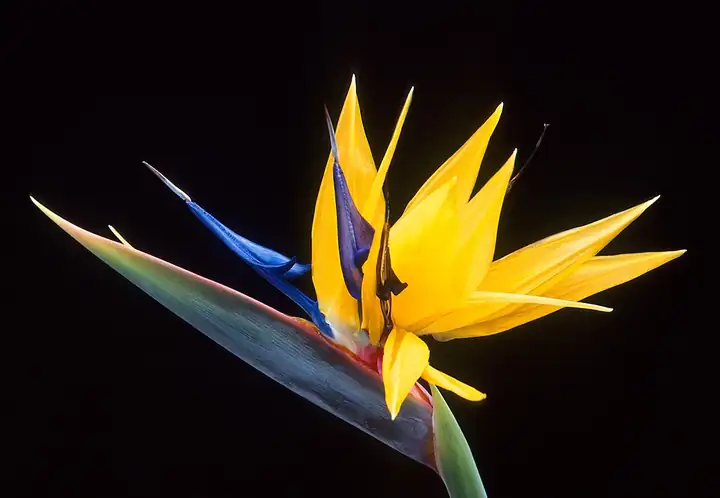
Bird of paradise
Strelitzia reginae (orange bird of paradise); the giant white bird of paradise is S. nicolai · Bird of paradise family (Strelitziaceae)
| Hardiness zones | 10 to 12 |
|---|---|
| Sun | full sun to part shade |
| Water | moderate |
| Life cycle | perennial |
| Frost | Tender: killed by frost |
About Bird of paradise
Bird of paradise is a clumping South African plant with stiff, paddle-shaped gray-green leaves on long stalks and, in enough sun, a beaked orange-and-blue flower that looks like a crane's head (NC State, Clemson). Indoors it is grown mostly as a big, architectural foliage plant 3-5 ft tall; it needs a very sunny window and a few years of maturity to bloom. The giant white bird of paradise, S. nicolai, is the tree-like one sold for tall rooms and can reach 30 ft outdoors (Clemson).
Hardy outdoors only in zones 10-12 (NC State); it is grown indoors everywhere and can summer outdoors in a sunny to lightly shaded spot once nights stay above about 60 F, which is also when Clemson says to bring it back in.
When to plant
Timing is counted from your average last spring frost (and first fall frost). Sow & Tell works out the actual dates for your ZIP code.
Usually bought as a nursery plant or started by dividing the rhizome in early spring; seed works but takes 4-10 years or more to flower (Clemson).
Growing it indoors
- Light: It wants the sunniest spot you have, such as a south window, and it tolerates less light but then grows slowly and won't flower (Clemson, NC State).
- Water: Wet the whole root ball, then let the mix dry slightly before watering again, and water less in the darker, cooler months (Clemson, NC State). Both soggy and bone-dry soil cause trouble; root rot from slow-draining mix or too-frequent watering is the main disease (Clemson).
- Humidity: Clemson says it prefers about 60 percent humidity and may need daily misting or a humidifier in dry winter rooms.
- Temperature: Clemson gives 65-70 F days and 50-55 F nights, cooler than most houseplants, and says to bring a summered plant indoors when temperatures fall below 60 F.
- Feeding: Feed every two weeks in spring and weekly in summer, with none in fall and winter; too much fertilizer gives lots of leaves and little or no bloom (Clemson).
- Repotting: Repot or divide in early spring before new growth starts, when the clump fills the pot, into fresh well-drained mix one size up; none of the pages we opened give a set interval.
Soil
A fertile, loamy, well-drained potting mix in a pot with a drainage hole (NC State).
Pot in a fertile, loamy, well-drained potting mix in a container with a drainage hole (NC State).
Feeding
- Spring, as new growth starts: water-soluble houseplant fertilizer. Clemson feeds every two weeks in spring; water first and never feed a wilted plant (MU Extension).
- Summer: water-soluble houseplant fertilizer. Clemson feeds weekly through summer, at label strength.
- Fall and winter: none. Stop feeding and water less while light is low (Clemson).
Too much fertilizer gives a big leafy plant with few or no flowers (Clemson).
Harvest
Blooms in summer and fall, and now and then through the year, once a division is 2-3 years old and gets plenty of sun; the flowers are good for cutting (NC State, Clemson).
Varieties (4)
NC State and Clemson Extension name 1 cultivar and 3 other Strelitzia forms.
| Variety | Type | Days | Notes |
|---|---|---|---|
| Mandela's Gold | Orange bird of paradise (S. reginae) | Yellow petals with a blue tongue instead of the usual orange, on grayish-green leaves. | |
| Strelitzia reginae var. juncea | Orange bird of paradise (S. reginae) | Smaller flowers and reed-like leaf stalks that never develop blades. | |
| Giant bird of paradise (Strelitzia nicolai) | Tree form | The big banana-leaved one sold for tall rooms; up to 30 ft outdoors on a trunk to 20 ft, with white flowers and blue tongues. | |
| White bird of paradise (Strelitzia alba) | Tree form | A larger tree-like form 5-6 ft wide and up to 18 ft tall with white flowers. |
Pests to watch for
Scale insects, Mealybugs, Twospotted spider mite, Whiteflies, Aphids
Diseases and problems
Root and crown rot, Leaf spots
In the kitchen
Safety: Mildly poisonous: the fruit and seeds mainly cause mild nausea, vomiting and drowsiness (NC State rates it low severity, gastrointestinal irritants). Don't confuse it with the shrub also called bird of paradise, Caesalpinia gilliesii, which is more toxic (ASPCA).
Pets: Toxic to dogs, cats and horses (ASPCA, 'bird of paradise flower', Strelitzia reginae): gastrointestinal irritants cause mild nausea, vomiting and drowsiness, mainly from the fruit and seeds.
Sources
Photo: Photo: Scott Bauer, USDA, Public domain, via Wikimedia Commons. Photo resized for the web.

Planting dates and advice are general guidance; check with your local Cooperative Extension office for your area.