
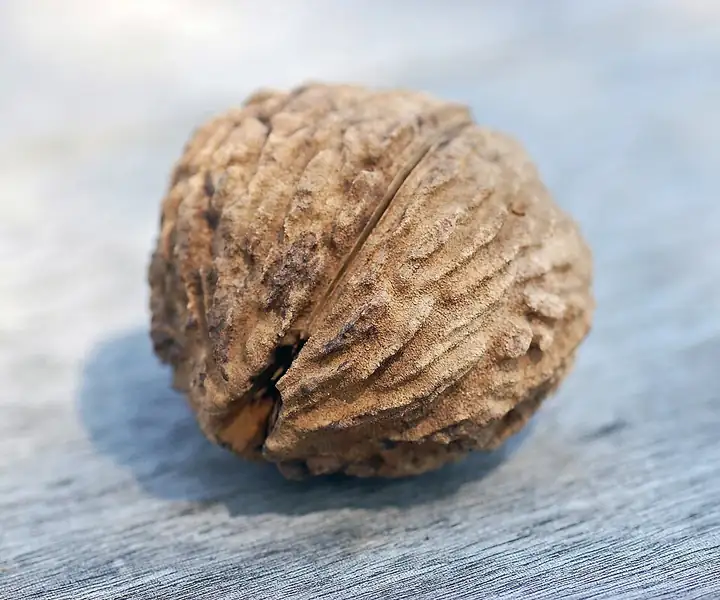
Black walnut
Juglans nigra · Walnut family (Juglandaceae)
| Hardiness zones | 4 to 9 |
|---|---|
| Sun | full sun |
| Water | moderate |
| Life cycle | perennial |
| Frost | Hardy: takes frost |
| Soil pH | 6.5–7.2 |
| Spacing | 360 to 720 inches |
About Black walnut
Black walnut is a big, fast-growing native tree, 50 to 90 feet tall, with richly flavored nuts in thick green husks. Its leaves, stems and roots contain juglone, a natural chemical that stunts or kills sensitive plants such as tomatoes, azaleas, peonies, apples and blueberries under and near the tree, so site it well away from the vegetable garden.
NC State lists zones 4-9; the tree is native from the eastern U.S. and southeastern Canada west to the Great Plains and Texas.
When to plant
Timing is counted from your average last spring frost (and first fall frost). Sow & Tell works out the actual dates for your ZIP code.
Plant bare-root trees in early spring as soon as the soil can be dug, or container trees in early October or March, at the nursery depth with no fertilizer in the hole (University of Missouri). Space nut trees at least 30 feet apart; they are thinned to about 60 feet as they grow. Grafted trees bear in about 4 to 7 years; seedlings take 8 to 12 (University of Missouri; Rutgers). Remember juglone: keep it 50 to 60 feet from tomatoes, peppers, potatoes and other sensitive crops (Rutgers).
Soil
Deep (at least 3 feet), well-drained soil; it does best with a topsoil pH of about 6.5 to 7.2 and fails on sites that stay flooded 3 days or more (USDA Forest Service). NC State notes it grows in clay, loam or sand from strongly acid to slightly alkaline.
Choose deep (at least 3 feet), well-drained soil, clear out tall fescue and other perennial weeds, and correct pH and low phosphorus with lime and phosphorus as a soil test calls for (University of Missouri; USDA Forest Service).
Feeding
- First year, early June, only if new shoots have grown 8 to 10 inches: nitrogen fertilizer such as urea (46-0-0). Spread about half a cup around the tree; skip it on trees with less than 8 inches of new growth, since it can burn the leaves (University of Missouri). Rutgers advises no fertilizer at all the first year, so this one is optional.
- Established trees: March: nitrogen fertilizer such as urea (46-0-0), guided by a soil test. About 1 cup per inch of trunk diameter, spread within the drip line (University of Missouri; soil test per Rutgers).
- Established trees: May: nitrogen fertilizer such as urea (46-0-0), guided by a soil test. Repeat the March amount within the drip line (University of Missouri).
Avoid frost pockets, droughty sites and ground that floods for 3 days or more, and keep the tree 50 to 60 feet from juglone-sensitive plants such as tomatoes (University of Missouri; USDA Forest Service; Rutgers).
Harvest
Nuts ripen from September into October inside a thick green husk; they're ready when your thumb can dent the husk (NC State; Iowa State; K-State). Gather them promptly and hull right away, wearing rubber gloves, because the husk juice stains everything and spoils the kernel's flavor if left on (Iowa State; K-State).
One crop of nuts each fall, ripening in October.
Varieties (3)
The Extension sources we could open name only 3 black walnut cultivars.
| Variety | Type | Days | Notes |
|---|---|---|---|
| Black Gem | Grows fast when young. | ||
| Kwik-Krop | Forms a rounded crown. | ||
| Thomas | Excellent flavor. Nuts crack easily. |
Pests to watch for
Aphids, Fall webworm
Diseases and problems
Thousand cankers disease, Walnut anthracnose, Bacterial blight, Root rot, Canker, Leaf spot
In the kitchen
The rich, strong-flavored kernels are eaten on their own or baked into fudge, brownies, candies, cakes and fall dishes (Iowa State; K-State).
Keeping it: Cure hulled, washed nuts for 2 to 3 weeks, then crack them; the oily kernels turn rancid if kept warm, so freeze them in sealed bags, where they keep almost indefinitely, or refrigerate them for short spells (Iowa State; Rutgers).
Safety: Black walnuts are tree nuts, one of the major food allergens named by the FDA; anyone with a tree-nut allergy should avoid them. The husk juice stains skin badly, so wear gloves. The juglone in the tree poisons many plants nearby (NC State; Iowa State).
Pets: Toxic to dogs and horses, not to cats (ASPCA): moldy nuts or husks can cause tremors and seizures in dogs, and horses can get laminitis and colic.
Sources
- plants.ces.ncsu.edu
- centerforagroforestry.org
- nrs.fs.usda.gov
- njaes.rutgers.edu
- yardandgarden.extension.iastate.edu
- extension.k-state.edu
- fda.gov
- aspca.org
Photo: Photo: Derek Ramsey / Wikimedia Commons, CC BY-SA 3.0 (CC BY-SA 3.0). Photo resized for the web.

Planting dates and advice are general guidance; check with your local Cooperative Extension office for your area.