
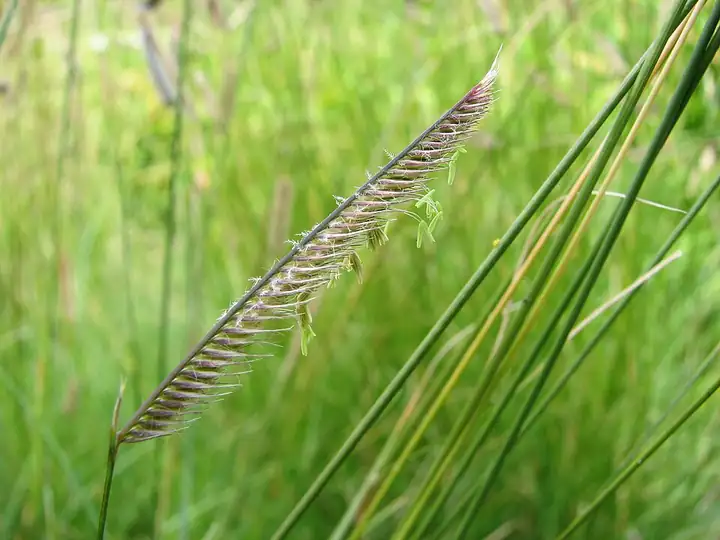
Blue grama
Bouteloua gracilis (including 'Blonde Ambition') · Grass family (Poaceae)
| Hardiness zones | 3 to 10 |
|---|---|
| Sun | full sun |
| Water | low |
| Life cycle | perennial |
| Frost | Hardy: takes frost |
About Blue grama
Blue grama is a short, tough native grass of the western Great Plains and Southwest, with fine blue-green leaves and little flag-like seed heads that hang off one side of the stem like tiny mosquito larvae, hence its nickname mosquito grass (NC State, USDA NRCS). It is also a no-fuss native lawn in the dry West: it can live on very little rain, stays green in summer, and goes tan and dormant from fall to late spring (Wildflower Center, Colorado State). The taller 'Blonde Ambition' is grown as an ornamental grass for its chartreuse-to-blonde seed heads, and blue grama is a caterpillar host for several skippers.
NC State lists zones 3-10 (Clemson says 3-9). Native from southern Canada through the Great Plains and western mountains and foothills to Mexico; it dislikes acid soil, shade and frequent flooding (USDA NRCS).
When to plant
Timing is counted from your average last spring frost (and first fall frost). Sow & Tell works out the actual dates for your ZIP code.
Plant ornamental clumps in spring, crown level with the soil (Clemson). For a lawn, Colorado State says seed from March to mid-August (not later) at 3-5 lb per 1,000 sq ft, or lay plugs or sod June to mid-August; keep the surface moist for the first 3-4 weeks. USDA NRCS seeds it 1/4-1/2 inch deep in a firm, weed-free bed in April to mid-May in the central Plains.
Soil
Well-drained sandy loam, gravel or clay, including poor, rocky and alkaline soils; it does poorly in acid or soggy soil (NC State, USDA NRCS).
For a lawn, kill the old grass and weeds first, mow it very short, core-aerate heavily, then seed and rake it into the holes (Colorado State). Ornamental clumps need no special prep.
Feeding
- New seeded lawn, every 3-4 weeks during the first summer, stopping after late August: slow-release or natural organic lawn fertilizer. Colorado State suggests light feedings every 3-4 weeks after planting the first season; follow the label rate.
- Established lawn: once a year in July or August: slow-release or natural organic lawn fertilizer. One summer feeding a year is plenty for an established blue grama lawn (Colorado State); ornamental clumps need little or none (Clemson).
Don't overwater or overfeed once it's established; it needs little or no watering, and Colorado State suggests 1-2 inches every 4-5 weeks only for a greener lawn in a dry summer. Mow high, and don't seed after mid-August.
Varieties (5)
Sources document 1 ornamental cultivar and 4 USDA/state conservation releases used for range, erosion and native-lawn seed.
| Variety | Type | Days | Notes |
|---|---|---|---|
| Lovington | Conservation release (1963) | From a 1944 harvest near Lovington, New Mexico; uniform, leafy, with strong seedlings that establish fast. | |
| Hachita | Conservation release (1980) | Collected in 1957 near Hachita, New Mexico, in a very dry area; the most drought-tolerant blue grama tested in New Mexico. | |
| Alma | Conservation release (1992) | A blend of 270 plants from Hachita, Lovington and another source, made for range and cropland reseeding in the southern and central Plains. | |
| Bad River Ecotype | Conservation release (1996) | From the Bad River floodplain in South Dakota; establishes readily for the Northern Great Plains. | |
| Blonde Ambition | Ornamental | 30-36 in tall and wide; blue-green leaves about 1 ft tall and showy chartreuse seed heads that age to blonde and stand through winter. |
Pests to watch for
Grasshoppers, Green June beetle (fig-eater), White grubs
Diseases and problems
Leaf spot, Rust
In the kitchen
Safety: No toxicity is reported in the sources we checked; USDA NRCS calls it a palatable forage grass for livestock.
Pets: Not listed by the ASPCA.
Sources
- plants.ces.ncsu.edu
- wildflower.org
- plants.sc.egov.usda.gov
- planttalk.colostate.edu
- planttalk.colostate.edu
- hgic.clemson.edu
- aspca.org
- aspca.org
Photo: Photo: Agnieszka Kwiecień, Nova / Wikimedia Commons, CC BY-SA 4.0 (CC BY-SA 4.0). Photo resized for the web.

Planting dates and advice are general guidance; check with your local Cooperative Extension office for your area.