
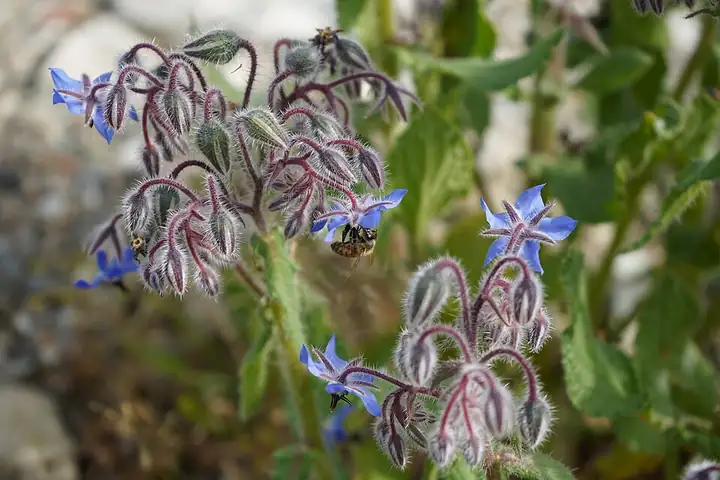
Borage
Borago officinalis · Borage family (Boraginaceae)
| Hardiness zones | 2 to 11 |
|---|---|
| Sun | full sun to part shade |
| Water | low |
| Life cycle | annual |
| Frost | Tender: killed by frost |
| Spacing | 12 inches |
About Borage
Borage is a bristly annual with star-shaped blue flowers that bees love. It reseeds itself readily, and its young leaves taste like cucumber, though they should be eaten only sparingly.
Grown as an annual in every zone (NC State lists 2-11); self-sown seedlings return year after year.
When to plant
Timing is counted from your average last spring frost (and first fall frost). Sow & Tell works out the actual dates for your ZIP code.
- Sow seeds outdoors: up to 2 weeks after the last frost
Sow directly in the garden after frost is past; it is difficult to transplant. Space plants 12 inches apart in rows 18 inches apart.
Soil
Adapts to clay, loam or sandy soil and a wide pH range; drought tolerant.
Plant in a sunny spot in well-drained soil; borage does well even in poor or dry soil once established.
Feeding
Very fertile soil or heavy feeding gives lots of leafy growth with less flavor and can encourage root and stem rot.
Harvest
Pick young leaves and flowers as needed; wear gloves, since the stiff hairs can irritate skin.
Varieties (3)
Only 3 named borage selections are documented in extension sources; most gardeners grow the plain blue-flowered species.
| Variety | Type | Days | Notes |
|---|---|---|---|
| Alba | Borage (Borago officinalis) | Leaves have a cucumber-like aroma (UC Master Gardeners, species-level note); the flowers are used as a garnish and frozen into ice cubes for drinks. White-flowered form of borage. | |
| Bianca | Borage (Borago officinalis) | Illinois Extension says borage leaves have a cucumber-like flavor (species-level note); the flowers are used as a garnish and in desserts and drinks. Compact, sturdier form with white flowers; good for pots. | |
| Variegata | Borage (Borago officinalis) | Leaves have a cucumber-like aroma (UC Master Gardeners, species-level note); the flowers are used as a garnish and frozen into ice cubes for drinks. Blue flowers (paler than usual) over green leaves mottled with white. |
Diseases and problems
Powdery mildew
In the kitchen
Flowers garnish drinks and desserts, and young leaves add a cucumber flavor to salads and soups, in small amounts only.
Keeping it: Pick edible flowers the day you use them; if you must hold them, keep them in a plastic bag in the fridge for a day or so.
Safety: Borage contains pyrrolizidine alkaloids that can damage the liver (and lungs) and may cause cancer, so eat leaves only sparingly and use only certified PA-free seed oil. Avoid it in pregnancy, and it may raise bleeding risk with blood thinners (MSKCC, NC State).
Pets: Toxic to dogs, cats and horses (ASPCA): can cause vomiting, diarrhea and skin irritation
Sources
- plants.ces.ncsu.edu
- extension.illinois.edu
- extension.umd.edu
- mskcc.org
- aspca.org
- ucanr.edu
- extension.umd.edu
Photo: Photo: Christian Orlandi, CC BY-SA 4.0, via Wikimedia Commons (CC BY-SA 4.0). Photo resized for the web.

Planting dates and advice are general guidance; check with your local Cooperative Extension office for your area.