
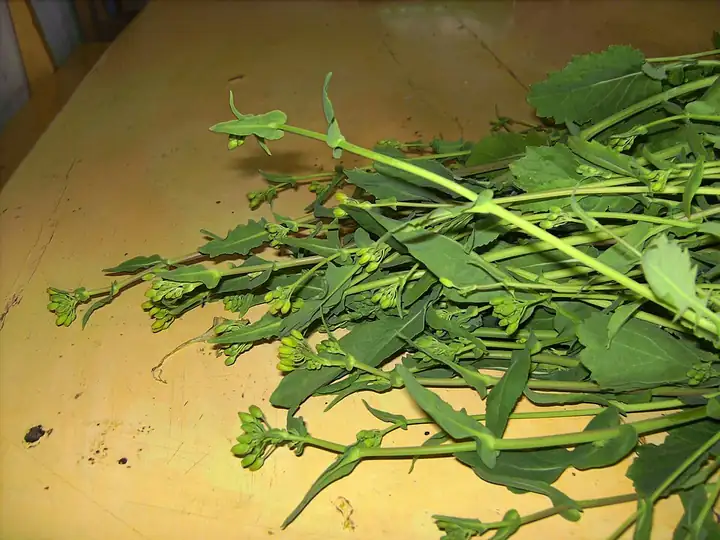
Broccoli raab (rapini)
Brassica rapa Ruvo Group · Cabbage family (Brassicaceae)
| Hardiness zones | 2 to 11 |
|---|---|
| Sun | full sun to part shade |
| Water | moderate |
| Life cycle | annual |
| Frost | Hardy: takes frost |
| Soil pH | 6.0–6.5 |
| Spacing | 4 inches |
| Days to harvest | 35 to 65 days |
About Broccoli raab (rapini)
Broccoli raab, also called rapini or broccoli rabe, is a turnip relative grown for its leafy stems, tender leaves and small clusters of broccoli-like buds; despite the name, it isn't a true broccoli. Its zesty, slightly bitter flavor is a staple of Italian cooking, and it is quick, ready in about 5 to 9 weeks from seed.
Grown as a cool-season annual in spring and fall; fall plantings can overwinter but may be killed well below 15F. It is the same species as field mustard, which the California Invasive Plant Council rates Limited (advisory).
When to plant
Timing is counted from your average last spring frost (and first fall frost). Sow & Tell works out the actual dates for your ZIP code.
Days count from seeding (Cornell lists 35 to 55; NC State about 60 to 65 to the first flower heads). Sow in early spring and again in mid to late summer; in the North, spring sowings run April through May. Late-fall sowings overwinter and are cut in late winter or early spring.
Soil
Fertile, well-drained soil high in organic matter; quick, steady growth keeps it tender.
Keep pH 6.0 to 6.5; follow a soil test, or work in about 2 lb of 10-10-10 per 100 sq ft before planting.
Feeding
- 3 to 5 weeks after the seedlings come up: nitrogen fertilizer. Side-dress beside the rows and water it in.
- overwintered plantings: late winter, just before new growth: nitrogen fertilizer. Side-dress once more and water it in.
Harvest
Cut stems with their leaves and tight buds when plants are about 12 to 18 inches tall, before the yellow flowers open; for tender greens, cut at 8 to 10 inches. If the cut end shows a solid white core, cut higher on the stem.
Cut the leafy stems and tight buds once, before the flowers open; plants go to seed quickly after that, so sow again for a later crop.
Varieties (5)
Extension sources document 5 broccoli raab varieties and types, mostly without details.
| Variety | Type | Days | Notes |
|---|---|---|---|
| Fall Raab | Fall type | Forms flower heads slightly earlier than spring types and may overwinter better. | |
| Spring Raab | Spring type | More bolt-resistant; best for spring sowing. | |
| Novantina | Named in Oregon State's guide to winter vegetables west of the Cascades. | ||
| Sessantina Grossa | Grown on Northeast farms. | ||
| Zamboni | Uniform plant with small leaves. |
Pests to watch for
Aphids, Whiteflies, Flea beetles, Cabbage looper, Cutworms, Beet armyworm, Slugs, Brown garden snail
Diseases and problems
Clubroot, White rust, Alternaria leaf spot (cabbage family), Damping-off, Bacterial soft rot
In the kitchen
Leaves, stems, buds and flowers are all eaten, usually steamed, sauteed, broiled or fried, in Italian and Asian dishes.
Keeping it: Keep it cold (32-41F) and humid in a closed bag or container, away from fruit such as apples that give off ethylene gas, which it is sensitive to.
Safety: If you take the blood thinner warfarin, keep the amount of leafy greens you eat about the same from day to day, because they are rich in vitamin K (NIH Office of Dietary Supplements).
Pets: Not listed by the ASPCA
Sources
- content.ces.ncsu.edu
- plants.ces.ncsu.edu
- sare.org
- rvpadmin.cce.cornell.edu
- extension.oregonstate.edu
- ask.ifas.ufl.edu
- cal-ipc.org
- ods.od.nih.gov
- aspca.org
- aspca.org
Photo: Photo: Victor M. Vicente Selvas / Wikimedia Commons, Public domain. Photo resized for the web.

Planting dates and advice are general guidance; check with your local Cooperative Extension office for your area.