
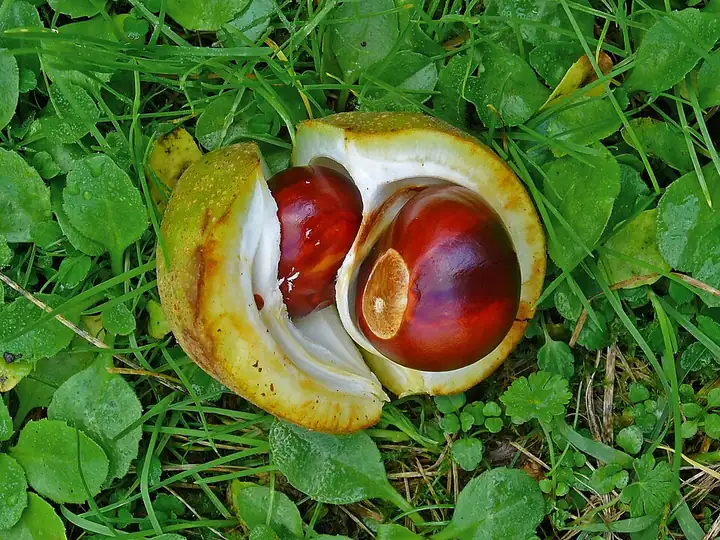
Buckeye
Ohio buckeye (Aesculus glabra), red buckeye (A. pavia), bottlebrush buckeye (A. parviflora, a large shrub), and the non-native common horse chestnut (A. hippocastanum) and red horse chestnut (A. x carnea) · Soapberry family (Sapindaceae; formerly the horse-chestnut family, Hippocastanaceae)
| Hardiness zones | 3 to 9 |
|---|---|
| Sun | full sun to part shade |
| Water | moderate |
| Life cycle | perennial |
| Frost | Hardy: takes frost |
About Buckeye
Buckeyes are native trees and shrubs with hand-shaped leaves, showy spring or early-summer flower spikes, and shiny brown nuts with a pale 'buck's eye' scar. Ohio buckeye, Ohio's state tree, is native from western Pennsylvania to southeastern Nebraska and south to Georgia and Texas; red buckeye grows from North Carolina to northern Florida, west to central Texas and north to southern Illinois; and bottlebrush buckeye is native to Georgia, Alabama, South Carolina and Florida (wildflower.org, NC State). Horse chestnut comes from southeastern Europe (NCCIH) and is on a few advisory invasive lists, such as West Virginia's. Every part, and especially the nuts, is poisonous, and buckeyes and horse chestnuts are not true chestnuts: the edible chestnut is a different tree with its own page.
Ohio buckeye is hardy in zones 3-7, red buckeye 4-8, bottlebrush buckeye 5-9 and horse chestnut 4-7 (NC State). Horse chestnut is on some advisory invasive lists (West Virginia; the Native Plant Society of Oregon), though no state bans it.
When to plant
Timing is counted from your average last spring frost (and first fall frost). Sow & Tell works out the actual dates for your ZIP code.
Plant container or balled-and-burlapped trees; container trees can go in any time the ground can be worked, but fall is best in the South because roots keep growing through mild winters (Clemson). Dig no deeper than the root ball and at least twice as wide, set the top roots level with the soil, and mulch 2-4 inches deep without touching the trunk (Clemson). Buckeyes grow a taproot and are hard to move once settled, so plant young trees where they will stay (NC State, Morton Arboretum). Give Ohio buckeye 24-60 ft of room; bottlebrush buckeye spreads by suckers into wide colonies (NC State).
Soil
Deep, rich, moist but well-drained soil, slightly acid for Ohio buckeye; red buckeye takes sand, loam, clay or limestone and some wet soil, and bottlebrush buckeye likes rich, moist, acid soil. Dry soil and hot sun bring leaf scorch (NC State, wildflower.org, Morton Arboretum).
Test the soil first. Loosen a wide planting area and mix 10-20 percent compost into the native soil you dig out; use only composted material, and don't dig deeper than the root ball (Clemson).
Feeding
- Spring to early summer, after the tree is established, and only if a soil test or weak growth shows a need: slow-release nitrogen fertilizer with a ratio near 3-1-1 or 3-1-2 (3-0-1 or 3-0-2 if the soil test shows enough phosphorus). Spread it evenly from just outside the trunk flare to the drip line and water it in. Clemson cites 2-4 lb of slow-release nitrogen per 1,000 sq ft per year, split between spring and late summer; follow your soil test.
- Late summer to early fall, the second half of the split feeding (only if a soil test calls for it): slow-release nitrogen fertilizer, same as spring. Water it in, and skip it if the tree is drought-stressed, since roots can't take up fertilizer from dry soil (Clemson).
First-year watering matters far more than fertilizer: water daily for the first 2 weeks, every 2-3 days through week 12, then weekly, using 1-1.5 gallons per inch of trunk diameter, until the tree is established (about 1.5 years for a 1-inch trunk). Skip a watering only after more than an inch of rain (UMN). Buckeyes scorch and drop leaves early in dry soil and hot sun, so keep young trees watered in summer droughts; too much fertilizer can burn roots and push soft growth (NC State, Morton Arboretum, Clemson).
Harvest
Red buckeye blooms in March-April, Ohio buckeye in May, and bottlebrush buckeye in early summer (June-July); the nuts ripen in fall (NC State, wildflower.org). Rake up the nuts where children, dogs or horses play. Overgrown bottlebrush buckeye can be cut back hard to renew it (NC State).
Varieties (13)
NC State and the Morton Arboretum document these 13; few buckeye cultivars are sold, and none of the horse chestnuts are native.
| Variety | Type | Days | Notes |
|---|---|---|---|
| Rogers | Bottlebrush buckeye (native) | Blooms later than the species. | |
| Baumannii | Common horse chestnut (non-native) | Blooms late and lasts longer. | |
| Wisselink | Common horse chestnut (non-native) | Variegated leaves. | |
| Early Glow ('J.N. Select') | Ohio buckeye (native) | Resists leaf blotch, leaf scorch and powdery mildew far better than the species; dependable red fall color and few nuts. | |
| Atrosanguinea | Red buckeye (native) | Deeper red flowers. | |
| Humilis | Red buckeye (native) | Low or sprawling shrub with small clusters of red flowers. | |
| Splendens | Red buckeye (native) | Scarlet flowers. | |
| var. flavescens | Red buckeye (native) | Wild yellow-flowered form from central Texas; where it meets the red form they cross and give two-toned flowers. | |
| Variegata | Red buckeye (native) | Leaves edged in creamy white or yellow. | |
| Briotii | Red horse chestnut (A. x carnea, non-native hybrid) | Dark rosy red flowers with yellow throats; resists leaf blotch. | |
| Fort McNair | Red horse chestnut (A. x carnea, non-native hybrid) | Reddish-pink flowers with yellow throats and dark green leaves; resists leaf blotch. | |
| O'Neil's Red | Red horse chestnut (A. x carnea, non-native hybrid) | Deep red flowers in foot-long clusters; rarely sold. | |
| Rosea | Red horse chestnut (A. x carnea, non-native hybrid) | Deep pink to rose flowers in late spring. |
Pests to watch for
Japanese beetle, Bagworm, Scale insects
Diseases and problems
Leaf blotch, Powdery mildew, Anthracnose, Leaf scorch
In the kitchen
Safety: All parts are poisonous to eat, especially the nuts, plus the leaves, bark, flowers and young shoots; they contain aesculin, aescin and possibly alkaloids and can cause vomiting, diarrhea, weakness, paralysis and stupor, and children are most at risk (NC State, wildflower.org). These nuts are not chestnuts: NCCIH notes horse chestnut seeds look like sweet chestnuts, but the raw seeds, bark, flowers and leaves are unsafe to swallow; only processed seed extracts were used in studies.
Pets: Toxic to dogs, cats and horses (ASPCA, listed as Buckeye / Horse chestnut, Aesculus): aesculin and other saponins can cause severe vomiting and diarrhea, depression or excitement, dilated pupils, weakness, wobbliness, seizures and coma.
Sources
- plants.ces.ncsu.edu
- plants.ces.ncsu.edu
- plants.ces.ncsu.edu
- plants.ces.ncsu.edu
- plants.ces.ncsu.edu
- wildflower.org
- wildflower.org
- wildflower.org
- mortonarb.org
- nccih.nih.gov
- aspca.org
- aspca.org
- extension.rutgers.edu
- extension.rutgers.edu
- eddmaps.org
- hgic.clemson.edu
- hgic.clemson.edu
- extension.umn.edu
Photo: Photo: H. Zell / Wikimedia Commons, CC BY-SA 3.0 (CC BY-SA 3.0). Photo resized for the web.

Planting dates and advice are general guidance; check with your local Cooperative Extension office for your area.