
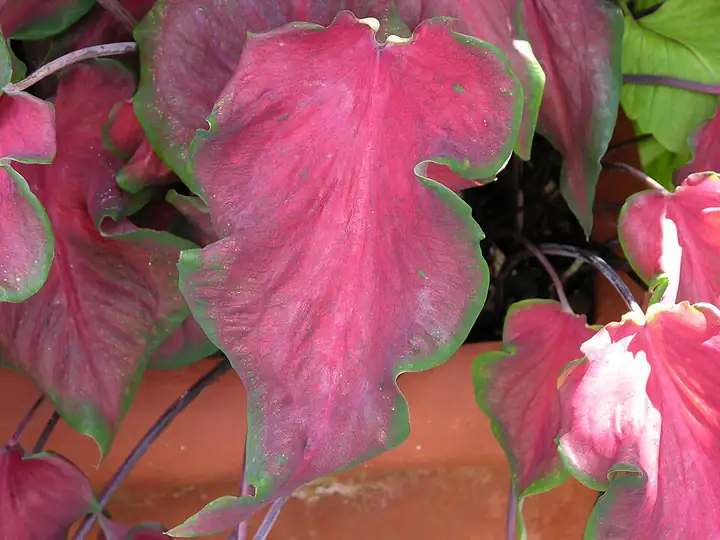
Caladium (angel wings)
Caladium bicolor (syn. Caladium x hortulanum) · Arum family (Araceae)
| Hardiness zones | 9 to 10 |
|---|---|
| Sun | part shade |
| Water | high |
| Life cycle | tender perennial (grown as an annual) |
| Frost | Tender: killed by frost |
| Spacing | 8 to 14 inches |
| Soil temperature to plant | at least 70°F |
About Caladium (angel wings)
Caladiums grow from tubers and are grown for big heart- or arrow-shaped leaves splashed in red, pink, white and green. They are tropical plants from Central and South America, so most gardeners plant them as summer annuals in shade, with a few newer kinds that take some sun (Clemson). All parts are poisonous.
Hardy only in zones 9-10 (NC State, Clemson); elsewhere dig and store the tubers in fall or replant new ones each year.
When to plant
Timing is counted from your average last spring frost (and first fall frost). Sow & Tell works out the actual dates for your ZIP code.
Plant tubers 1.5-2 inches deep, eyes up, 8-14 inches apart, once the soil is 70 F, about when okra goes in (Clemson). Cool soil means slow growth or rotted tubers. In fall, dig before the leaves lose all color, dry 1-2 weeks, and store in dry peat or vermiculite above 50 F; never refrigerate.
Soil
Warm, moist, well-drained, acidic soil high in organic matter; tubers rot in cold or soggy soil (NC State, Clemson).
Test the soil first; caladiums like acidic, organic soil (NC State, Clemson).
Feeding
- Every six weeks in the ground (no soil test): fertilizer such as 12-6-6 (15-0-15 in coastal soils already high in phosphorus). Scatter around plants and water in; wash any granules off the leaves to prevent burn (Clemson). Follow a soil test when you have one.
- Every two weeks in containers: liquid all-purpose soluble fertilizer. Or use a 6-month slow-release fertilizer at planting instead (Clemson).
Avoid high-phosphorus fertilizers and watering in the heat of the day; keep soil evenly moist but never soggy, or tubers rot (Clemson).
Varieties (17)
| Variety | Type | Days | Notes |
|---|---|---|---|
| Aaron | Fancy-leaved | Some sun tolerance. | |
| Candidum | Fancy-leaved | White leaves with green veins; white kinds store best over winter. | |
| Fallen City | Fancy-leaved | Dark green heart-shaped leaves with deep red blotches. | |
| Fire Chief | Fancy-leaved | Limited sun tolerance. | |
| Florida Elise | Fancy-leaved | Some sun tolerance. | |
| Freida Hemple | Fancy-leaved | No sun tolerance; keep in shade. | |
| Moonlight | Fancy-leaved | White leaves. | |
| Pink Cloud | Fancy-leaved | Some sun tolerance. | |
| Postman Joyner | Fancy-leaved | Dark red leaves. | |
| Red Flash | Fancy-leaved | Good sun tolerance. | |
| Summer Breeze | Fancy-leaved | Pale green to white leaves with bright green veins. | |
| White Queen | Fancy-leaved | Some sun tolerance. | |
| Peppermint | Lance-leaved | Red-and-white candy-cane striping. | |
| Pink Gem | Lance-leaved | Good for hanging baskets. | |
| Red Frill | Lance-leaved | Good for hanging baskets. | |
| Candidum Jr. | Lance-leaved (dwarf) | Dwarf white with green veins. | |
| Miss Muffett | Lance-leaved (dwarf) | Dwarf; no sun tolerance. |
Pests to watch for
Slugs, Brown garden snail
Diseases and problems
Tuber rot, Leaf spot
In the kitchen
Safety: All parts are poisonous (NC State: medium severity). Chewing it burns and swells the lips, mouth and tongue and can cause vomiting and diarrhea, and the sap can irritate skin. Keep it away from small children.
Pets: Toxic to dogs, cats and horses (ASPCA): insoluble calcium oxalate crystals cause mouth pain and swelling, heavy drooling, trouble swallowing and vomiting.
Sources
Photo: Photo: Derek Ramsey (Ram-Man) / Wikimedia Commons, CC BY-SA 3.0 (CC BY-SA 3.0). Photo resized for the web.

Planting dates and advice are general guidance; check with your local Cooperative Extension office for your area.