
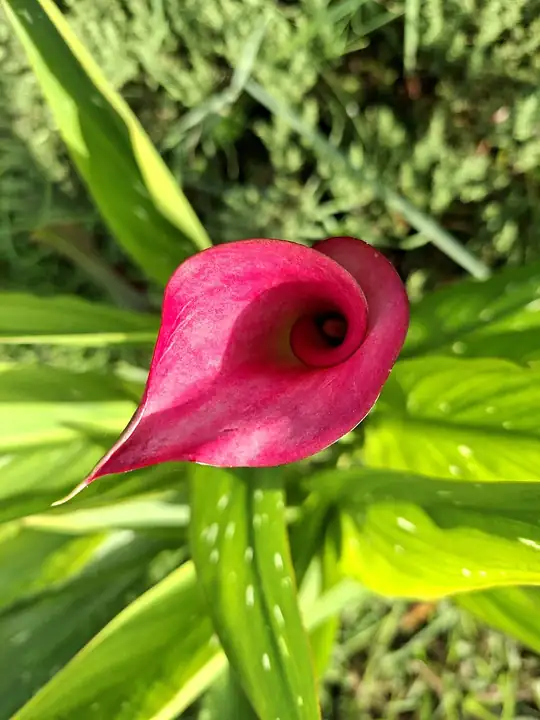
Calla lily
Zantedeschia aethiopica (white calla) and colored calla hybrids (Zantedeschia spp.) · Arum family (Araceae)
| Hardiness zones | 7 to 10 |
|---|---|
| Sun | full sun to part shade |
| Water | high |
| Life cycle | tender perennial (grown as an annual) |
| Frost | Tender: killed by frost |
| Spacing | 12 to 18 inches |
| Soil temperature to plant | at least 55°F |
About Calla lily
Calla lilies grow from rhizomes and make elegant funnel-shaped 'flowers' that are really a colored leaf-like spathe wrapped around a spike of tiny true flowers. Despite the name they aren't true lilies; they're in the arum family with jack-in-the-pulpit (NC State). The big white calla loves wet soil and pond edges, and the smaller colored hybrids are summer favorites in pots. White calla is listed as invasive (Limited) by the California Invasive Plant Council, where it spreads into coastal wetlands.
NC State lists zones 7-10 for callas and 8-10 for white calla (it may live in zone 7 with protection and mulch). Farther north, dig and store the rhizomes each fall. Cal-IPC rates white calla a Limited invasive in California's coastal wetlands (advisory, not a ban).
When to plant
Timing is counted from your average last spring frost (and first fall frost). Sow & Tell works out the actual dates for your ZIP code.
- Start seeds indoors: 6 to 8 weeks before the last frost
- Set out plants: around the last frost
- Sow seeds outdoors: around the last frost
Start rhizomes in pots 1-2 inches deep about 6-8 weeks before the last frost in a warm (70-75 F) spot, or plant them outdoors after the last frost once the soil is about 55 F, 3-4 inches deep with the eyes up and 12-18 inches apart (Iowa State, Clemson, Penn State, NC State). Where they aren't hardy, dig rhizomes after frost kills the leaves, dry them 1-2 weeks, and store in peat moss or vermiculite at 50-60 F (Iowa State, NC State).
Soil
Moist, humus-rich soil; white calla even grows in boggy ground or up to 12 inches of water, while colored callas want moist but well-drained soil. Give afternoon shade in hot climates (NC State, Penn State).
Work organic matter into moist, rich soil and spread an all-purpose garden fertilizer over the bed before planting (Iowa State, NC State).
Feeding
- Through the summer growing season: water-soluble fertilizer with a 1:2:2 or 1:2:1 ratio for flowering plants. Iowa State's advice for tender bulbs and perennials: feed every 1-3 weeks at the label rate, or at quarter strength each time you water; a slow-release fertilizer in spring is an alternative.
Don't let potted callas dry out (Penn State), and handle rhizomes gently; cuts and bruises invite rot in storage (Iowa State).
Harvest
Callas bloom in summer, about June through September or October; white calla blooms in early summer (Clemson, NC State). For vases, cut just before the spathe starts to curl downward; in the garden, cut stems as blooms fade (Oklahoma State, Penn State). Some newly planted rhizomes skip a season before flowering (UF/IFAS).
Varieties (13)
Extension sources we could open document 13 calla cultivars; NC State names the colored hybrids without describing them.
| Variety | Type | Days | Notes |
|---|---|---|---|
| Galaxy | Colored calla hybrid | ||
| Golden Sun | Colored calla hybrid | ||
| Lavender Petite | Colored calla hybrid | ||
| Pink Persuasion | Colored calla hybrid | ||
| Whipped Cream | Colored calla hybrid | ||
| Crowborough | White calla (Z. aethiopica) | Tolerates cold better than most; suited to cooler climates. | |
| Giant Spotted Beauty | White calla (Z. aethiopica) | Green leaves spotted with white. | |
| Green Goddess | White calla (Z. aethiopica) | Spathes striped with green; flowers last longer. | |
| Pershore Fantasia | White calla (Z. aethiopica) | Large white spathes. | |
| Pink Mist | White calla (Z. aethiopica) | Pink spathe and spadix; harder to grow and best in part shade. | |
| Red Desire | White calla (Z. aethiopica) | Red spadix. | |
| Royal Valentine | White calla (Z. aethiopica) | Burgundy spathes and spotted leaves. | |
| White Sail | White calla (Z. aethiopica) | Very large white spathe. |
Pests to watch for
Japanese beetle, Thrips
Diseases and problems
Rhizome rot
In the kitchen
Safety: Poisonous if eaten: calcium oxalate crystals cause painful burning and swelling of the lips, tongue and throat, plus stomach pain and diarrhea; NC State rates callas high severity and warns they may be fatal if eaten. The sap can irritate skin, so wear gloves when handling rhizomes (Penn State).
Pets: Toxic to dogs, cats and horses (ASPCA, listed as calla or arum lily): insoluble calcium oxalate crystals cause mouth pain and swelling, drooling, trouble swallowing and vomiting (not in horses). Unlike true lilies (Lilium) and daylilies, callas do not cause kidney failure in cats, and the signs usually pass on their own (FDA).
Sources
- plants.ces.ncsu.edu
- plants.ces.ncsu.edu
- hgic.clemson.edu
- extension.psu.edu
- yardandgarden.extension.iastate.edu
- yardandgarden.extension.iastate.edu
- blogs.ifas.ufl.edu
- blogs.ifas.ufl.edu
- extension.okstate.edu
- aspca.org
- aspca.org
- fda.gov
- plantright.org
- cal-ipc.org
Photo: Photo: Anna.Massini / Wikimedia Commons, CC BY 4.0 (CC BY 4.0). Photo resized for the web.

Planting dates and advice are general guidance; check with your local Cooperative Extension office for your area.