
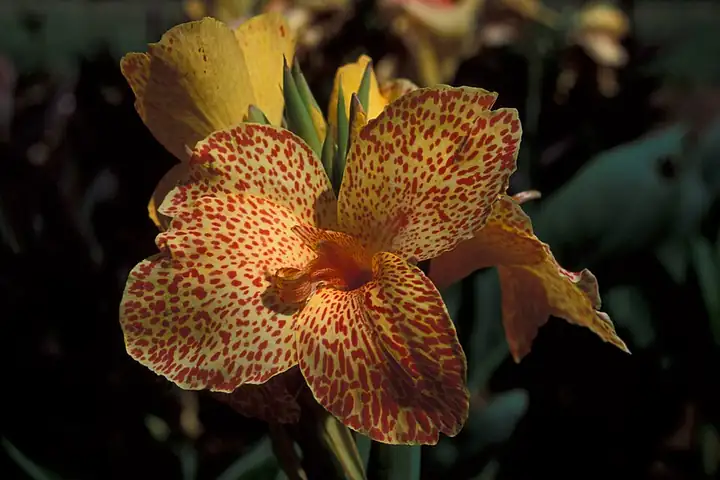
Canna
Canna x generalis (garden cannas) and Canna indica · Canna family (Cannaceae)
| Hardiness zones | 6 to 10 |
|---|---|
| Sun | full sun |
| Water | high |
| Life cycle | tender perennial (grown as an annual) |
| Frost | Tender: killed by frost |
| Spacing | 12 to 36 inches |
| Soil temperature to plant | at least 55°F |
About Canna
Cannas are big tropical-looking plants with paddle-shaped leaves in green, bronze, purple or stripes and bright red, orange, yellow or pink flowers from early summer until frost. Red-flowered kinds attract hummingbirds, and bees visit too (NC State). Despite the nickname 'canna lily', they are not true lilies and are safe for cats.
NC State lists zones 6-10 for the genus (garden hybrids 8-11); leave rhizomes in the ground under mulch in zone 8 and warmer, and dig them elsewhere. Canna indica has naturalized in the Southeast and spreads into disturbed ground and roadsides (NC State).
When to plant
Timing is counted from your average last spring frost (and first fall frost). Sow & Tell works out the actual dates for your ZIP code.
- Sow seeds outdoors: around the last frost
Plant rhizomes after the last frost with the eyes up, about 3-4 inches deep (Penn State; Clemson says 1-2, NC State 4-6); in Florida, UF plants them about 2 weeks before the last frost. North of zone 8, dig rhizomes after frost blackens the leaves, cut stems to 2-3 inches, let them dry a few days, and store in dry peat or vermiculite at about 40-50 F (NC State, Penn State, UMN).
Soil
Rich soil high in organic matter with steady moisture; they handle wet spots and even standing water once established, but rhizomes rot in poorly drained winter soil (NC State, Clemson).
Rich soil high in organic matter that stays moist (Clemson, NC State).
Feeding
- Every 4-6 weeks through the growing season: balanced fertilizer such as 10-10-10. Clemson suggests 3-4 lb per 100 sq ft, watered in well; UF suggests a monthly balanced or controlled-release feeding. Follow a soil test.
Rhizomes rot in poorly drained soil (NC State); give plenty of water in hot weather (Clemson).
Harvest
Cannas bloom from early summer until frost. Snip off faded flower stalks so they don't set seed and keep blooming (Clemson, NC State). Divide crowded clumps in spring, making sure each piece has at least one eye (bud) (Penn State).
Varieties (19)
| Variety | Type | Days | Notes |
|---|---|---|---|
| Musifolia | Canna indica | Huge banana-like leaves on plants 6-10 feet tall. | |
| Purpurea | Canna indica | Bronze leaves and orange-red flowers. | |
| Red Stripe | Canna indica | Purple leaves and red flowers. | |
| Black Knight | Garden canna | Red flowers and smoky purple leaves on strong 4-6 foot stalks. | |
| Brandywine | Garden canna | Heavy-blooming red flowers; green leaves edged red; about 3 feet. | |
| Chesapeake | Garden canna | Yellow flowers fading to white; about 4 feet. | |
| Ermine | Garden canna | Creamy white flowers with pale yellow centers. | |
| Intrigue | Garden canna | Orange-red flowers over purple-gray leaves. | |
| Lucifer | Garden canna | UF/IFAS names it among cannas for Florida gardens. | |
| Mrs. Pierre S. du Pont | Garden canna | Pink flowers over green leaves; about 4 feet. | |
| Picasso | Garden canna | UF/IFAS names it among cannas for Florida gardens. | |
| Pretoria ('Bengal Tiger') | Garden canna | Orange flowers over green leaves with yellow veins. | |
| Red Tiger | Garden canna | Cherry-red flowers over creamy yellow and green striped leaves. | |
| Striped Beauty | Garden canna | Cream flowers from yellow buds over green leaves streaked yellow; 3-5 feet; not very cold-hardy. | |
| Tropicanna ('Phasion') | Garden canna | Orange flowers over leaves striped red, yellow and green; 4-6 feet. | |
| White Tiger | Garden canna | Creamy white flowers over striped leaves. | |
| Wyoming | Garden canna | UF/IFAS names it among cannas for Florida gardens. | |
| Cannova Lemon | Garden canna (Cannova series) | Yellow flowers over green leaves. | |
| Golden canna | Native species (Canna flaccida) | Yellow-flowered canna native to Florida marshes and pond edges; needs damp soil. |
Pests to watch for
Japanese beetle, Slugs, Brown garden snail, Aphids, Larger canna leafroller (Brazilian skipper)
Diseases and problems
Rust, Mosaic viruses, Bud rot, Aster yellows, Leaf spot, Root and crown rot
In the kitchen
Canna indica (achira) has been grown for its starchy rhizomes in Central and South America for over 4,000 years; the starch goes into noodles, and the leaves wrap tamales (NC State).
Safety: NC State and the ASPCA list garden cannas as non-toxic.
Pets: Not toxic to dogs, cats or horses (ASPCA)
Sources
- plants.ces.ncsu.edu
- plants.ces.ncsu.edu
- plants.ces.ncsu.edu
- hgic.clemson.edu
- extension.psu.edu
- gardeningsolutions.ifas.ufl.edu
- extension.umn.edu
- aspca.org
Photo: Photo: Forest and Kim Starr, CC BY 3.0, via Wikimedia Commons (CC BY 3.0). Photo resized for the web.

Planting dates and advice are general guidance; check with your local Cooperative Extension office for your area.