
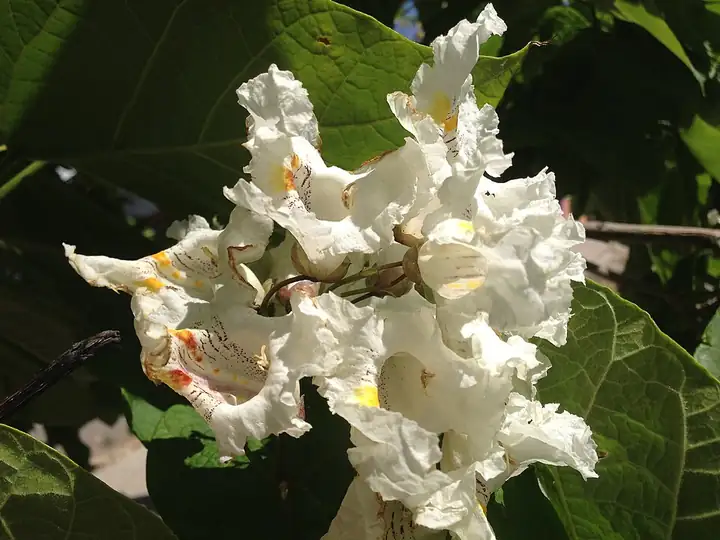
Catalpa
Northern catalpa (Catalpa speciosa) and southern catalpa (Catalpa bignonioides) · Trumpet-vine family (Bignoniaceae)
| Hardiness zones | 4 to 9 |
|---|---|
| Sun | full sun to part shade |
| Water | moderate |
| Life cycle | perennial |
| Frost | Hardy: takes frost |
| Soil pH | 5.5–7.0 |
About Catalpa
Catalpas are fast-growing native trees with huge heart-shaped leaves, big upright clusters of frilly white flowers spotted purple and yellow in late spring, and long, skinny 'cigar' pods that hang into winter. Northern catalpa is native from western Tennessee and northeastern Arkansas to southwestern Indiana and eastern Missouri, and southern catalpa to the Gulf Coast from northern Florida to Mississippi and Louisiana, but both have been planted and gone wild across much of the country (wildflower.org, NRCS). NRCS calls them weedy trees that escape cultivation easily, and they are the only food of the catalpa sphinx caterpillar, the 'catalpa worm' anglers use for bait (Penn State).
Northern catalpa is hardy in zones 4-8 and southern catalpa in zones 5-9 (NC State). Both escape cultivation easily (NRCS), and a few local advisory lists, such as Ann Arbor, Michigan's, call northern catalpa invasive.
When to plant
Timing is counted from your average last spring frost (and first fall frost). Sow & Tell works out the actual dates for your ZIP code.
Plant container or balled-and-burlapped trees; container trees can go in any time the ground can be worked, but fall is best in the South because roots keep growing through mild winters (Clemson). Dig no deeper than the root ball and at least twice as wide, set the top roots level with the soil, and mulch 2-4 inches deep without touching the trunk (Clemson). Keep catalpas well away from buildings, fences, property lines, power lines and septic systems: they drop flowers, big leaves and pods from spring through winter, and the brittle branches break in storms (NRCS, wildflower.org).
Soil
Prefers deep, moist, well-drained soil but tolerates dry, poor, wet or flooded sites; NRCS gives a pH range of 5.5-7.0 (NC State, NRCS).
Test the soil first. Loosen a wide planting area and mix 10-20 percent compost into the native soil you dig out; use only composted material, and don't dig deeper than the root ball (Clemson).
Feeding
- Spring to early summer, after the tree is established, and only if a soil test or weak growth shows a need: slow-release nitrogen fertilizer with a ratio near 3-1-1 or 3-1-2 (3-0-1 or 3-0-2 if the soil test shows enough phosphorus). Spread it evenly from just outside the trunk flare to the drip line and water it in. Clemson cites 2-4 lb of slow-release nitrogen per 1,000 sq ft per year, split between spring and late summer; follow your soil test.
- Late summer to early fall, the second half of the split feeding (only if a soil test calls for it): slow-release nitrogen fertilizer, same as spring. Water it in, and skip it if the tree is drought-stressed, since roots can't take up fertilizer from dry soil (Clemson).
First-year watering matters far more than fertilizer: water daily for the first 2 weeks, every 2-3 days through week 12, then weekly, using 1-1.5 gallons per inch of trunk diameter, until the tree is established (about 1.5 years for a 1-inch trunk). Skip a watering only after more than an inch of rain (UMN). Mature trees in decent soil often need little or no fertilizer, and too much nitrogen pushes soft growth (Clemson); catalpa branches are already brittle and break in storms (wildflower.org).
Harvest
Northern catalpa blooms in late spring to early summer, a little before southern catalpa (May-June); the long pods turn brown in fall and split to release winged seeds through winter (NC State, wildflower.org).
Varieties (4)
NC State documents these four southern catalpa cultivars; we found no well-documented northern catalpa cultivars.
| Variety | Type | Days | Notes |
|---|---|---|---|
| Aurea | Southern catalpa | Yellow-green leaves. | |
| Nana | Southern catalpa | Dwarf form, usually grafted high on a trunk to make a small standard with drooping branches. | |
| Purpurea | Southern catalpa | Purple leaves. | |
| Variegata | Southern catalpa | Leaves splashed with creamy white. |
Diseases and problems
Verticillium wilt, Leaf spot, Powdery mildew, Twig blight
In the kitchen
Safety: NRCS warns that the roots are highly poisonous. NC State tags northern catalpa as a possible cause of skin rash (contact dermatitis) without giving details.
Pets: Not listed by the ASPCA.
Sources
- plants.ces.ncsu.edu
- plants.ces.ncsu.edu
- wildflower.org
- wildflower.org
- plants.sc.egov.usda.gov
- plants.sc.egov.usda.gov
- extension.psu.edu
- content.ces.ncsu.edu
- aspca.org
- eddmaps.org
- hgic.clemson.edu
- hgic.clemson.edu
- extension.umn.edu
Photo: Photo: Famartin / Wikimedia Commons, CC BY-SA 3.0 (CC BY-SA 3.0). Photo resized for the web.

Planting dates and advice are general guidance; check with your local Cooperative Extension office for your area.