
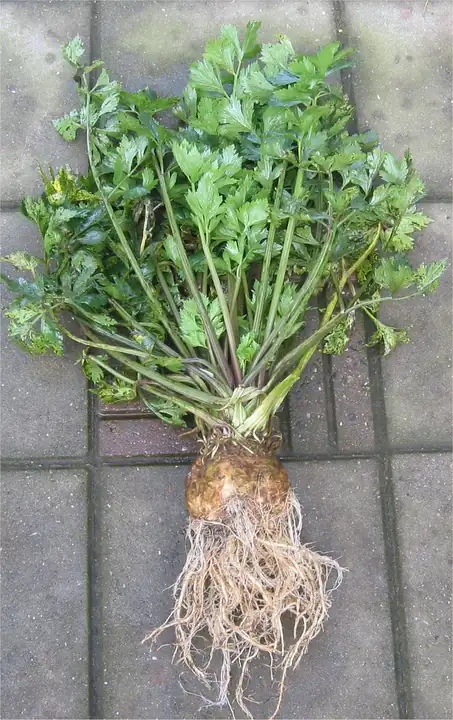
Celeriac
Apium graveolens var. rapaceum · Carrot family (Apiaceae)
| Hardiness zones | 2 to 11 |
|---|---|
| Sun | full sun |
| Water | high |
| Life cycle | biennial |
| Frost | Half-hardy: takes a light frost |
| Soil pH | 5.8–6.5 |
| Spacing | 6 to 12 inches |
| Days to harvest | 100 to 121 days |
About Celeriac
Celeriac, also called celery root, is a kind of celery grown for its knobby, round base instead of its stalks. The cream-colored flesh tastes like mild celery, and the roots keep for months in cold storage, which makes it a handy winter vegetable. It needs a long, cool season and steady moisture.
Grown as an annual in every zone; it needs a long, cool season. About 10 days of nights below 40F with days below 50F can make young plants bolt.
When to plant
Timing is counted from your average last spring frost (and first fall frost). Sow & Tell works out the actual dates for your ZIP code.
- Start seeds indoors: 10 to 12 weeks before the last frost
- Set out plants: up to 2 weeks after the last frost
Days count from transplanting: Arkansas lists 100 to 115 days for common varieties, and a Maine trial dug roots 121 days after setting out. Start the tiny seed indoors 10 to 12 weeks before transplanting (it can take up to 3 weeks to sprout) and set plants out after the last frost with the crown at soil level.
Soil
Fertile, well-drained loam kept evenly moist; celery-type crops need 1 to 2 inches of water a week.
Follow a soil test, aim for pH 5.8 to 6.5 in well-drained loam, and work in compost before planting.
Feeding
- 4 to 6 weeks after transplanting: nitrogen fertilizer such as 21-0-0. Side-dress beside the row and water it in; for celery, Utah State uses about 1/4 cup of 21-0-0 per 10 ft of row.
- about 3 to 4 weeks before harvest: nitrogen fertilizer such as 21-0-0. Side-dress once more beside the row and water it in.
Don't let plants dry out or overfeed them: drought, overwatering and too much fertilizer are tied to blackheart, a calcium disorder.
Harvest
Dig roots when they are about 3 to 4 inches across, from late summer into fall; the flavor is best after the first fall frost. Under a straw or leaf mulch, roots can stay in the bed and be dug through winter.
Dig each root once it is 3 to 4 inches across, from late summer into fall. You can snip a few leaves any time, and under mulch the roots can wait in the bed through winter.
Varieties (6)
Extension sources document 6 celeriac varieties.
| Variety | Type | Days | Notes |
|---|---|---|---|
| Alicia | Tested in a 2022 Maine trial; roots generally smaller than Balena and Brilliant. | ||
| Balena | Gave the highest marketable yield in a 2022 Maine trial; roots generally larger than Alicia and Diamant. | ||
| Brilliant | 110 days | Roots 3 to 5 inches across that store well; grown on Northeast farms and larger than Alicia and Diamant in a Maine trial. | |
| Diamant | Grown on Northeast farms; in a 2022 Maine trial its roots were smaller than Balena and Brilliant. | ||
| Giant Prague | 115 days | Large, nearly round root with smooth skin; best dug at 3 to 4 inches across, and it stores well. | |
| Monarch | 100 days | Smooth, cream-colored roots of excellent quality. |
Pests to watch for
Aphids, Thrips, Flea beetles, Tarnished plant bug, Leafhoppers, Cutworms, Cabbage looper, Twospotted spider mite
Diseases and problems
Cercospora early blight, Septoria late blight, Blackheart (calcium disorder), Powdery mildew
In the kitchen
Peeled and grated or cut into thin strips for salads, or cooked in soups and stews, pureed, and baked in gratins with other root vegetables.
Keeping it: Trim the tops to about an inch and cut off the rootlets, then keep roots near 32F with high humidity, in a perforated bag in the refrigerator or packed in damp sand; stored this way they can last six to eight months.
Safety: People with celery allergy may also react to celeriac; in Europe, celeriac allergy is often tied to mugwort and birch pollen allergy (PLoS ONE, 2011).
Pets: Not listed by the ASPCA
Sources
- uaex.uada.edu
- publications.mgcafe.uky.edu
- sare.org
- extension.umaine.edu
- aggie-horticulture.tamu.edu
- extension.usu.edu
- polk.extension.wisc.edu
- pmc.ncbi.nlm.nih.gov
- aspca.org
- aspca.org
- extensionpubs.unl.edu
Photo: Photo: Rasbak, CC BY-SA 3.0, via Wikimedia Commons (CC BY-SA 3.0). Photo resized for the web.

Planting dates and advice are general guidance; check with your local Cooperative Extension office for your area.