
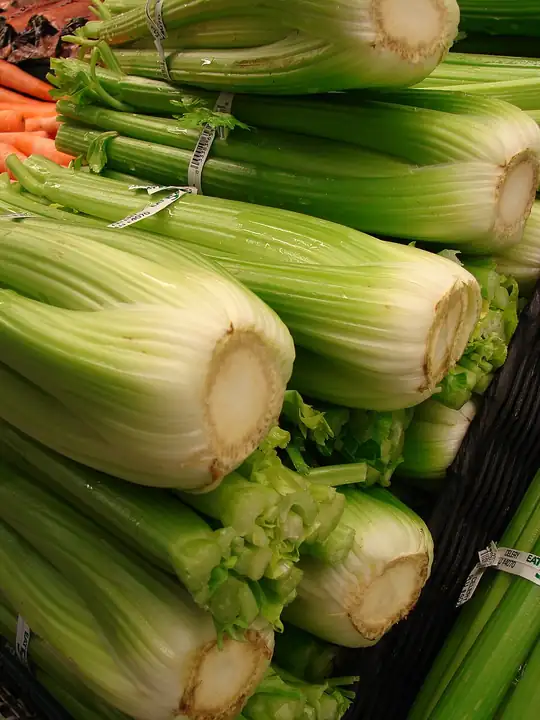
Celery
Apium graveolens var. dulce · Carrot family (Apiaceae)
| Hardiness zones | 2 to 11 |
|---|---|
| Sun | full sun |
| Water | high |
| Life cycle | biennial |
| Frost | Tender: killed by frost |
| Soil pH | 6.0–6.5 |
| Spacing | 12 inches |
About Celery
Celery is grown for its crisp leaf stalks, and celeriac (celery root) comes from the same species. It needs a long, cool, steady season with plenty of water, so it takes more care than most vegetables.
Grown as an annual; it prefers 55 to 65F. Several weeks of cool temperatures can make plants flower, and hot weather above 85F calls for extra water.
When to plant
Timing is counted from your average last spring frost (and first fall frost). Sow & Tell works out the actual dates for your ZIP code.
- Start seeds indoors: 10 to 12 weeks before the last frost
- Set out plants: up to 2 weeks after the last frost
Start seed indoors 10 to 12 weeks before transplanting and set plants out after the last frost; young plants exposed to cold for weeks may bolt. Space rows about 2 feet apart.
Soil
Fertile, well-drained soil with lots of organic matter; give 1 to 2 inches of water a week.
Use fertile soil rich in organic matter; follow a soil test, use up to 1 inch of compost per 100 sq ft, and choose a complete fertilizer high in potassium such as 4-4-8.
Feeding
- 4 weeks after transplanting: nitrogen fertilizer such as 21-0-0. Use about 1/4 cup per 10 ft of row beside the plants and water it in.
- 8 weeks after transplanting: nitrogen fertilizer such as 21-0-0. Repeat about 1/4 cup per 10 ft of row and water it in.
Harvest
Snap off outer stalks once they are a foot or more long, or cut the whole plant when it is at least 3 inches across at the base.
Varieties (7)
Extension sources name few celery varieties for home gardens; most are green Utah or Pascal types. Celery needs a long season (about 80 to 100 days from transplants in Texas).
| Variety | Type | Days | Notes |
|---|---|---|---|
| Summer Pascal | Green (Pascal type) | Blanches easily, forms a full heart, and has smooth stalks and high yields. Suited to the eastern U.S. | |
| Conquistador | Green (Utah type) | A refined Tall Utah selection with dark green, smooth stalks. | |
| Tall Utah 52-70R Improved | Green (Utah type) | A compact plant with dark green, medium-length stalks. | |
| Utah 52-70 | Green (Utah type) | 90 to 100 days | Longer stalks than older Utah strains, with less leaf discoloration. |
| Ventura | Green (Utah type) | Long, glossy green, very smooth stalks, with some field tolerance to fusarium. | |
| Golden Self-Blanching | Self-blanching | On Wisconsin Extension's celery list. | |
| Tango | 80 to 85 days | Recommended for Central Texas. |
Pests to watch for
Aphids, European earwig, Slugs, Carrot weevil, Beet armyworm, European corn borer, Voles
Diseases and problems
Powdery mildew, Nutrient deficiency, Root and crown rot, Boron deficiency, Aster yellows, Cucumber mosaic
In the kitchen
Eaten raw as a snack or in salads, and a base flavor, with onion and carrot, for soups, stews and stuffing.
Keeping it: Keep celery unwashed in a plastic bag in the refrigerator drawer and use it within about 5 days for the best crunch.
Pets: Not listed as toxic by the ASPCA
Sources
Photo: Photo: Forest & Kim Starr, CC BY 3.0, via Wikimedia Commons (CC BY 3.0). Photo resized for the web.

Planting dates and advice are general guidance; check with your local Cooperative Extension office for your area.