
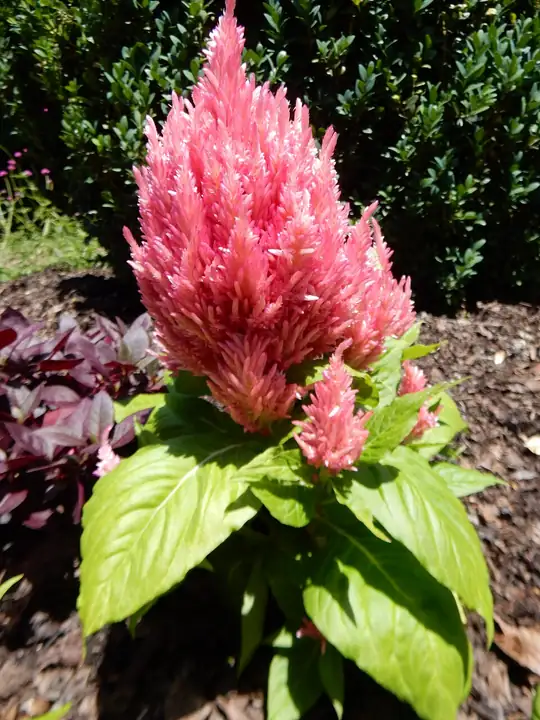
Celosia
Celosia argentea (plume group, once C. plumosa; crested cockscomb group, once C. cristata); wheat celosia C. spicata · Amaranth family (Amaranthaceae)
| Hardiness zones | 10 to 11 |
|---|---|
| Sun | full sun |
| Water | moderate |
| Life cycle | annual |
| Frost | Tender: killed by frost |
| Soil pH | 6.0–6.4 |
| Spacing | 6 to 12 inches |
| Days to harvest | 90 to 120 days |
| Soil temperature to plant | at least 65°F |
About Celosia
Celosia is a heat-loving summer annual with flower heads in three main shapes: feathery plumes, velvety crested 'cockscombs' that look like a rooster's comb or brain coral, and slim wheat-like spikes. The colors are hot and bright, from red and orange to gold, pink and purple. It's easy from seed, shrugs off heat and dry spells, and makes a long-lasting cut flower that dries beautifully.
Grown as a summer annual in every zone; NC State lists it as hardy only in zones 10-11, and frost kills it. UF/IFAS rates it not a problem species in Florida's natural areas.
When to plant
Timing is counted from your average last spring frost (and first fall frost). Sow & Tell works out the actual dates for your ZIP code.
- Start seeds indoors: 6 to 8 weeks before the last frost
- Set out plants: up to 2 weeks after the last frost
- Sow seeds outdoors: up to 2 weeks after the last frost
Days to harvest count from sowing to first usable flowers: MSU lists 90-120 days for tall cut-flower series, and UF/IFAS says plants can take up to about 90 days to bloom. Start seed indoors 6-8 weeks before the last frost (Wisconsin, MSU) or sow outdoors in soil of 65 F or warmer after frost; UMD advises waiting for nights that stay above about 65 F, because cold below 60 F stunts plants and makes them flower early and small. Don't let transplants get potbound in cell packs: they stay stunted (Illinois, UMD).
Soil
Well-drained soil with plenty of organic matter; it tolerates dry, sandy soil but blooms best with regular water (NC State, Illinois, UF/IFAS).
Loosen the soil and work in organic matter for good drainage; UMD suggests a pH of about 6.0-6.4 and a soil test before planting.
Feeding
- Once transplants are growing well in early summer: complete fertilizer with extra nitrogen (UMD suggests a 3-1-2 ratio, such as 15-5-10). Celosia needs plenty of nitrogen (UMD); spread at the rate a soil test or label gives and water it in.
Don't plant into cold soil or cold nights: temperatures below 60 F stunt plants and trigger early, small flowers (UMD). Overhead watering and crowding invite leaf spots and flower rot (NC State, UMD).
Harvest
Blooms from early summer until frost (June to October in Illinois). Cut plume and wheat types when about half the florets are open, and crested types once the comb has filled out but before the edges fade (UMD, Oklahoma State); leave seed heads only if you want volunteers.
Varieties (19)
| Variety | Type | Days | Notes |
|---|---|---|---|
| Chief series | Crested (cockscomb) | 90 to 120 days | Sturdy stems with combs 2-7 in wide in gold, persimmon, carmine and red; good fresh or dried. |
| Cramer's series | Crested (cockscomb) | Well-branched plants with 15-20 stems each, 30-36 in tall, and 2-6 in blooms in burgundy, wine and lemon-lime. | |
| Neo series | Crested (cockscomb) | Pink, gold, orange, red and rose; stems 28-40 in long. | |
| Orange Queen Improved | Crested (cockscomb) | 90 to 120 days | Two densely folded orange combs, about 7 in each, on strong 36-40 in stems; good fresh or dried. |
| Prestige Scarlet | Crested (cockscomb) | Deep scarlet combs about 3.5 in wide over a long season; heat tolerant, 15-20 in tall. | |
| Sparkler series | Plume | Red feathery plumes. | |
| Celway series | Wheat (C. spicata) | Tall, 40-48 in, with a central plume ringed by smaller spikes; long vase life; orange, purple, red, salmon, terracotta and white. | |
| Cramers Amazon | Wheat (C. spicata) | Vigorous, 4-6 ft, with burgundy-tinged leaves and deep purple-pink spikes that fade to pink. | |
| Flamingo Feather | Wheat (C. spicata) | Upright, 24-36 in, with pale and rose-pink spikes that have a silvery sheen. | |
| Flamingo Purple | Wheat (C. spicata) | Magenta-purple spikes on dark-leaved plants 28-34 in tall; blooms late. | |
| Kosmo series | Wheat (C. spicata) | Very compact, about 8 in tall, with dense spikes; blooms early in cherry, orange, purple-red, salmon and yellow. | |
| Ruby Parfait | Wheat (C. spicata) | Dark purple spike tips that fade to pink at the base; 24-36 in; good vase life. | |
| Tassles Deep Rose | Wheat (C. spicata) | ||
| Asian Garden | Long-lasting purple plumes. | ||
| Dracula | Holds up well to weather-related problems. | ||
| Eternity Improved | Scarlet flowers. | ||
| Jewelbox Mix | Mix of magenta, fuchsia, coral, apricot and gold. | ||
| New Look | Bright red flowers; fair resistance to Phytophthora. | ||
| Venezuela | Compact plant with dark pink flowers. |
Pests to watch for
Aphids, Twospotted spider mite, Thrips, Slugs, Brown garden snail, Root-knot nematodes
Diseases and problems
Root rot, Damping-off, Leaf spot, Powdery mildew, Alternaria leaf blight
In the kitchen
Young leaves and tender shoots of many celosias are edible cooked, added to soups and stews like spinach (NC State, UF/IFAS); only eat plants grown without pesticides.
Safety: NC State and the ASPCA list celosia as non-toxic. If you try the young greens, cook them and use only plants that haven't been sprayed (UF/IFAS).
Pets: Non-toxic to dogs, cats and horses (ASPCA, Celosia plumosa / cockscomb); the ASPCA also lists woolflower (C. cristata) as non-toxic to dogs and cats.
Sources
- plants.ces.ncsu.edu
- hort.extension.wisc.edu
- extension.msstate.edu
- extension.umd.edu
- extension.illinois.edu
- ask.ifas.ufl.edu
- blogs.ifas.ufl.edu
- uaex.uada.edu
- assessment.ifas.ufl.edu
- extension.okstate.edu
- aspca.org
- aspca.org
- extension.rutgers.edu
- yardandgarden.extension.iastate.edu
Photo: Photo: Shuvaev / Wikimedia Commons, CC BY 4.0 (CC BY 4.0). Photo resized for the web.

Planting dates and advice are general guidance; check with your local Cooperative Extension office for your area.