
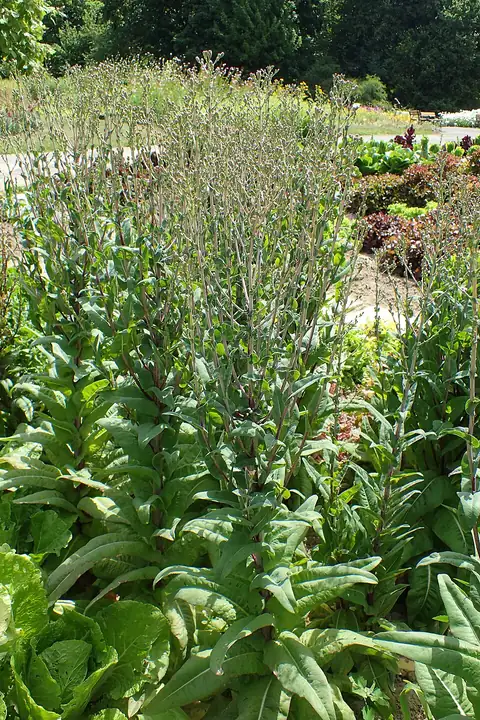
Celtuce (stem lettuce)
Lactuca sativa var. augustana · Daisy family (Asteraceae)
| Hardiness zones | 2 to 11 |
|---|---|
| Sun | full sun to part shade |
| Water | moderate |
| Life cycle | annual |
| Frost | Half-hardy: takes a light frost |
| Spacing | 8 inches |
About Celtuce (stem lettuce)
Celtuce is a lettuce grown for its thick central stem rather than its leaves. Peeled, the crisp, pale-green core has a mild, nutty taste, and it is popular in Chinese cooking, where it is sold as wosun. Long days make it bolt quickly, so it does best as a cool-season crop.
Grown as a cool-season annual in every zone; it grows best at average temperatures of 50 to 60F. In Florida and other mild-winter areas, sow it in fall, winter or early spring.
When to plant
Timing is counted from your average last spring frost (and first fall frost). Sow & Tell works out the actual dates for your ZIP code.
Grow it like lettuce: sow in early spring, or in fall and winter where winters are mild. Sowings made in late spring bolt in the long days of early summer before the stems are ready (UC Davis).
Soil
Grow it like regular lettuce, in fertile, well-drained soil kept evenly moist.
Prepare the bed as you would for lettuce (UF/IFAS says to grow it like regular lettuce), following a soil test.
Harvest
Cut the stem when it is about 12 to 18 inches long, cutting down into the leafy part, and harvest soon after it starts to stretch, before it turns woody and bitter. Pick leaves young; older leaves turn bitter.
Cut the stem once, when it is 12 to 18 inches long and before it gets woody and bitter. You can pick a few young leaves for salads before then.
Varieties (2)
University sources name only 2 celtuce varieties; few are sold in the U.S., and UC Davis is breeding new ones.
| Variety | Type | Days | Notes |
|---|---|---|---|
| Spring Tower | One of the two most popular celtuce varieties; used as a standard in UC Davis trials. | ||
| Summer 38 | One of the two most popular celtuce varieties; used as a standard in UC Davis trials. |
In the kitchen
Peel the stem, then slice the crisp core raw into salads, pickle it, or stir-fry, boil or stew it. Young leaves are eaten in salads or cooked as greens.
Safety: The stem skin and older leaves hold a bitter, milky sap, so peel stems and pick leaves young. If you take the blood thinner warfarin, keep the amount of leafy greens you eat about the same from day to day, because they are rich in vitamin K (NIH Office of Dietary Supplements).
Pets: Not listed by the ASPCA
Sources
- edis.ifas.ufl.edu
- gms.ctahr.hawaii.edu
- plantbreeding.ucdavis.edu
- caes.ucdavis.edu
- plantbreeding.ucdavis.edu
- ods.od.nih.gov
- aspca.org
- aspca.org
Photo: Photo: Krzysztof Ziarnek, Kenraiz, CC BY-SA 4.0, via Wikimedia Commons (CC BY-SA 4.0). Photo resized for the web.

Planting dates and advice are general guidance; check with your local Cooperative Extension office for your area.