
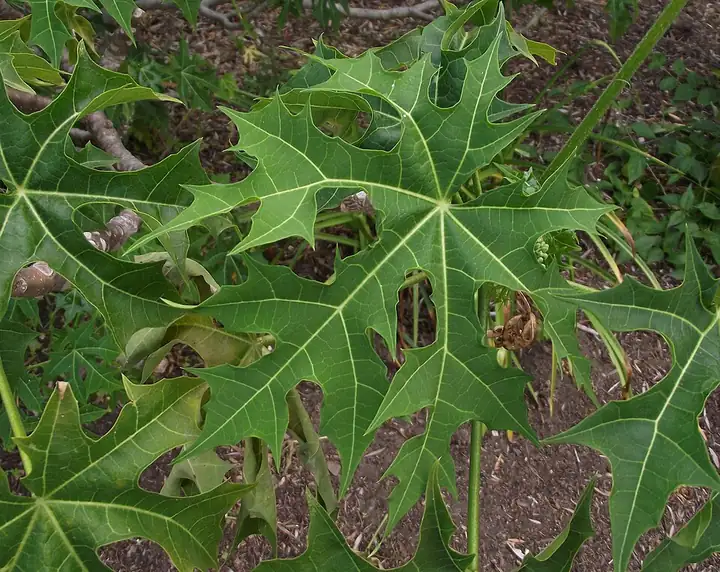
Chaya (tree spinach)
Cnidoscolus aconitifolius (C. chayamansa) · Spurge family (Euphorbiaceae)
| Hardiness zones | 9 to 11 |
|---|---|
| Sun | full sun to part shade |
| Water | moderate |
| Life cycle | perennial |
| Frost | Tender: killed by frost |
| Soil pH | 5.0–6.5 |
| Spacing | 36 to 84 inches |
| Days to harvest | 90 to 150 days |
About Chaya (tree spinach)
Chaya is a fast-growing shrub from Mexico and Central America grown for its big, lobed leaves, which are cooked like spinach and are rich in protein, vitamin C, calcium and iron. Raw leaves are poisonous: they contain hydrocyanic (cyanide-forming) compounds, so chaya must always be boiled before eating. Garden types have few or no stinging hairs, while wild chaya stings.
UF/IFAS Master Gardeners put it in zones 9-11; it is cold sensitive but often regrows after a freeze. It is grown outdoors in South Florida and Guam; in colder areas it needs frost protection.
When to plant
Timing is counted from your average last spring frost (and first fall frost). Sow & Tell works out the actual dates for your ZIP code.
Grow it from woody stem cuttings 6-12 inches long, planted at the start of the warm season in well-drained soil; they root slowly (UF/IFAS). Days to harvest count from setting out a rooted cutting: edible leaves come about 3-5 months later (University of Guam).
Soil
Well-drained soil with compost worked in; it handles heavy rain and some drought once established but may dislike very acid soil (University of Guam; UF/IFAS).
Dig a hole at least twice as wide as the root ball and mix in compost, manure or fertilizer; it prefers pH 5 to 6.5.
Feeding
- during the growing season, if growth is slow: a complete fertilizer with more nitrogen than phosphorus and potassium. Feeding is optional; follow a soil test and the label, and water it in.
Don't take more than about half the leaves at one time, and don't let cuttings sit in wet soil: the soft young wood rots easily.
Harvest
Cut young leaves with a bit of stem, wearing gloves against stinging hairs and sap. Take no more than about half of the leaves at once (University of Guam; UF/IFAS allows up to 60%), and it regrows quickly; one plant feeds most families.
Harvest leaves year-round in frost-free areas, taking up to about half of them at a time; plants regrow quickly, especially after the first year's pruning.
Varieties (3)
Extension sources describe 3 forms by leaf shape and stinging hairs rather than formal named cultivars.
| Variety | Type | Days | Notes |
|---|---|---|---|
| Florida five-lobed chaya | Cultivated type | The type found in Florida, with five-lobed leaves; a large shrub about 6-8 ft tall. | |
| Pig chaya | Low-sting cultivated type | Small leaves with three shallow lobes and almost no stinging hairs; UF/IFAS calls it one of the best eating types. | |
| Wild chaya (kadagan) | Wild, stinging type | Covered in stinging hairs and seldom eaten; garden chaya (the chayamansa group) is grown because it lacks them. |
Pests to watch for
Aphids, Twospotted spider mite, Broad mite
Diseases and problems
Cassava common mosaic virus, Stem rot in soft young cuttings
In the kitchen
Always cook it: boil leaves and tender stems uncovered for at least 5 minutes (University of Guam; UF/IFAS suggests simmering 20 minutes), then use it like cooked spinach, in soups or served with butter or oil.
Keeping it: Refrigerated leaves darken to deep green or black but stay edible; cook them within a few days.
Safety: Raw leaves are highly poisonous because of hydrocyanic acid; boil them in an uncovered pot in a well-ventilated room, since the steam carries the toxin, and don't rely on a quick stir-fry (University of Guam; UF/IFAS). The white sap and the stinging hairs on wild types can irritate skin, so wear gloves.
Pets: Not listed by the ASPCA
Sources
Photo: Photo: Tortie tude, CC0, via Wikimedia Commons (CC0). Photo resized for the web.

Planting dates and advice are general guidance; check with your local Cooperative Extension office for your area.