
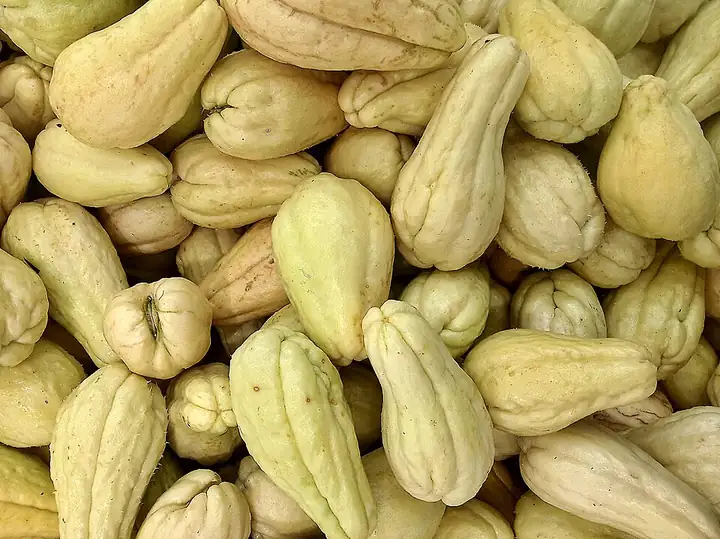
Chayote
Sechium edule · Gourd family (Cucurbitaceae)
| Hardiness zones | 8 to 11 |
|---|---|
| Sun | full sun to part shade |
| Water | high |
| Life cycle | perennial |
| Frost | Tender: killed by frost |
| Soil pH | 5.5–7.0 |
| Spacing | 144 inches |
About Chayote
Chayote, called mirliton in Louisiana and vegetable pear elsewhere, is a vigorous climbing squash-family vine from southern Mexico and Central America. It bears pale green, pear-shaped fruit with mild flesh like a firm zucchini, and the young shoots and leaves are cooked as greens too. You plant the whole fruit, which holds a single seed, and a happy vine can give dozens of fruit in fall.
A frost-tender perennial grown mainly in Louisiana, Florida, California and Hawaii; tops die back in cold weather, but with thick mulch the roots often survive Louisiana winters and regrow each spring (LSU AgCenter). It flowers as days shorten in late summer, so it needs a long, frost-free fall to ripen fruit.
When to plant
Timing is counted from your average last spring frost (and first fall frost). Sow & Tell works out the actual dates for your ZIP code.
- Set out plants: up to 2 weeks after the last frost
Plant a whole, mature fruit: let it sprout from the wide end in a warm spot indoors, then set it in a 3-gallon pot at a 45-degree angle, sprouted end down, about two-thirds buried. Move it outdoors to a sunny spot after frost danger passes. In Florida, plant in early spring (or fall in South Florida). Fruit sets after the vine flowers in late summer and is ready about 35 days after pollination.
Soil
Fertile, well-drained soil; it hates wet feet, so use a raised bed or mound where water stands.
Plant in fertile, well-drained soil improved with compost or other organic matter; a soil test can guide other amendments, and UF/IFAS suggests a pH near 6.0 following cucumber guidelines.
Feeding
- About a month after planting, once the vine is a few feet long: fertilizer as your soil test recommends, or compost. Spread it around the plant about 4 to 5 inches from the stem and water it in.
- Midsummer: fertilizer as your soil test recommends, or compost. Feed again if growth slows, following your soil test.
- When the first fruits are small: fertilizer as your soil test recommends. A light feeding helps carry the fall crop; water it in well.
Too much nitrogen makes the vine more prone to leaf diseases; don't plant the fruit too deep, which can rot it, and don't let water stand around the roots.
Harvest
Pick fruit young, about 4 to 6 inches long, while the skin and seed are still tender, usually from late summer until the first frost. Older fruit is still edible but tougher, especially once it starts to sprout. Harvest in the cool of the morning and handle gently.
The vine flowers as days shorten in late summer and keeps bearing fruit until frost, then comes back from the roots each spring where winters are mild; yields are best once the plant is 2 to 3 years old.
Varieties (2)
Extension sources name only two common Florida types; chayote is usually sold by fruit color, and LSU AgCenter recommends Louisiana heritage mirlitons from local growers.
| Variety | Type | Days | Notes |
|---|---|---|---|
| Florida Green | Green fruit, usually smooth-skinned; one of the two most common types grown in Florida. | ||
| Monticello White | Pale white fruit; one of the two most common types grown in Florida. |
Pests to watch for
Twospotted spider mite, Melonworm, Aphids, Whiteflies, Cucumber beetles, White grubs, Root-knot nematodes
Diseases and problems
Ascochyta leaf spot, Fusarium wilt, Fruit rot
In the kitchen
Eat young fruit raw in salads, or cook it like summer or winter squash: stuffed, baked, fried, stewed, curried, in casseroles or pickled. Tender shoots and young leaves are stir-fried or cooked like spinach, and the seed is edible too.
Keeping it: Wrap fruit in waxed paper or a perforated plastic bag and keep it cool, about 45-55F; colder than 45F causes chilling injury, and above about 78F the fruit sprouts.
Safety: UF/IFAS and LSU AgCenter list no safety concerns for chayote fruit, seed or young shoots. Plant a whole fruit, not dried seeds, if you want a vine.
Pets: Not listed by the ASPCA
Sources
Photo: Photo: Filo gèn', CC BY-SA 4.0, via Wikimedia Commons (CC BY-SA 4.0). Photo resized for the web.

Planting dates and advice are general guidance; check with your local Cooperative Extension office for your area.