
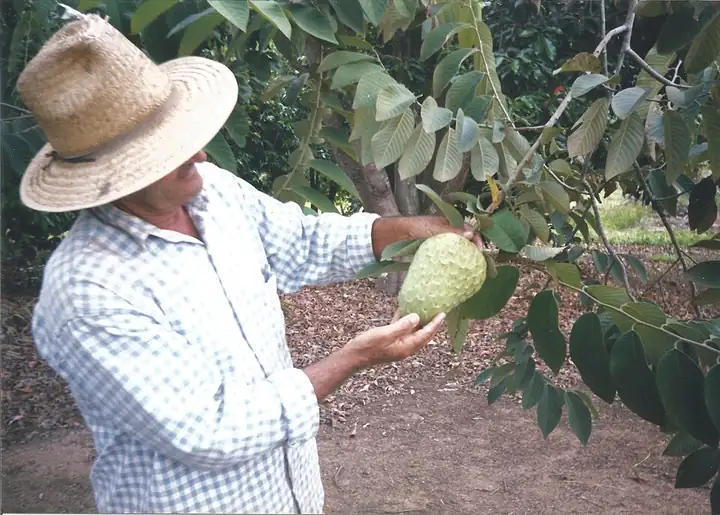
Cherimoya
Annona cherimola · Custard apple family (Annonaceae)
| Hardiness zones | 10 to 11 |
|---|---|
| Sun | full sun |
| Water | moderate |
| Life cycle | perennial |
| Frost | Tender: killed by frost |
| Soil pH | 5.0–8.0 |
| Spacing | 240 to 300 inches |
About Cherimoya
Cherimoya is a small tree from the highland tropics whose big green fruit (1/2 to 6 lb, with smooth to bumpy skin) is eaten fresh as a dessert; growers describe the flavors of different varieties as banana, pineapple, papaya or lemon. It likes mild coastal-valley weather, so in the U.S. it is grown mainly in Southern California; it dislikes long humid spells like Florida's. Its flowers usually need hand pollination for a good crop, and its seeds are poisonous.
No source we found gives USDA zones; the 10-11 range is our reading of UC's advice that it needs a nearly frost-free site (mature trees of hardy varieties take only short dips to 26 F). In the U.S. it is grown mainly in coastal-valley Southern California (San Diego, Santa Barbara and Ventura counties); UC says it doesn't tolerate long humid spells like Florida's.
When to plant
Timing is counted from your average last spring frost (and first fall frost). Sow & Tell works out the actual dates for your ZIP code.
Plant grafted trees 20-25 ft apart in a sunny, nearly frost-free spot; most varieties do well 3-15 miles inland from the ocean in California, and inland sites need shelter from extreme heat and dry wind (UC). Mature trees of hardy varieties take short dips to 26 F, and the tree benefits from 50-100 hours at 32-45 F in winter (UC).
Soil
Good drainage matters most: sandy loam or decomposed granite is best, though it grows in many soils from pH 5 to 8 (UC Cooperative Extension).
Choose a spot with excellent drainage; sandy loam or decomposed granite is ideal (UC Cooperative Extension).
Feeding
- About every 3 months: balanced fertilizer such as 8-8-8. UC Ventura County feeds about every 3 months; follow the label for the amount and water it in.
Yellow leaves often mean cold or soil that is too wet or too dry rather than hunger, so check watering before feeding more; keep the crown dry to avoid crown rot (UC).
Harvest
Fruit ripens 5-8 months after pollination, from about November to June in California (UC). Clip it while still firm, when the skin turns from deep green to light green or greenish tan, depending on the variety (UC).
One crop a year: flowers come after the leaves drop in late spring or early summer, and fruit ripens 5-8 months later, from about November to June in California. Hand-pollinating flowers over several weeks spreads the harvest out.
Varieties (11)
UC Cooperative Extension (Ventura County) documents 11 cherimoya varieties grown in California.
| Variety | Type | Days | Notes |
|---|---|---|---|
| Bayott | A Bays x Ott cross with small to medium, smooth, oval fruit. | ||
| Bays | Good, lemony flavor. Medium, smooth, round fruit. | ||
| Booth | Papaya-like flavor. Small to medium, smooth, cone-shaped fruit. | ||
| Chaffey | Lemony flavor. Small to medium, smooth, oval fruit; suited to coastal sites. | ||
| Deliciosa | Fair flavor. Large, bumpy, cone-shaped fruit; suited to inland sites and more frost hardy. | ||
| El Bumpo | Excellent flavor. Medium, bumpy, cone-shaped fruit. | ||
| Ott | Sweet, mild flavor. Small to medium, slightly bumpy, round fruit; suited to inland sites. | ||
| Pierce | Sweet pineapple-banana flavor. Medium, smooth, oval fruit; suited to inland sites. | ||
| Ryerson | Very sweet. Medium, very smooth, cone-shaped fruit; ripens early. | ||
| Spain | Banana-like flavor. Small to medium, smooth, cone-shaped fruit. | ||
| White | Mild, papaya-like flavor. Large, bumpy, oval fruit; suited to coastal sites. |
Pests to watch for
Mealybugs, Garden ants
Diseases and problems
Armillaria root rot, Verticillium wilt, Crown rot
In the kitchen
A dessert fruit eaten fresh: let it soften, then spoon out the creamy flesh and discard the seeds (UC Cooperative Extension).
Keeping it: Picked fruit softens and ripens in about 6-7 days at room temperature; don't chill it below about 46-50 F, which can turn the flesh dark and mealy and keep it from developing full flavor (UC).
Safety: The seeds, leaves and branches contain poisonous alkaloids; eat only the flesh and never chew or swallow the seeds (UC Cooperative Extension).
Pets: Not listed by the ASPCA
Sources
Photo: Photo: Marcelo RosaMelo / Wikimedia Commons, CC0 (CC0). Photo resized for the web.

Planting dates and advice are general guidance; check with your local Cooperative Extension office for your area.